
World War I: The Forgotten War That Changed Everything
Why the First World War Deserves a Place in Our Memory

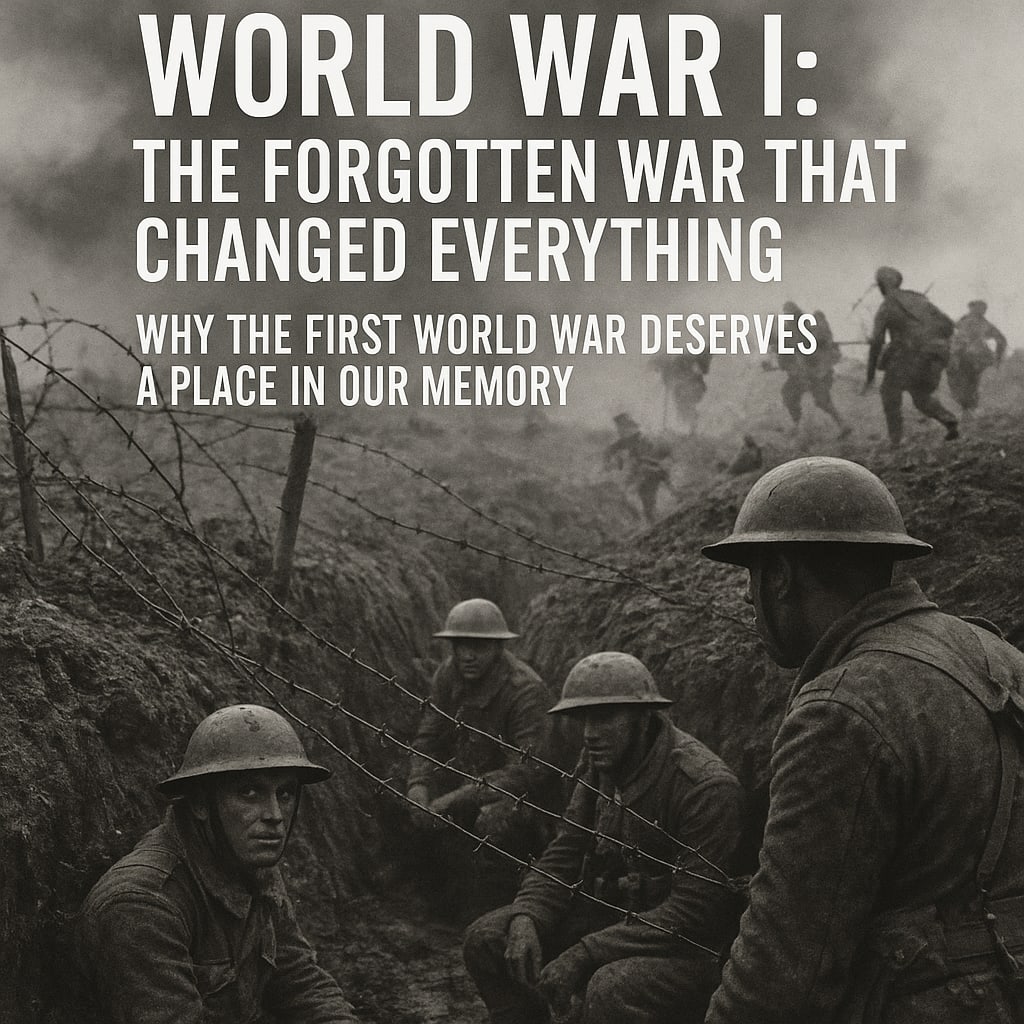
World War I: The Forgotten War That Changed Everything
Why the First World War Deserves a Place in Our Memory
The first time the world tore itself apart, it did so in muddy trenches, across barbed wire, and under clouds of poison gas. It was a war born of empires and ideologies, where millions of lives were sacrificed for territory, honor, and alliances. Today, over a century later, World War I often stands in the shadow of the more recent and visually documented World War II. Yet, it was this first global conflict that laid the groundwork for the modern world—altering borders, collapsing dynasties, and forever changing how we view war, humanity, and history itself. In our fast-paced digital age, remembering World War I isn’t just a tribute to the fallen; it’s a responsibility we bear to understand how the past shaped our present.
The War That Came from Nowhere—Or So It Seemed
In 1914, most people believed Europe was too civilized for war. But beneath the surface of diplomacy and empire-building, tension simmered. The assassination of Archduke Franz Ferdinand of Austria-Hungary by a Serbian nationalist lit a fuse that detonated alliances and dragged much of the world into a massive conflict. By August, countries including Germany, France, Britain, Russia, and eventually the United States were entangled in what became known as The Great War.
It wasn’t just a European affair. Colonies from Africa, soldiers from India, laborers from China, and recruits from the United States all found themselves swept into the chaos. Over 30 nations participated. The war was global in reach and devastating in consequence.
A New Kind of Horror
World War I introduced the world to industrialized warfare. Battles were no longer about cavalry charges and heroic duels—they were about machine guns, mustard gas, tanks, and long-range artillery. Trench warfare turned battlefields into stagnant hellscapes, with soldiers spending weeks or months in freezing, rat-infested mud. The concept of "shell shock" (now known as PTSD) emerged from the psychological trauma experienced in those endless trenches.
More than 16 million people died, and over 20 million were wounded. Many survivors returned home disfigured or deeply scarred—mentally and physically. These were the young men of an entire generation, particularly in countries like France and Britain, where entire towns were left without sons.
Collapsed Empires and New Realities
The war didn’t just kill people; it killed empires. The Austro-Hungarian, Ottoman, Russian, and German empires all collapsed in its aftermath. New nations emerged from the ashes—Yugoslavia, Czechoslovakia, and others—while revolutions reshaped others, most notably in Russia, where Lenin’s Bolsheviks overthrew the monarchy and set the stage for the rise of the Soviet Union.
The map of the world was redrawn at the 1919 Treaty of Versailles, but the treaty itself planted the seeds of future conflict. Germany was humiliated with harsh reparations and blame, fueling the national resentment that Adolf Hitler would later exploit to ignite World War II.
Why We Forgot
Part of why World War I has faded from public memory is its complexity and the lack of clear moral narratives. Unlike World War II—with its clear villain in Nazi Germany and heroic liberation stories—World War I is murky. It’s a war with no obvious “good guy,” and many of its causes—imperial ambition, entangled alliances, and military arrogance—feel distant from our current reality.
Additionally, the war lacked the cinematic, visual storytelling that defined later conflicts. The footage is grainy. The soldiers, often anonymous. The battles, largely static. This makes it harder to connect with the conflict in an emotional or visual way.
Why We Must Remember
Yet forgetting World War I is dangerous. It’s in this war that we see the first mass-scale failure of diplomacy, the fragility of peace, and the terrible cost of national pride run amok. It reminds us that wars often begin not with great causes, but with small mistakes, miscalculations, and moments of fury that spiral out of control.
It also reminds us of resilience. The poetry of Wilfred Owen and Siegfried Sassoon, the courage of nurses and medics, the Christmas Truce of 1914—all of these show that even in the darkest times, humanity fights to stay human.
The Echoes Today
Many of today’s global tensions—whether in Eastern Europe, the Middle East, or Asia—have roots in the post-World War I realignments. The lessons learned then—about nationalism, militarism, and international cooperation—remain relevant. Understanding World War I helps us understand how fragile peace really is.
A Final Thought
As the generations who remember it firsthand disappear, it becomes even more essential that we keep World War I alive in our collective consciousness. Not to glorify it, but to learn from it. To understand the cost of pride and the price of power. To recognize that the world we live in was built on the shattered bones of that forgotten war.
So let us remember—not just the names carved on memorials, but the lessons they left behind.
About the Creator
Abid khan
"Writer, dreamer, and lifelong learner. Sharing stories, insights, and ideas to spark connection."
'Go' is an ancient Chinese game that archaeologists have found stones from.
Over a thousand years ago, game pieces from the ancient Chinese board game "Go" were interred together. An examination of these "Go stones" reveals that they are made of expertly carved porcelain, smoke-blackened clay, or shell material.
By Francis Damiabout 19 hours ago in History
The Final Legacy of Alexander the Great: How One Man Changed the Ancient World
Alexander inherited a strong kingdom from his father, Philip II of Macedon, but he transformed it into something far larger. Within a little more than a decade, he conquered the Persian Empire, marched through Egypt, reached Central Asia, and entered parts of India. This rapid expansion created one of the largest empires of the ancient era. Yet Alexander’s vision went beyond military victory. He sought to create a world where Greek and Eastern cultures blended together. This cultural mixing became one of his most lasting achievements.
By Say the truth 3 days ago in History

Comments
There are no comments for this story
Be the first to respond and start the conversation.