
Mesia and the Hollow Eyes
Some eyes never close, even after death
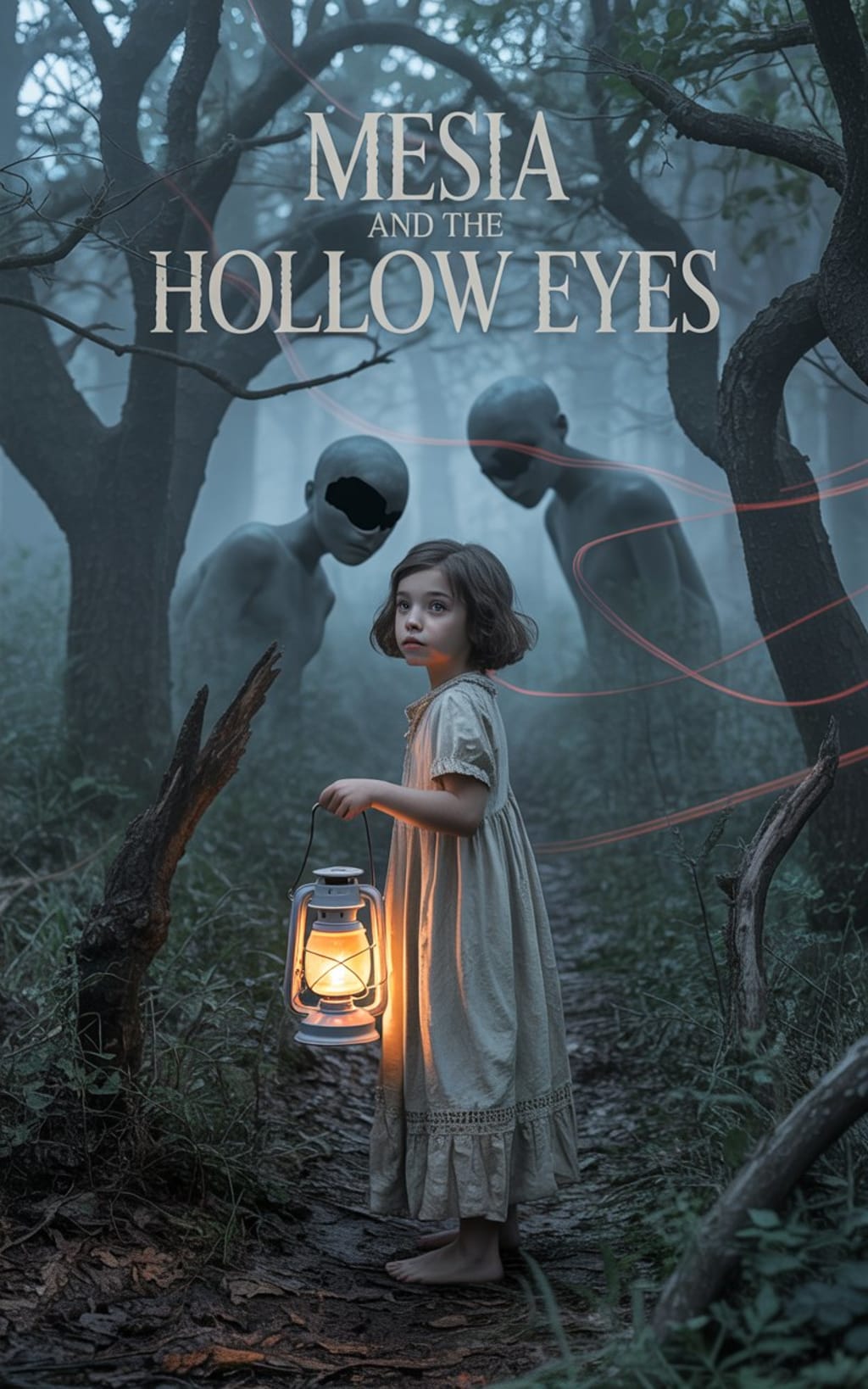
The village of Elder Hollow was quiet—too quiet. Tucked between blackened trees and crooked hills, it was a place the world had mostly forgotten. Only one road led in, and no roads led out, as if the earth itself had sealed the place shut.
Mesia was twelve when she arrived. She didn’t know why her uncle brought her there—only that her parents were gone, and the city was no longer “safe.” Uncle Bartholomew never said much. He smoked thick cigars and spoke in half-muttered warnings.
“Don’t stray from the house after dusk,” he told her. “Don’t look out the attic window. And whatever you do, Mesia, if you hear someone call your name from the woods… you don’t answer.”
She nodded. She was too polite to question things, even when her bedroom had scratch marks on the door and a padlock on the inside.
It didn’t take long for Mesia to notice the eyes.
They were in paintings, carved into trees, and stitched into curtains—always the same: large, round, and hollow. No iris, no pupil. Just deep, empty ovals staring outward. They gave her chills. Once, when she mentioned them to her uncle, he slammed his cup so hard the ceramic cracked.
“They see things,” he muttered. “Don’t talk about them.”
One night, the wind refused to sleep.
It howled through the window cracks and rattled the floorboards like bones. Mesia couldn’t rest. She climbed quietly from her bed and wandered the halls, barefoot and pale in the moonlight. The old house creaked like it was breathing.
Something drew her to the attic door.
She didn’t know why. Perhaps it was the wind, or perhaps it was the voice she almost didn’t hear—whispering so softly, like a lullaby through the walls:
“Mesia… come see…”
The attic was forbidden, but children and curiosity are old friends.
She opened the latch.
The air hit her like a shiver—cold and old and full of dust. Cobwebs clung to the low beams. There was a window at the far end, just as Uncle Bartholomew had warned her about. It was round, framed in rusted metal, and looked out toward the forest.
She approached.
At first, she saw only fog.
Then the fog moved.
Figures emerged from the woods, slow and tall—too tall. Ten, maybe twelve of them, walking stiffly toward the house. No faces. Just deep, empty sockets where eyes should be.
She gasped and stepped back—but the floor groaned.
One of the figures stopped.
Turned.
And lifted a hand.
It pointed directly at her.
Mesia slammed the attic door shut and raced to her bed, heart thudding like a trapped bird. She didn’t sleep.
By morning, the world pretended to be normal again. Uncle Bartholomew made porridge. The trees stood still. No sign of the figures.
But something had changed.
The house watched her now.
She felt it in every room. When she opened the bathroom mirror, her reflection blinked late. When she closed her closet, she heard a second breath that wasn’t hers.
Then came the scratching.
At night, from beneath the floorboards. Like someone writing… or trying to get out.
She told her uncle. He went pale, gripped her shoulders, and said:
“You opened the attic, didn’t you?”
She nodded.
He didn’t speak for a long time. Then he told her the story.
Many years ago, Elder Hollow had been larger—more children, more laughter. But something came from the forest. It didn’t speak. It only watched. At first, the villagers ignored the hollow-eyed figures. Until people started to change.
They spoke in whispers.
They stopped sleeping.
Some just vanished.
One by one, the children went first. They said the Hollow Eyes were looking for something—a child with the “sight,” someone who could see them back. That’s when the villagers sealed the attic. When they painted eyes on the trees, on the doors, on the clothes—to keep them away.
It didn’t work.
“We made a deal,” Uncle Bartholomew said. “One child every twenty years. To keep the rest of the village safe.”
Mesia froze. “You brought me here... to give me to them?”
He looked ashamed.
Before he could answer, the lights flickered—and went out.
The house moaned. The wind screamed. And from every wall came voices—chanting her name in a thousand broken whispers:
“Me—si—a… Me—si—a…”
She ran. To the attic. To the window.
They were already there.
Surrounding the house. Eyes wide. Hollow. Hungry.
Mesia had no choice. She opened the window.
And stepped into the night.
They say Elder Hollow is quiet again.
The trees have grown thicker. The house is still.
But if you go near it—if you look into the attic window at just the right moment—you might see a girl in a white dress.
Her eyes?
Hollow.
Just like the rest.
About the Creator
Keep reading
More stories from kamran khan and writers in Horror and other communities.
Limited Edition Labubu Doll – Cute, Collectible, and Coveted
In a quiet corner of a bustling city, nestled between antique bookshops and cozy tea cafes, was a tiny store called Whimsy & Wonder. Its wooden sign swung gently in the breeze, painted with pastel stars and a sleepy moon. The shop was a hidden gem, known only to a few, and it held the rarest, most enchanting collectibles you could imagine.
By kamran khan7 months ago in Horror
Killing him slowly
There’s an intruder in my house again. He stumbles through the door, wet carrier bags in hand. He’s bought me offerings. I show my appreciation, letting him caress my beautiful body. He wants to touch me. I rub myself against his legs. He sighs, dropping the bags. He can’t resist touching me. Running his hand slowly down my spine, I arch my back towards his caress, let out a low purr. It’s what we both need.
By N J Delmas16 days ago in Horror
My Phone Started Recording Me While I Slept”
I don’t remember giving my phone permission to record me. That’s the part that keeps me awake. I noticed it in the morning, half-asleep and reaching for my phone out of habit. A notification sat at the top of my screen, calm and ordinary. Sleep Session Saved — 6h 42m I don’t use sleep apps. I tapped it, expecting a glitch. Instead, a dark interface opened. A clean waveform. Timestamps. Everything looked intentional—professional, even. Recorded: 2:11 AM – 2:24 AM My stomach tightened. I pressed play. At first, it was just background noise. The refrigerator. Distant traffic. Then my breathing—slow, deep, unaware. Hearing yourself asleep feels wrong, like reading someone else’s private thoughts. I was about to close it when my breathing stopped. The silence stretched too long. Then I heard footsteps. Soft. Careful. Inside my apartment. I sat up so fast I felt dizzy. The recording continued. A faint creak near my bedroom door. Fabric brushing against something. Movement that sounded deliberate, restrained. Then a whisper, so close it distorted the audio. “He’s still asleep.” I dropped the phone. I checked every lock, every window. Nothing was disturbed. No signs of anyone being there. I tried to delete the app. It wouldn’t let me. When I held the icon down, there was no uninstall option. Just a line of text beneath it. Recording improves with familiarity. That night, I turned my phone off completely. I left it on the kitchen counter, face-down, disconnected. I still woke up at 3:00 AM to find it warm. Powered on. Another notification waiting. The next recording was worse. It started with a clicking sound—like a microphone being activated manually. Then a voice spoke. Calm. Clinical. Not mine. “Subject is restless tonight.” I heard myself shift in bed. “Increased awareness detected.” A pause. Then a soft laugh. “They always think it’s the phone.” I didn’t sleep after that. The recordings came every night. Longer. Clearer. Sometimes there were multiple voices. They talked about me like I wasn’t human—like I was data. Heart rate. Fear response. Attachment. One night, I heard myself speak. I don’t remember waking up, but there was my voice, quiet and empty. “Am I doing better?” I asked. “Yes,” one of them replied gently. “You’re learning.” That was when fear shifted into something worse. Familiarity. They started using my name. Mentioned memories I’d never shared online. Childhood moments. Private thoughts. Dreams I barely remembered myself. They knew me. On the final night, the app saved a video. I didn’t know my phone could record video with the screen off. The footage was grainy, green-tinted, like night vision. My bedroom, seen from the upper corner near the ceiling—an angle that shouldn’t exist. I watched myself sleeping. Then something stepped into frame. Tall. Indistinct. Its face never fully focused, like the camera refused to understand it. It leaned over my bed, studying me with something almost gentle. It reached out. Touched my forehead. In the video, my eyes opened. And I smiled. I woke up gasping. My phone buzzed immediately. Recording Complete — Integration Successful I don’t try to delete the app anymore. I don’t listen to the recordings. I barely sleep. But sometimes, late at night, when my phone grows warm in my hand, I feel calmer. Less alone. Like something is watching over me—learning me—handling things while I rest. And just before I drift off, I hear a whisper that doesn’t come from the phone. “Don’t worry. We’ll take over while you sleep.”
By Faizan Malik3 days ago in Horror




Comments
There are no comments for this story
Be the first to respond and start the conversation.