
Researchers believe they understand why the noses of Triceratops were so large.
Inside the large nostrils of the dinosaur

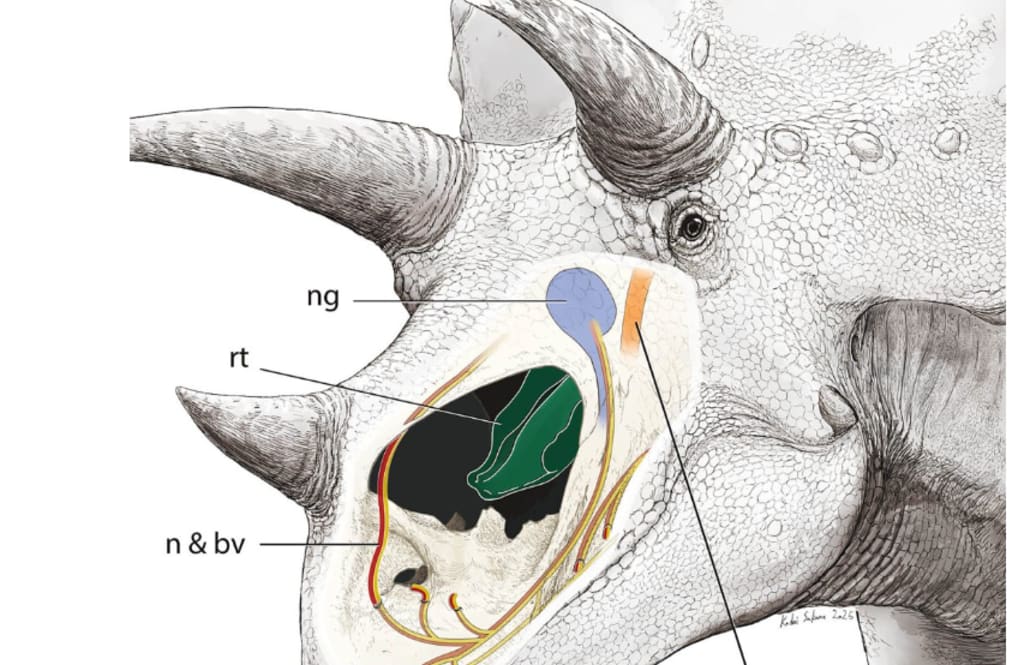
Triceratops have been characterised for almost a century by its visible features, including as their enormous beak, horns, and frills. However, what we couldn't see at all might be the true surprise. According to recent CT scans, this horned dinosaur redirected its snout's primary blood arteries and nerves through its nostrils rather than its jaw.
Scientists' understanding of the enlarged nasal cavity is altered by that peculiar diversion. The nose of a triceratops might have served as an active mechanism for cooling the brain and preserving water, rather than a hollow chamber for smell alone.
Inside the large nostrils of the dinosaur
Preserved canals track a supply network that extends upward into the nasal region from the heavy bones at the front of the skull, instead of forward from the jaw. Seishiro Tada of the University of Tokyo (UTokyo) examined the Triceratops' internal tubes and recorded how the snout's vascular and sensory channels were rerouted to make room for its larger nose.
Similar nerves and veins in most reptiles pass through the upper jaw to reach the nostrils, but in Triceratops, the morphology obstructed that path. This structural deviation suggests that the dinosaur's enormous nasal cavity had functions other than smell, which calls for a closer look at what occupied that area.
Nerves pushed via the nasal cavity
The majority of reptiles have two routes for nerves and blood vessels to reach the nostrils, one of which passes through the jaw. However, in Triceratops, the supply line had to enter from the nasal side due to a bony flange that prevented that shortcut.
According to Tada, "the nasal branch is used by nerves and vessels in triceratops because the jaw route is blocked by the shape of the skull." This rerouting technique made it possible for the nose to be well-supplied and sensitive even as the face became heavier and bigger.
The bone itself bears evidence of the diversion. Canals and grooves that indicate the former pressure and passage of soft tissues are still present in fossil skulls. In order to inform their view, the scientists looked at birds and crocodiles using the Extant Phylogenetic Bracket, a technique that contrasts fossils with extant relatives.
Researchers were able to locate glands and ducts without relying on conjecture thanks to CT images that showed clear tunnels in the front jaw bone. Nevertheless, temperature and airflow can be gently altered by little soft tissues. Instead of providing concrete evidence, the reconstruction is nonetheless a compelling idea supported by evidence.
Cooling concealed within bone
The team deduced a respiratory turbinate, a thin, coiled surface that conserves water and heat, deep within the nose cavity.
This structure effectively transfers heat and water from breathes because it keeps wet tissue close to the blood, unlike a smell-only fold. Since several birds display the same bone basis, the strongest hint was provided by a ridge along the inner snout.
Tada pointed out that direct evidence is still lacking. Nonetheless, the attachment base found in certain birds closely resembles the ridge inside the horned dinosaur's nose.
Despite the rarity of such evidence in other dinosaurs, that similarity lends credence to the conclusion that Triceratops probably carried a respiratory turbinate.
A blood cooling pathway
An essential characteristic for creatures with big heads that produce excess heat is the ability of blood flowing down the nose to cool before it reaches the Triceratops brain. Inside the snout, where tiny internal surfaces allowed heat to disperse rapidly, heated blood probably travelled near breathed air in Triceratops.
The team's model transformed the larger nose into an effective heat exchanger by placing an extended nasal lining next to a thick network of blood vessels. It's possible that this cooling system helped shield delicate brain and eye structures during locomotion, feeding, and perhaps fighting in hot weather.
Turbinates, which are curled nasal structures, may have preserved water at the same time. Water from exhaled air can be captured by moist tissue inside these folds and reintroduced into the body on the subsequent breath.
That recycling would have decreased moisture loss with each inhalation and exhalation for a large animal, particularly during dry conditions. It's possible that a nasal gland assisted in preserving the moisture required for water recovery and heat exchange.
The nasal system would have reduced the expense of breathing for a heavy herbivore by releasing heat and recovering water in the same little area.
Other horned dinosaurs with large noses
This nasal configuration may not have been unique to triceratops. Parts of the same internal structure, including channels that imply comparable neural pathways, may be seen in other horned dinosaurs.
Throughout the group, one characteristic consistently emerges: a notably enlarged nose aperture. This pattern suggests that large noses were an early evolutionary trait of horned dinosaurs and persisted because they were functional.
The ridge linked to turbinates is even more noticeable in certain species. That might be the result of variations in the strength or structure of the skull, or even minute changes in the way wind passed through the snout.
When combined, those differences imply that there was more than one nasal design. It's possible that horned dinosaurs tried somewhat different approaches, even if the general idea—an enlarged, active nose—stayed the same.
What fossils are unable to reveal
The group is cautious not to overstate the results, though. Although warm-blooded animals frequently have turbinates, the amount of heat a dinosaur produced is not always established by the discovery of evidence for a single structure.
Without substantially depending on turbinates, some reptiles use blood flow alone to cool their brains. This implies that a mammal's metabolism is not always correlated with its anatomy. The difference counts. Although fossil bone can reveal the locations of soft tissue attachments, it is unable to completely depict the functions of those tissues.
Additional specimens may benefit from testing the nasal ridge using new CT scans from UTokyo. The argument that these horned dinosaurs had more sophisticated nasal systems than previously believed would be strengthened if the pattern continues.
Examining skulls in more detail
Ceratopsian study focused mostly on frills and horns for decades. However, scientists now think that the deeper, hidden areas inside the skull may hold the true secrets to how these animals detected and survived their surroundings.
As additional CT data becomes available, Tada intends to extend the work to other parts of the skull, such as the frill, at UTokyo. The amount of anatomical diversity within a single species may be revealed by examining many specimens; this is a crucial question when fossils originate from several locations and eras.
By providing more precise maps of these concealed skull pathways, paleoartists and museums may be able to reconstruct dinosaur faces more precisely and reduce the amount of conjecture on the locations of important blood arteries and nerves.
The latest results already demonstrate the depth of understanding that method may provide. The team was able to turn a huge nasal cavity from a mystery into proof of cooling and water regulation by connecting fossilised bone tunnels to the anatomy of live animals.
More fossils and more distinct anatomical ridges will be needed for future testing, but the existing model has already reduced the number of things that may possibly fit inside that massive region.
About the Creator
Keep reading
More stories from Francis Dami and writers in Horror and other communities.
Killing him slowly
There’s an intruder in my house again. He stumbles through the door, wet carrier bags in hand. He’s bought me offerings. I show my appreciation, letting him caress my beautiful body. He wants to touch me. I rub myself against his legs. He sighs, dropping the bags. He can’t resist touching me. Running his hand slowly down my spine, I arch my back towards his caress, let out a low purr. It’s what we both need.
By N J Delmas27 days ago in Horror



Comments
There are no comments for this story
Be the first to respond and start the conversation.