
An Albatross Off Course
Good luck, or so the sailors say.
Of my most valued possessions, the small black book is the one that I cherish the most. It comes before the ivory handled hairbrush gifted to me by my grandmother, before my collection of sea glass and razor clam shells. It comes before even the few terse letters I keep folded beneath the linens in the chest at the foot of my bed.
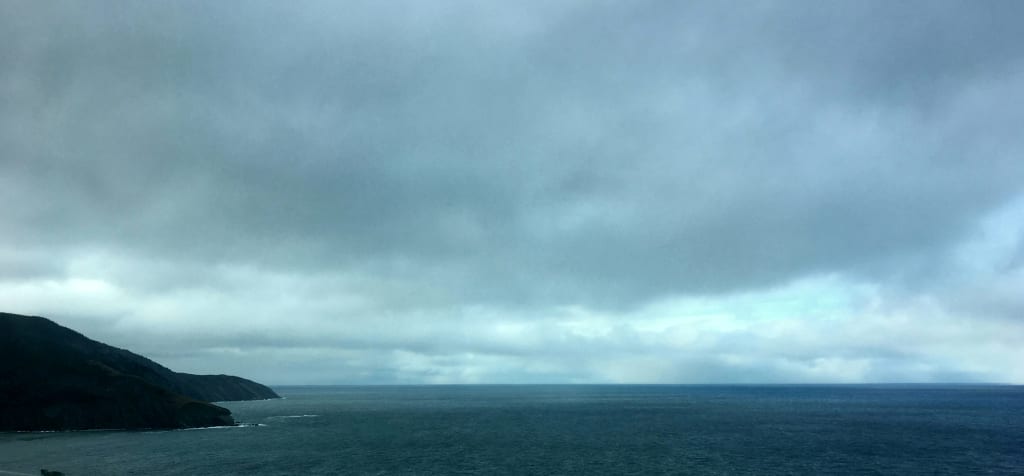
I was born where the wind is harsh, and the winters long. The roiling North Atlantic looms around our house on the hill like an ever-present mongrel dog. Gnashing and tumultuous, taking whatever scraps of life we throw at it. The men and women in this place have learned to work with the ocean, to carve some semblance of existence from it's unforgiving depths. They respect it, fear it, and depend on it. We are a band of maritime people, spanning generations of fishermen and sailors, wives with leathered hands and children with salt water permanently staining their cheeks.
My mother was one such child, raised on wild blueberries and watered down milk. Her Daddy was a fisherman, a coal miner, and a farmer. Her Ma came from Scotland during the Clearances. She is competent and able, with little patience for tears or tall tales.
My father was altogether different. He was from Montreal, a dreamer, an artist, and a poet. His parents had been well-off and he never wanted to wished for what he could not have. He met my mother on a visit east one summer. He was touring the countryside with a gaggle of friends and landed in this village, all dark haired and dark eyed, tall and lean limbed. He said he fell in love with her that first day, while he watched her taking in the washing before the black smoke from the mine ruined it with soot.
They married that fall and my father never returned to Montreal. That was until I was seven years old and the desolation of this place, the wicked, rough lifestyle, and the longing for culture and comforts became too much for his soft soul. He left us that spring and retreated to the city. He begged my mother to come with him, but it is often said that if you grow up near the ocean you can never live away from it. Such is true for my mother, stubborn hard woman that she is. They argued and fell out, he boarded a train and we moved in with my grandmother.
My father named me Rosemary when I was three months old and they were confident I would live. "A strong name for a strong girl." I remember him saying that to me often. I don't blame my father for his soft soul or his inability to adapt to this merciless place. It is a secret of mine, one that I would never admit to my mother or grandmother, that I sense many of those same sentiments in myself. That somehow this way of life may just not be enough for me. For all I can find beautiful in the monotonous and the mundane, the ocean reminds me of the endless horizons beyond the harbor and forest.
So here I find myself, flipping through this worn black book, with its oilskin cover softened by age and handling. I've memorized each page and must stop myself from reaching out to trace the well-known sketches and gouache scenes. This book is my last connection, my only real clue. I use it to piece together my blurry memories and sew along side the fabrications of who I remember, or make my father out to be. He painted each of these pages that first summer he was here. While he was living so fully and falling in love, before the darkness of late October came stealing, giving way to the first hard winter he had really known. But again, soon enough, spring arrived, and the days turned hot and humid and the wind gentled and the ocean calmed and the pink and violet lupins lined each road and hill, growing wild and stark and so alive. My father livened then too, with the knowledge that there would soon be a baby for him to share his beautiful words and pretty thoughts with. One that might be like him, soft souled and soft hearted with dark hair and dark eyes.
When my father first left he had written a few times, and sent money when he could, but my mother was bitter. She was resentful and angry and found herself too often alone, although the choice was her own to stay. She gave me the letters but I didn't write back. There wasn't much for a girl of eight to say. I started dreaming then, of leaving this place for a while at least. I knew that if not, I would find myself married to some local boy with coal dust in his lungs and a passel of children to feed.
At forty-five my mother is strong and braw, he hair still shiny and pale. Her hands are rough from years of work, from lye soap and wool gloves. Her eyes are sharp, though they furrow with her brow from a lifetime of squinting over the water. She's in the front room right now, reading while my grandmother knits a bonnet for the Mackenzie's new baby.
There comes a knock from downstairs. Visitors are common on Sundays. They come for a spot of tea and talk of the week before and of the one to come. I hear my mother open the door and the familiar voice of Angus McMaster booms through the house. Bits of conversation float through my open door, echoing off plaster walls and rough hewn floor boards.
"Seen an albatross past the mouth of the harbor this morning, he did."
"Alive?" My mother queries.
"Alive as you and I, circling the skies this far north if you'd imagine it." Angus responds, a measure of excitement in his voice. It's unusual to see an albatross. The great beaked birds don't often venture much past their warm southern waters.
"Surely good luck then." My grandmother chimes in, clicking her tongue. For all of their practicality and no nonsense beliefs, many of our people still take stock in the old seafarer's tales and superstitions. A cat on board a ship for success, a woman brings bad fortune, and an albatross spotted alive means good luck to come.
"Aye, must be." Angus agrees and their conversation drifts off as they move to the kitchen to put the kettle on. I turn to my window at the sound of a soft bray, the curtain lifts gently and the ocean breeze cools my room. I fiddle with a shell on my windowsill, it's edges softened by the sea where they once had been jagged. Looking into the water has long since been a source of calm for me, and I wonder if I could ever be content to live away from its great vast expanse.
The sound comes again and I spot the bird. Too big for a gull with black legs and wide wings. To see an albatross in these parts is almost unheard of, let alone this close to land. It must have followed the fishermen in this morning, smelling their boats filled with the catch. Good luck, indeed.
I venture downstairs after Angus has left and find my mother slumped at the kitchen table, a small stack of mail in her hand. She looks up.
"There's a letter for you. Mr. McMaster brought the post." She sounds so forlorn and I can't think why. I have no notion of who could be writing me. I take it from her hand and glance at the return post address. A town in Quebec. With a tremor in my hand I sit and open the letter to read:
"Rosemary,
I'm writing to you after so many years, not to upset you or bring up past pains but because I know my time to be measured. To say it short and simply, I'm afflicted with tuberculosis and reside in a sanatorium situated in southeast Quebec. The clean air is meant to help but I find myself missing the hustle and bustle of my city streets. That fact remains, they call to me as the ocean calls to your mother.
My prognosis is not good and I feel myself growing weaker for the disease was caught too late, perhaps due to my own stupidity in ignoring the signs. By the time this letter reaches you I will likely be gone.
I want you to know, dear daughter, that I had always hoped we would reconcile. That somehow you may have come to the city and spent some time. I know this letter, nor a hundred of the same could make up for the loss of years between us. In any fashion, I've made sure to take care of you. I'm leaving to you all that I have, the townhome in Ville-Marie and the sum of my accounts. You may contact my solicitor, a Mr. James Harvelle working from the offices of Louis, Harvelle & Aubert. Of the exact amount I am not sure but I believe it to be approximately $20,000. 00. After I came home to Montreal I achieved a measure of success with my work in the arts and am at least content to be able to leave something to you, to ensure your future. I hope that you will come to Montreal, if not to stay, then to at least to experience something more than rocks and water, more than work and hard times.
I'm sorry I didn't write more, and don't blame your lack of reply, I can only imagine your anger and disappointment in me. I hope you will try to remember me well, as I was in those first six years of your life, for not one day has passed that I haven't thought of my little dark eyed girl in the east.
Your father,
Daniel Claverie
11th of August, 1912
Le Haut-Saint-Maurice, Quebec."
My father had enclosed a small photograph in the envelope. He in a a bed with striped nightclothes and a crisp white sheet pulled up to his chest. A smile on his face and his hand posed in the air at a wave. His hair still dark and his limbs still long. Twenty thousand dollars. A lifechanging amount.
I can scarcely believe the words and read the letter again before passing it to my mother.
"Will you go? I'll not try to stop you if it's your wish." Her eyes are so sharp and I don't know how to respond.
I find myself on a train bound for Montreal two weeks later. Alone for the first time in my life, mourning a father I hadn't the chance to know. Upon arrival I somehow make my way to the solicitor's office and square away the details with the kind man who hands me a set of keys and arranges transportation across the city.
The house is three stories, the grandest I've ever set foot in. Filled with fine furniture covered by white linens and dust. A sense of melancholy surrounds me. During my initial exploration I come across what must be an office and glance to the right. Set in a bookcase spanning the entire wall are shelves upon shelves of small black books just like the one in my trunk in the front hall. Each one filled with drawings and paintings and notes scribbled wildly. A lifetime captured on ivory pages. As I flip through, one catches my eye; an unmistakable house on a hill, surrounded by water, a woman hanging out laundry, a baby in a basket, and a great beaked bird soaring above. "Good luck" is jotted beneath.
About the Creator
Keep reading
More stories from writers in Humans and other communities.
Will AI Replace Me? Why “Augmentation” Is the Word We Should All Use
“Will AI replace me?” It’s the quiet question behind office small talk, late-night scrolling, and career-planning anxiety. Whether you’re a designer experimenting with generative tools, a teacher adapting lesson plans, a developer integrating APIs, or a writer watching algorithms produce paragraphs in seconds, the fear feels personal.
By Mind Meets Machine5 days ago in Humans



Comments
There are no comments for this story
Be the first to respond and start the conversation.