
Direction
Orientation Held Long Enough to Become Architecture

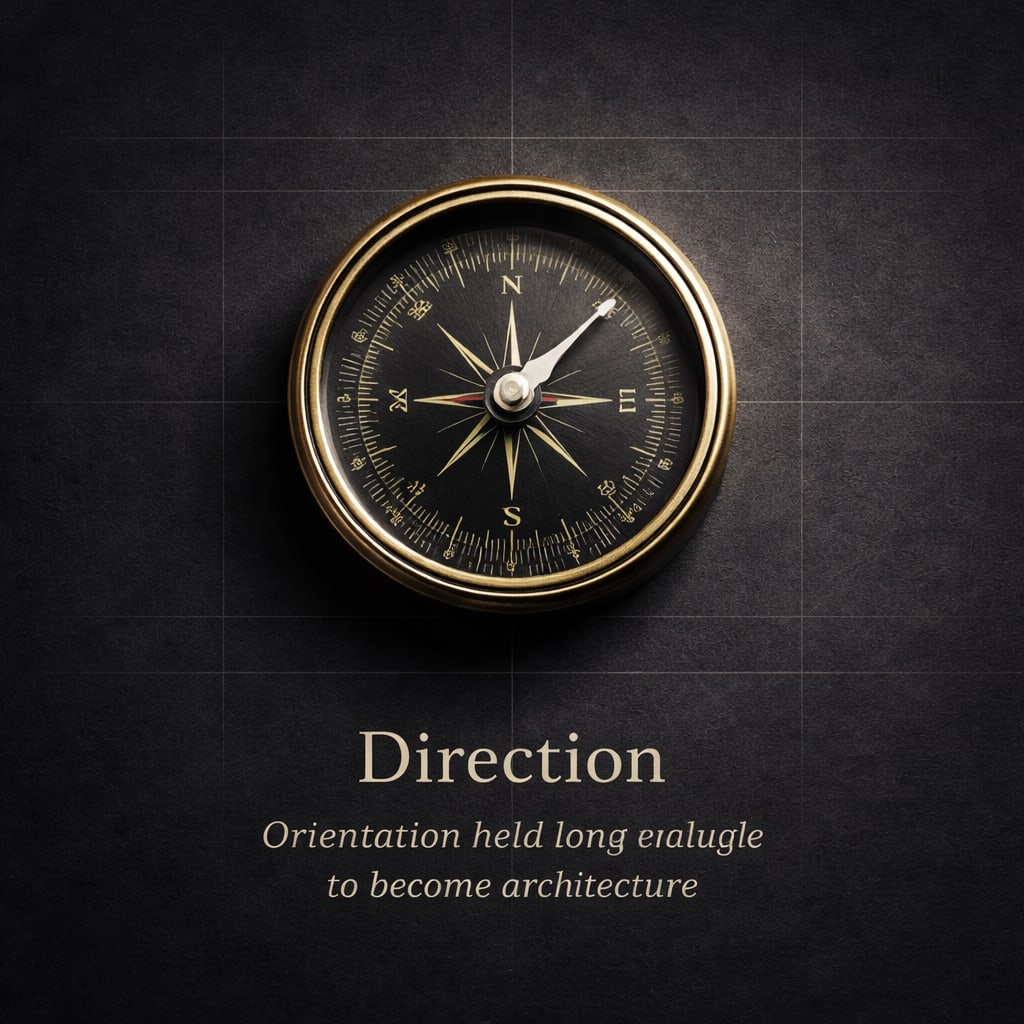
Direction
Orientation Held Long Enough to Become Architecture
The Discipline of Moving With Intention
Direction is not about moving fast.
It is about moving true.
Most people confuse motion with momentum.
They confuse urgency with purpose.
They confuse intensity with clarity.
But direction is quieter than all of that.
Direction is the ability to choose a line and remain with it.
Not because it is easy.
Not because it is validated.
Not because it is applauded.
But because it is aligned.
When you have direction, you stop reacting to every sound.
You stop pivoting at every opinion.
You stop collapsing at every discomfort.
You begin to measure your movement by coherence, not applause.
Direction is not loud.
It does not announce itself.
It shows up as consistency.
It shows up as repetition.
It shows up as a steady return to what you said mattered.
Without direction, life feels like drift.
You respond to what is urgent.
You prioritize what is loud.
You become shaped by what pulls hardest.
With direction, something changes.
You do not chase every opportunity.
You do not answer every call.
You do not argue every misunderstanding.
You conserve energy.
You choose.
Direction is restraint.
It is the discipline of saying no without hostility.
It is the steadiness of saying yes without frenzy.
It is the quiet power of walking past what once would have hooked you.
It is not about knowing every step.
It is about knowing your orientation.
North does not panic because the wind shifts.
It remains north.
When direction is established internally, you stop asking:
“Is this working?”
“Do they approve?”
“Am I falling behind?”
You start asking:
“Is this aligned?”
“Does this build?”
“Does this sustain?”
Direction is infrastructure.
It protects you from your own impulses.
It protects you from the noise of others.
It protects you from abandoning yourself for short-term relief.
It is not rigid.
It adjusts when truth adjusts.
But it does not bend for comfort.
The person without direction exhausts themselves trying to be everywhere.
The person with direction becomes reliable.
Reliable to themselves first.
And reliability, repeated long enough, becomes identity.
Direction is not intensity.
It is orientation held long enough to become architecture.
Before the Line Moves
Direction is not a mood.
It is a commitment.
It is the refusal to let emotion redraw the map daily.
We do not lose direction in dramatic collapse.
We lose it in subtle concessions.
In small self-betrayals.
In repeated hesitation.
A life without direction does not implode.
It diffuses.
This is a declaration:
I will not drift simply because drifting is easier than choosing.
The Cost of Losing Direction
How Drift Quietly Rewrites Identity
Losing direction rarely feels catastrophic.
It feels reasonable.
You adjust to avoid conflict.
You pivot to maintain approval.
You delay because certainty feels distant.
You soften the line to keep the peace.
None of these feel dangerous in isolation.
But direction is not lost in a single act.
It is lost in accumulation.
When direction weakens, several things begin to happen:
You become reactive instead of intentional.
You start measuring your worth by response.
You confuse movement with progress.
You say yes to preserve connection.
You say no to preserve comfort.
Slowly, you become shaped by what pressures you most.
Drift does not scream.
It negotiates.
It suggests:
“Just this once.”
“Not worth the fight.”
“Maybe later.”
“It’s fine.”
Drift feels compassionate.
It feels flexible.
It feels adaptive.
But drift is not adaptation.
It is erosion.
Without direction, energy scatters.
Projects remain unfinished.
Boundaries fluctuate.
Identity becomes situational.
You begin to forget what you originally meant.
And forgetting your own meaning is expensive.
The cost of losing direction is not failure.
It is fragmentation.
You feel busy but unsatisfied.
Engaged but unanchored.
Productive but uncertain.
You expend enormous effort maintaining impressions.
When direction returns, something stabilizes immediately.
Decisions simplify.
Energy concentrates.
Noise loses influence.
You do not need to move faster.
You need to move true.
Direction does not eliminate difficulty.
It eliminates diffusion.
And diffusion is the quiet killer of architecture.
The Vow of Direction
(Spoken privately. Embodied consistently.)
I will not abandon my line to avoid discomfort.
I will not confuse urgency with importance.
I will not adjust my direction to match another’s instability.
If I redraw the line, I will do so consciously —
not reactively.
If I pause, it will be for clarity —
not collapse.
I will measure my movement by alignment,
not applause.
I will remain oriented when approval disappears.
My direction is not defiance.
It is design.
Drift cannot define what I have deliberately chosen.
— Flower InBloom
About the Creator
Flower InBloom
I write from lived truth, where healing meets awareness and spirituality stays grounded in real life. These words are an offering, not instruction — a mirror for those returning to themselves.
— Flower InBloom
Keep reading
More stories from Flower InBloom and writers in Humans and other communities.
When Structures Rise Without Listening
The Tower I was not born in defiance. I was born in longing. They gathered at my base with dust on their feet and stars in their eyes. Their hands trembled not from arrogance, but from memory — a faint remembering that they once touched something vast.
By Flower InBloomabout 12 hours ago in Humans
Unofficial Challenge: What would you do if you were rich?
I love the kind of work I get to do in my career, but as I job search and browse apartments again due to another understaffed and unsustainable work environment that I did not intend to get into, my daydreams of better days consistently lean into the same question: What would I do if I didn't have to worry about my basic needs being met?
By Kay Husnick7 days ago in Writers



Comments (1)
Love it BLESSINGS to you My friend HUGS