
Do Adults Ever Stop Being Children?
Silenced emotions, lost questions, and what we accept in the name of growing up

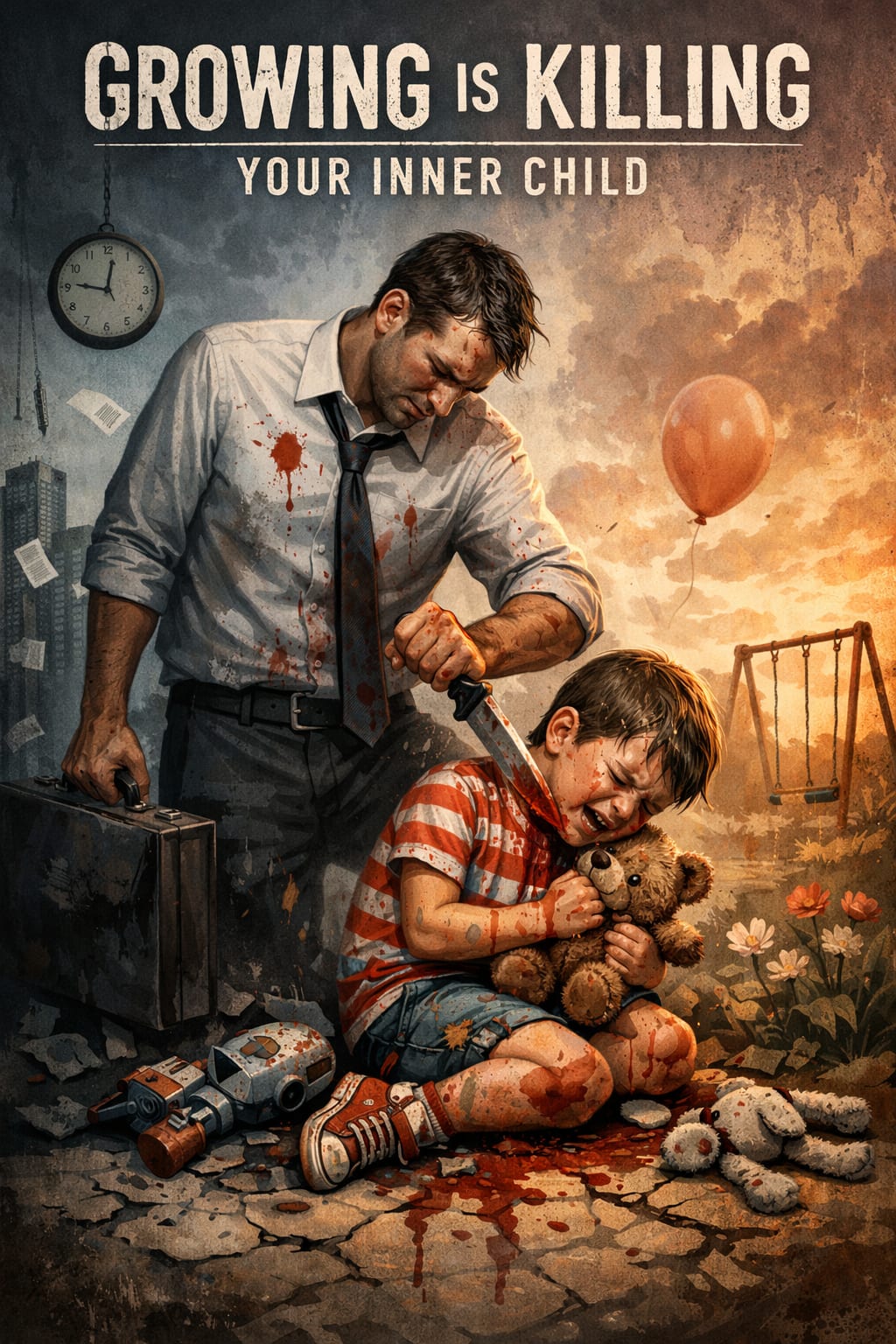
Are We Truly Growing Up, or Are We Just Children Pretending to Be Adults?
Growing up…
The word itself sounds simple, yet truly understanding its meaning is anything but easy. From a very young age, we are taught one repeated sentence: “You need to grow up.” But almost no one asks the real question: “What does growing up actually mean?”
Childhood is the phase where everything is pure and honest. As children, we do not hide our fears, suppress our emotions, or feel ashamed of our dreams. We ask questions freely, without worrying about how we will be perceived. Every question opens a new door, and every feeling becomes a lesson about life.
Then one day, we are told: “You’re grown up now. Don’t act like that. Don’t say that.”
And we believe it.
We obey.
We adapt.
But we need to ask ourselves: is adaptation the same as growth, or is it simply pretending to be grown up?
For most people, growing up is defined as getting older and taking on responsibilities. Yet in reality, many of us have not grown—we have merely conformed. We act according to what society expects, shape our choices to fit social norms, and slowly begin to fear being ourselves.
True growth is not measured by age, status, or social roles. Real maturity begins with protecting the child within us. Growing up does not mean silencing your voice or hiding your emotions; it means speaking honestly, feeling deeply, and asking questions without fear.
Society tells us: “If you are grown up, you must be quiet, controlled, and obedient.”
But this is not maturity—it is self-erasure.
We ften say, “We’ve grown up,” when in fact we have simply learned to stay silent. We have adapted, but in doing so, we have lost parts of ourselves. Inside us, the child still exists—still questioning, still feeling, still wanting to speak.
This creates an inner conflict. On one side, we want to remain true to ourselves; on the other, we feel pressured to meet external expectations. This silent struggle exhausts us. We appear mature on the outside, yet internally we remain unheard.
True growth lies in finding balance between these two worlds. It is about listening to the child within us instead of silencing it. It is about understanding that maturity does not require emotional numbness or blind obedience.
Growth also means responsibility—but not the kind defined by pleasing others. Real responsibility is taking ownership of your life, standing behind your choices, and accepting your mistakes without betraying yourself.
Growing up also involves confronting reality. Life brings loss, disappointment, and failure. Yet maturity is not avoiding pain; it is learning from it without losing your inner truth. Truly grown individuals do not suppress their emotions—they understand and transform them.
In truth, many of us are children who learned too early how to act like adults. We were taught how to behave, not how to feel. We were told how to fit in, not how to remain whole.
Real growth begins when we refuse to abandon ourselves. When we protect our values, listen to our fears, honor our dreams, and allow ourselves to feel fully.
Growing up is both an internal and external process. Internally, it means staying connected to your emotions and identity. Externally, it means facing reality with courage and responsibility. Only when these two are in harmony can we speak of true maturity.
Ultimately, growing up is not about age.
It is not about conformity.
It is about remaining yourself while moving forward.
Many of us have only pretended to grow up. Real growth begins when we stop performing adulthood and start living it—honestly, consciously, and without abandoning the child within.
About the Creator
Nurgul Najaf
I'm not here to say what everyone says.
I write what people feel but rarely admit.
A mind that questions, a soul that observes — welcome to my chaos.
Keep reading
More stories from Nurgul Najaf and writers in Humans and other communities.
When the Whole World Feels Like It's Against You
Home doesn't feel like home anymore. Conversations with family turn into battles. The people I thought would never leave now feel like strangers. Even my friends, the ones who once saw my soul, seem to avoid my eyes. I keep wondering: Is it me? Am I the reason they’re pulling away?And then comes the most painful part — when someone says, “Everyone goes through this,” or “You’re not the only one.” Maybe they mean well. But those words don’t comfort me. They silence me. Because I don’t want my pain to be compared or minimized. I want it to be seen. I want someone to say, “Yes, this hurts — and I’m here with you.”So if you’re like me — feeling like you're shouting into a void, like your soul is bruised and tired — I want you to know something:What you feel is real. It is valid. And you are not weak for feeling it.
By Nurgul Najaf9 months ago in Humans
How Emotional Availability In Relationships Supports Mental Health For Partners
Emotional availability is a human capability to be present, responsive, and open to the emotional requirements of a partner. It entails being an empathetic listener who speaks the truth, and can give constant emotional support. Emotional availability in relationships brings about a feeling of belonging and security where the partners involved feel that they are appreciated and heard. Such presence of emotions enhances relationships and promotes free communication, something that is crucial in sustaining psychological health.
By Mark Hipsterabout 3 hours ago in Humans
Dead and Wearing Green
She was wearing that green dress when I first saw her, five years ago to the day. Flowing meadow fabric draped over long legs, thick auburn hair flowing down her back. That smile. Of course, she is still beautiful now. But now she is no longer alive.
By Karen Cave5 days ago in Fiction


Comments
There are no comments for this story
Be the first to respond and start the conversation.