

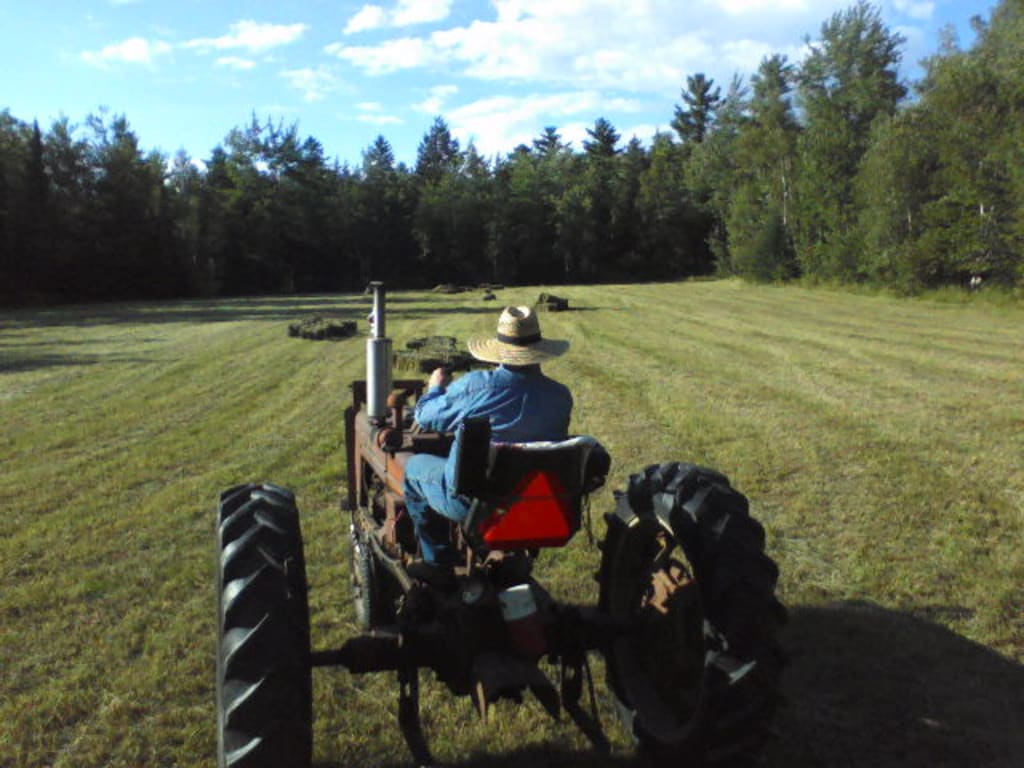
In 1965, my dad and mom bought the farm. Not in the euphemistic sense of dying, mind you, but in the literal meaning of purchasing a modest farm and large house halfway between Dad's work and the church they had joined when they moved to Maine. I was yet several years from existence at the time, but when I arrived I had the distinct pleasure of spending eighteen years on the farm. Not all of it was fun and games, though. No sir (or ma'am). There was wood to cut and stack for the winter, and there was hay to mow, rake, bale, and haul up to sell. We didn't have animals of our own besides the occasional flock of chickens (and the one year we ended up with roosters by mistake--weren't they a mean bunch!), but Dad owned enough acreage to put in 2,500 bales or more every summer and sold the crop to whoever wanted it. He got good prices for his quality feed, and the profit he made paid our tuition to a Christian school.
Putting up all that hay meant he needed a crew, and the cheaper, the better. So, he raised one. My older siblings were out doing their part while I stayed in the house with our Mum until I was six years old. Then I was called upon. It became my job to roll bales into groups. Mum and I would go out together sometimes, and other days I'd go alone. It was hot, dusty labor, and I loved getting huge glasses of lemonade afterward. One day, though, I received an unhappy surprise when I went to the kitchen for a third glass. I poured my cup full, set the pitcher down, and then guzzled half the cup before realizing my mistake. It wasn't lemonade; it was soapy water! Lemon-scented Dawn, if I recall correctly. I've never quite trusted lemonade ever since.
At any rate, my siblings and I were expected to haul hay, and since it affected my brother's ability to play ball with his friends from the neighborhood, many of them would help, too. When I was seven years old, Dad taught me how to drive one of the tractors. It was an Allis-Chalmers, and it had a hand-operated clutch in addition to a foot one. This made it possible for a little kid like me to engage the transmission even though my legs were too short and too weak to control the regular clutch. Once I began driving, I never wanted to stop.
From driving the AC to taking on the Farmall 200 when I was tall enough to use the foot clutch, I loved driving Dad's tractors whenever I had the chance. In the late 1970s and early 1980s, we were still mowing hay with a cutter bar. That was mesmerizing to watch because the blade would shuttle back and forth at high speeds as the tractor moved forward, and as the cutter bar encountered standing grass to cut it, the hay would remain standing for a moment like a line of soldiers shot in battle before falling. This repeated constantly until the operator reached the end of the row, raised the bar to turn the tractor, and then lowered it for the next pass.
Dad taught me how to replace the rivets on the cutter bar if a tooth became loose and how to add new teeth if old ones broke off. I learned equipment maintenance, but I misunderstood something important that led to a problem once. Dad sent me to mow a large field about a mile from our house. When I say "large," it took one hour to drive around the perimeter one time. He said he'd join me when he finished his work.
To engage power to the cutter bar, the tractor had to be stopped and my foot had to be on clutch. Then, I'd reach behind the seat for a little toggle switch and push it back. I didn't realize that I could disengage the cutter by moving the toggle forward even when the tractor was moving, and that's what caused the miscommunication on the day in question.
I had finished mowing about sixty percent of the field when Dad arrived with the mower-conditioner and began mowing behind me. Between us, we finished the field very quickly and headed up the hill to the road just as the skies opened up with pouring rain. Dad shouted to me to drive home in fourth gear, the fastest the 200 could go, and after I got started at that speed, he reminded me to disengage the cutter bar. Like I said, I didn't realize I could do that without stopping the tractor, so I disobeyed him.
In the meantime, the bar ran as fast as the speed of the tractor. I was terrified that something was going to break, but I couldn't stop, because Dad was on his diesel tractor behind me, and we were soaked to the skin. When we finally pulled into the dooryard and got off the tractors, he asked me why I didn't disengage my mower. When I explained, he understood. It was honestly one of the few times he showed patience for my misunderstanding, but I'm grateful he did. We ended up replacing a couple of teeth on the bar later in the week. It was a valuable lesson for me in obeying when I don't necessarily understand everything going on.
On another occasion, when I was in high school, Dad was mowing across the road from the house, and I was raking the large field behind the house. I was nervous about one hilly field, however, because the 200 had notoriously difficult brakes to engage, and it had been some time since I'd driven it. I asked him what gear I should use to ascend that hill, and he said that the tractor "should be able to make it in 2nd." Famous last words.
With those older tractors, shifting on the fly does not happen. To change gears, the tractor must be completely stopped. The Farmall 200 had a left clutch and two right-pedal brakes that could be operated separately or connected by a metal clip that flipped from the left brake to the right one. For the hill, I set the clip for double-brakes.
As I made my first pass up that hill, I added some speed to keep the 200 going, but halfway up, I realized I should have taken it in 1st gear, not 2nd. The engine began sputtering, and I knew that if it died, I'd have to figure out how to back the tractor and rake down the hill without wrecking, so I took a deep breath, pushed in the clutch with my left foot, and stood up on the brakes with my right foot.
To my dismay and terror, the tractor began slipping backward. I could not re-engage the clutch without popping the front end of the tractor and rolling it onto myself, so I pushed the gear to neutral and focused all my strength on the brakes. It was no good. Nothing was going to stop the 200 from racing back down the hill. I hollered and called out to God for help.
Somehow, the brakes began to work slightly, and then the rake turned sideways. It climbed the right rear tire of the tractor and pinned it in place. The front end of the 200 popped up a foot or so from the sudden stop, and went down again. I shut off the engine, put the tractor in first gear, and sat there, trembling.
After a minute or two, I looked around to see if anything was broken. It appeared that the 200 and the rake were okay, so I climbed down from the tractor. My knees almost betrayed me. I made my way up the hill, and as I crossed the road, Dad met me at the top of the hill on the other side. His face was filled with concern.
"Are you all right?" he said. "I had just finished and was coming to see how you were doing when I heard a yell."
I told him what had happened. He said, "I'll finish raking. You take this tractor and mower back to the house. You can be done for the day. I'm glad you're all right."
Dad was very partial to Farmall tractors and John Deere balers. As the years passed, he acquired two Farmall H tractors that became his workhorse machines alongside his diesel. The 200 is a small tractor, though when I was 7 it seemed large. Dad's farm is small. It's minuscule when compared to Midwestern U.S. farms. But for our experience, it was sufficient. One hundred fifty acres; about half-and-half fields to woods. He hayed the fields for many neighbors, too.
There was one fellow, Mr. L, who was amazed at Dad's self-control. Mr. L would watch Dad repair the baler or tractor multiple times a day and occasionally hit his finger with a hammer without ever saying anything more than, "Oh, that smahts." (Maine accent and slang meaning "ouch.") One time, Mr. L saw that happen two or three times. He was so impressed by Dad's control he said, "I don't think you even know HOW to swear!"
I'd like to say that I kept up Dad's stellar reputation in that department, but I haven't. What I can say is that while Dad and I didn't always know how to communicate well with each other, I'm thankful for the 52 years I had with him. There is much more to say about Mr. MacD having a farm, but this is it for now. Perhaps it is to be continued... .
About the Creator
Mack D. Ames
Tongue-in-cheek humor. Educator & hobbyist writer in Maine, USA. Mid50s. Emotional. Forgiven. Thankful. One wife, 2 adult sons, 1 dog. Novel: Lost My Way in the Darkness: Jack's Journey. https://a.co/d/6UE59OY. Not pen name Bill M, partly.
Reader insights
Outstanding
Excellent work. Looking forward to reading more!
Top insights
Compelling and original writing
Creative use of language & vocab
Easy to read and follow
Well-structured & engaging content
Excellent storytelling
Original narrative & well developed characters
Expert insights and opinions
Arguments were carefully researched and presented
Heartfelt and relatable
The story invoked strong personal emotions
Masterful proofreading
Zero grammar & spelling mistakes
On-point and relevant
Writing reflected the title & theme
Keep reading
More stories from Mack D. Ames and writers in Humans and other communities.
Time to change your life.
Is it even possible for you to change your life? A lot of people, more than there should be, are unhappy with their lives. But what are they doing about it? Usually nothing. People talk about how shitty their lives are and want change, but are they not taking the actions to change?
By Jen Phillips3 days ago in Humans
The Deer’s Lesson
In a dense forest filled with towering trees lived a mother deer and her young fawn. The fawn was still very small, barely able to stand on its own, when the mother began teaching it the ways of the forest. She knew she might not live long enough to see her child fully grown. Hunters roamed the forest constantly, carrying guns and traps, always seeking deer. On top of that, predators like lions, leopards, and other wild animals added constant danger. The mother would leap into action at the slightest noise, always keeping her young one close, unable to venture too far from its side.
By Sudais Zakwanabout 7 hours ago in Humans


Comments (1)
There are some very relatable stories in there, Bill, and what you say about the roosters is so true. We had one especially mean rooster who used to scare the heck out of me every time I tended to them. He was king of the roost, and he did not take kindly to me invading his space, even if it was to feed them!