
Facebook is Dead
A System That Isn't Working


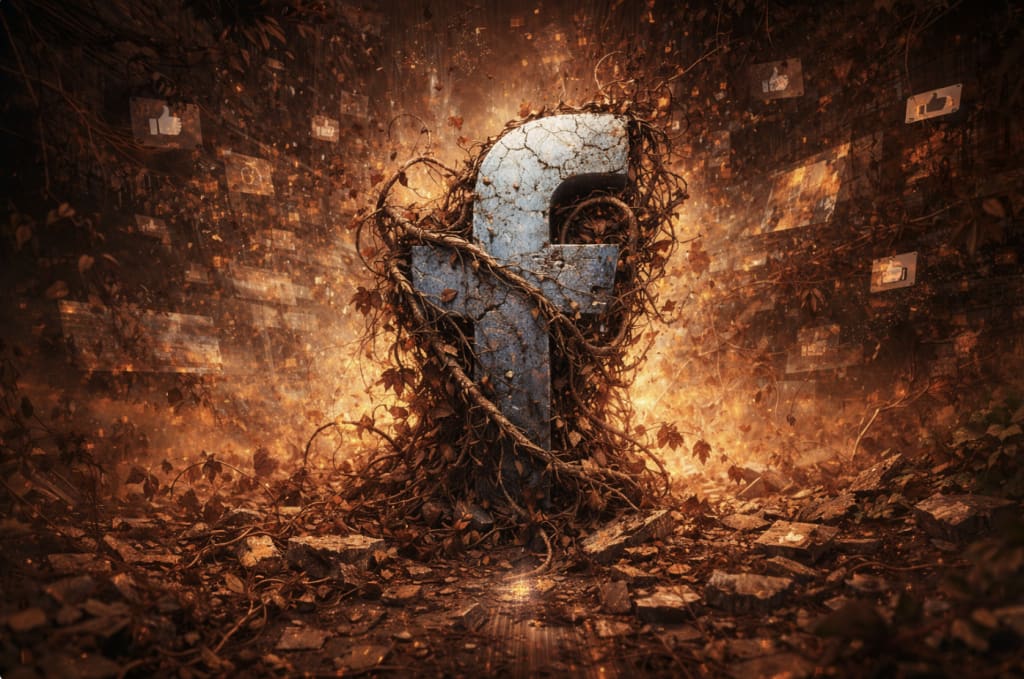
Or at least it feels like it's dead, doesn’t it?
Any system that is not maintained and improved but simply left to its own devices, will enter a stage of entropy (natural, slow decay, degradation, and dilapidation) and eventually die.
Systems do not decay randomly. They decay along the fault lines and break at the weak links built into their design. If profit becomes the primary organizing principle, everything else -- community, truth, connection -- eventually is sacrificed.
It may look as if it is still alive because some of its elements continue working by inertia, but overall, Facebook is largely dead on the inside.
When I was young, I read many short stories by Guy de Maupassant and was struck by his obsession with the macabre, with death, and with what happens after it. One detail was particularly memorable: when describing how men died and how people mourned them, Maupassant often inserted the detail of a corpse growing a beard overnight — as if it were the last burst of life in a dead body. It is scientifically incorrect; the beard does not grow after death. Rather, stubble may appear more pronounced because the skin dehydrates and the tissue shrinks. But at the time, it was a common misconception — and it stayed with me as a powerful metaphor.
To me, it feels as though Facebook is currently growing a beard after it has died.
It no longer serves its primary original purpose: connecting people who otherwise cannot stay in touch.
The architecture is still there, i.e. profiles, friends lists, Facebook groups, timelines, but the organizing logic has changed. What once prioritized relationships now prioritizes retention and engagement with paid content.
It no longer serves it's second function either, to inform people about what is going on in the world, because it circulates so much false and misleading information that people struggle to find the truth and retreat into their comfortable and safe information bubbles.
It does not even truly entertain. The reels we all watch simply gobble up our time without delivering the dopamine hit we expect.
All of this is happening because Facebook has been left to run on its own algorithm. The algorithm that believes it knows its users and feeds them more of the same content they already consume. But more of the same is never enough. So we stay hooked, hoping for something new and exciting while quietly burning away our time.
And the ads! I estimate that on any given day, I see five to seven ads, both open and covert, before I reach a friend’s post or a news organization I follow. Even if I block the ads (which takes time and effort because they are relentless and never disappear with just one click as FB also asks why you are blocking them, allegedly to “train” the algorithm to serve you better content), many more pop up in my feed.
Of course, this is not accidental. The platform is not built to reduce friction and my frustration as a consumer; it is built to monetize my attention, and friction is simply the cost I as a user am expected to absorb.
Have you ever tried buying something off Facebook? First, you run the risk of purchasing from charlatans, con artists, or scammers because Facebook refuses to take responsibility for verifying the legitimacy of ads. Second, when you buy something you genuinely like, the algorithm floods you with ads for the same product from other companies. How many garden trimmers and rain barrel kits do you think I really need, Facebook?
About six months ago, my algorithm began “suggesting” that I follow various right-wing influencers, GOP congresspeople, FOX News media personalities, and conservative think tanks. I suppose it was concerned that my political views lean too left-wing and wanted to help me “diversify.” I blocked them relentlessly and repeatedly told the algorithm I did not want conservative propaganda in my feed. It has improved somewhat, but when that wave first began, I was so frustrated that I considered quitting Facebook altogether.
As an author, the most frustrating part is that Facebook hides my posts containing links to Vocal, even from my friends, because it does not want users clicking external links and leaving the platform.
In other words, the system rewards enclosure. It favors content that keeps users inside its walls and quietly penalizes anything that suggests there is a world beyond it.
I tried placing the Vocal link in the first comment and disguising the post with the story’s cover image as the main photo, hoping the algorithm would prioritize the visual engagement and overlook the link. It helped somewhat, but even then my friends complain they rarely see my posts. More often now, I send them direct links in Messenger. It takes more time, but at least it brings some readership. And I hope my friends are pleased with the individual attention.
I have also noticed that even friends who do see my posts and read my stories rarely comment anymore. The most I can hope for is a supportive emoji. It is incredibly frustrating because even two or three years ago, people engaged deeply with my stories and offered thoughtful advice and even story ideas.
I understand why this is happening. Driven by the logic of maximizing engagement, Facebook pushes reels in an attempt to compete with TikTok’s all-consuming algorithm, to stay competitive. And yet it is still failing. What it is succeeding at, however, is disengaging people from one another. I see more and more friends growing frustrated and leaving the platform altogether. Some return later, hoping things have improved. They rarely have.
It is estimated that roughly 40% of Facebook accounts are now inactive or belong to the deceased users. Facebook does not automatically convert accounts into memorial pages unless the user has designated someone to manage the account after death. If this practice continues and Facebook fails to attract younger users, many of whom view it as a social network for "the boomers," then by 2035, as nature takes its course, Facebook may well have more accounts belonging to the dead than to the living. It will truly become a digital graveyard.
While working on this story, I noticed that Facebook had quietly altered my profile. It removed my self-description in the “Intro” section — something that had been there for nearly ten years. It labeled me a “digital creator” without asking for my permission and keeps inviting me to get verified with a blue check. I know that verification will not change much. Trust and the value of expertise is eroding everywhere, and people no longer believe what they see. Also, if everyone gets verified, what is the systemic value of verification?
So I keep scrolling in search of posts from my friends. It becomes an increasingly futile and time-consuming exercise, and I am running out of patience.
Stop growing your postmortem beard, Facebook. Return to life. Not by adding fancy features or pushing more reels, but by remembering what you were designed to do as a system, i.e. connect humans, rather than harvest their attention for profit.
I know you can do it if you put in the effort and listen to your users. It is all about genuine truth-based content, engagement, and community.
Remember how you started back in 2005?
We desperately need that Facebook back.
About the Creator
Lana V Lynx
Avid reader and occasional writer of satire and short fiction. For my own sanity and security, I write under a pen name. My books: Moscow Calling - 2017 and President & Psychiatrist
@lanalynx.bsky.social
Keep reading
More stories from Lana V Lynx and writers in Humans and other communities.
Ditched - Index
This index is just for my subscribers. I finished and published this long story or short novella of 6,000 words recently. I tried to link all previous parts of the story in the next one, so if you went along you shouldn't have been lost. This index is just put everything in one place.
By Lana V LynxExclusive • 5 months ago


Comments (4)
Interesting. I do remember the launch in 2005 and how it didn’t take long to explode. I reconnected with friends I may have never even talked to again. But now, I rarely go on. I only post once a year on my Birthday to compose something silly, thanking everyone for the wishes. Outside of that, it’s usually only the groups I’m involved in. You make some very valid points, Lana. FB is broken.
I think FB, like other SM's before it, has served its purpose, and its time for a new one to come forward for the world to join. I for one, honestly haven't felt like going on FB since the passing of my mother.
Some good points you raise here Lana but alas I fear Facebook has been left too far behind by other platforms already.
I use Messenger more, and when I post in many groups, my posts are marked as spam, and if the group owners don't release it, then it doesn't get seen. It didn't help that I was unable to post for ages, and I lost a lot of commenting followers on Vocal. The result of that is no Vocal bonuses. Great piece, and very pertinent and hopefully a Top STory