
George Grant: Canada’s Moral Conscience
George Grant: Canada’s Moral Conscience


In the heart of Toronto’s York University, a quiet professor with a fierce intellect and a sorrowful gaze penned a sentence that would shake Canada’s post-war complacency to its core: *“The truth is that we are a colony of a new kind of empire.”* The year was 1965, the book was *Lament for a Nation*, and the man was George Grant—philosopher, conservative revolutionary, and the unsettling moral conscience of a country perpetually unsure it had one.
Grant’s thought is a paradox that defies easy political labels. He was a conservative who mourned not progress, but the loss of tradition, community, and the good life in the face of a crushing, homogenizing “technological modernity.” He was a Canadian nationalist who believed his country’s sovereignty was already succumbing to the American-led juggernaut of liberal capitalism. And he was a deeply religious Christian (influenced by theologians like Augustine) who warned that a society focused solely on mastery and efficiency had abandoned any concept of inherent meaning or limit. His role was not to flatter Canada, but to question its very soul.
*Lament for a Nation*, sparked by the defeat of John Diefenbaker’s government and its more independent stance, was famously a eulogy. Grant argued that Canada’s historic project—a more communitarian, Tory-inspired society distinct from the American “republic of technology”—was no longer viable. The sheer gravitational pull of the American empire, with its ideology of individual rights, unfettered freedom, and technological domination, was irresistible. Canadians, he claimed, had willingly embraced this “universal and homogeneous state” for the prosperity it promised, selling their distinctive political tradition for a mess of consumer pottage.
Yet to call Grant merely a nationalist is to miss his profound depth. His lament was for something far greater than border policies. It was for the erosion of the “good” as defined by Plato and Hegel—a shared sense of justice, virtue, and order that modernity was systematically dismantling. In his seminal *Technology and Empire* (1969), he argued that the modern drive for technological mastery had become an end in itself, obliterating older ethical frameworks. When the only question is “Can we do it?”, the more vital questions—“Should we do it?” and “To what end?”—are silenced. In this, he foresaw debates about biotechnology, environmental degradation, and data capitalism decades before they reached the mainstream.
Grant’s persona as “moral conscience” stemmed from his unique position as an outsider on the inside. Scion of a famous Canadian family (his grandfather was Principal of Queen’s University, his mother a Hart Massey), he was deeply rooted in the establishment he critiqued. Wounded and inspired by his experience in WWII, haunted by the atomic bomb, and steeped in ancient philosophy, he brought a tragic, prophetic tone to Canadian discourse. He offered no easy policy solutions or happy endings. His gift was diagnosis, a chilling and precise diagnosis of a spiritual malady.
His influence is a subtle, lingering presence. He gave the Canadian Left a sophisticated critique of American imperialism that was not socialist, and the Canadian Right a traditionalism that was not merely economic. Environmentalists found in him a foundational thinker on the ethics of technology. Scholars of Canadian identity, even when they disagreed, had to grapple with his devastating, love-filled critique.
Today, in an age of algorithms, climate crisis, and deepening continental integration, Grant’s voice feels unnervingly contemporary. The questions he raised are our questions: What is a nation for beyond economic growth? Can a society survive without a shared sense of the sacred or the common good? What do we lose when efficiency becomes our only god?
George Grant did not provide comforting answers. He provided a piercing, sorrowful, and essential clarity. He was the man who stood on the bustling platform of Canadian modernity and asked, in a steady, unwavering voice, not where the train was going, but why we were so eager to board it in the first place. In that asking, he forever altered the moral landscape of his country.
About the Creator
Fred Bradford
Philosophy, for me, is not just an intellectual pursuit but a way to continuously grow, question, and connect with others on a deeper level. By reflecting on ideas we challenge how we see the world and our place in it.
Keep reading
More stories from Fred Bradford and writers in Humans and other communities.
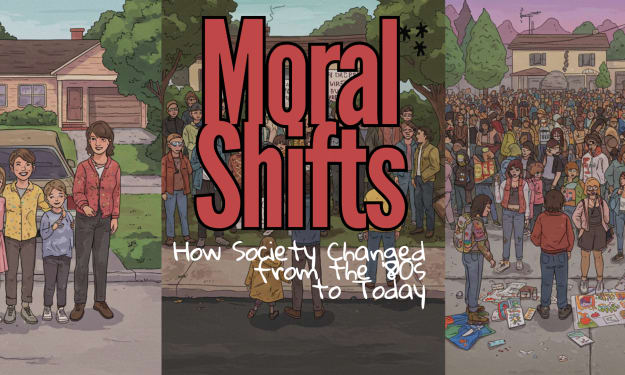
Moral Shifts
Society and its moral frameworks have transformed significantly from the 1980s to the 2000s onward, driven by cultural shifts, technological advancements, and evolving values. Comparing the 1980s, 1990s, and post-2000 eras reveals distinct differences in family structures, gender roles, attitudes toward diversity, environmental consciousness, and views on authority. Below, we explore five areas where societal morals and norms diverged, reflecting how each decade reshaped collective values.
By Fred Bradford6 months ago in Humans
Cabin Fever Because of Snow, Sleet, and Freezing Rain That Turned to Icy Roads
What Is Cabin Fever? The short answer is that cabin fever is restlessness from being in a confined area. Cabin fever is the distressing irritability or restlessness experienced when a person or group is stuck at an isolated location or in confined quarters for an extended time. Research shows that prolonged cold, gray skies, and being stuck indoors can trigger mood shifts similar to “winter blues.”
By Margaret Minnicks3 days ago in Humans
The Day ‘Stop’ Meant Nothing”
A quiet sign, a loud tragedy, and the cost of a world that won’t pause The stop sign had been there longer than anyone could remember. Its red paint had faded into a tired maroon, edges nicked and scarred by time, winters, and neglect. It stood at the corner like a patient elder, asking—politely, repeatedly—for the world to slow down. Most days, people barely noticed it. Cars rolled through the intersection without fully stopping, drivers glancing left and right just long enough to convince themselves it was safe to keep moving. Cyclists treated it like a suggestion. Walkers passed beneath it, trusting that someone else would obey. The sign did not shout. It did not move. It simply waited, believing in the rules it was made to represent. On the day everything changed, the sky was overcast—one of those gray mornings that feels unfinished, as if the sun forgot to show up. The air carried a cold stillness, the kind that makes sounds sharper and silences heavier. Snow threatened but didn’t fall. Life continued in its ordinary, careless rhythm. And then, somewhere beyond that quiet corner, violence arrived without asking for permission. There are moments in life when you realize how fragile the idea of “normal” really is. How quickly it dissolves. How easily it abandons us. That day, the word stop lost its power—not just on that sign, but everywhere. Gun violence does not announce itself. It doesn’t send warnings ahead of time. It doesn’t respect neighborhoods, routines, or innocence. It crashes into lives like an unwanted storm, leaving behind questions that never find answers. Afterward, people gathered near that intersection. Some stood silently. Others cried. A few argued—about causes, about laws, about what should have been done. The stop sign watched it all, unchanged, unmoved, still doing its job. Still asking the same thing it always had. Stop. But stopping is not something we are good at anymore. We rush through days like they owe us something. We scroll past suffering. We debate tragedies instead of mourning them. We turn real pain into statistics because numbers feel safer than names. Slower than grief is reflection, and reflection requires us to pause—something our world resists with impressive determination. The stop sign is a simple object, but it carries a complex promise: that if we all agree to pause, we can protect one another. That shared responsibility can reduce harm. That rules exist not to control us, but to keep us alive. Gun violence exposes how often we break that promise. After every incident, we hear the same phrases. Thoughts and prayers. This is complicated. Now is not the time. Each sentence is a way of rolling through the intersection without fully stopping. A way of acknowledging the sign without obeying it. Somewhere beneath the surface of all this noise, there are people trying to survive quietly. They don’t always protest. They don’t always speak. They float through the aftermath—traumatized, exhausted, invisible. Like something drifting beneath frozen water, their pain is easy to miss if you aren’t looking for it. Silent survival doesn’t make headlines. The survivors carry it with them to grocery stores, classrooms, and bedrooms where sleep comes reluctantly. They flinch at loud sounds. They measure exits when entering rooms. They learn to live with a background fear that never fully fades. And still, the world asks them to move on. The stop sign remains, doing what it has always done. It does not blame. It does not choose sides. It simply insists that some things require our full attention. That speed is not always strength. That hesitation can be an act of care. But caring takes effort. It requires us to sit with discomfort instead of rushing to conclusions. To listen without planning our rebuttals. To acknowledge that prevention is harder than reaction, and patience harder than outrage. In a culture addicted to momentum, stopping feels unnatural. We mistake motion for progress. We confuse volume with action. We demand quick fixes for slow-burning problems. Gun violence does not thrive in silence alone. It thrives in avoidance. Avoiding hard conversations. Avoiding responsibility. Avoiding the pause that might force us to change. The day “stop” meant nothing was not a single day. It was a culmination. A buildup of moments when we chose convenience over caution, speed over safety, certainty over compassion. That’s what makes the sign so haunting. It reminds us that the tools for prevention are often already in place—but they only work if we agree to honor them. You can repaint a stop sign. You can replace it. You can install brighter lights, louder warnings. But none of it matters if we don’t believe in the message behind it. Stop is not weakness. Stop is not surrender. Stop is not delay for the sake of delay. Stop is a decision. A decision to value life over haste. A decision to notice the people we usually overlook. A decision to treat prevention as seriously as punishment. Long after the crowd dispersed, the intersection returned to its routine. Cars passed. People walked. The sign stood quietly, holding its ground. It did not know about politics or policy. It did not understand arguments. It only understood its purpose. To protect. Maybe that’s what we’ve forgotten—not just how to stop, but why stopping matters. If we paused more often, we might see what’s drifting beneath the surface of our communities: grief waiting to be acknowledged, fear waiting to be eased, resilience waiting to be supported. If we stopped, even briefly, we might hear the quiet voices drowned out by louder ones. We might notice the warning signs before they become memorials. The stop sign will keep standing there, faithful and ignored, until we decide its message is worth following. The question isn’t whether the sign is clear enough. The question is whether we are willing to listen.
By Inayat khan2 days ago in Humans
Self Help: Grifters' Gospel
On Self-Help, Snake Oil, and the Illusion of Change Psychology professionals and students can be imagined on two opposite sides of a line called self-help books: likely a larger group opposes pop-science and step-by-step manuals filled with talk of success, journaling, and not giving a f**k; others love them, but they aren’t many.
By Avocado Nunzella BSc (Psych) -- M.A.P a day ago in BookClub


Comments
There are no comments for this story
Be the first to respond and start the conversation.