
"Nuclear War: Humanity’s Final Gamble"
Nuclear War: Humanity’s Final Gamble" Exploring the Devastating Consequences, Global Tensions, and the Urgent Need for Disarmament
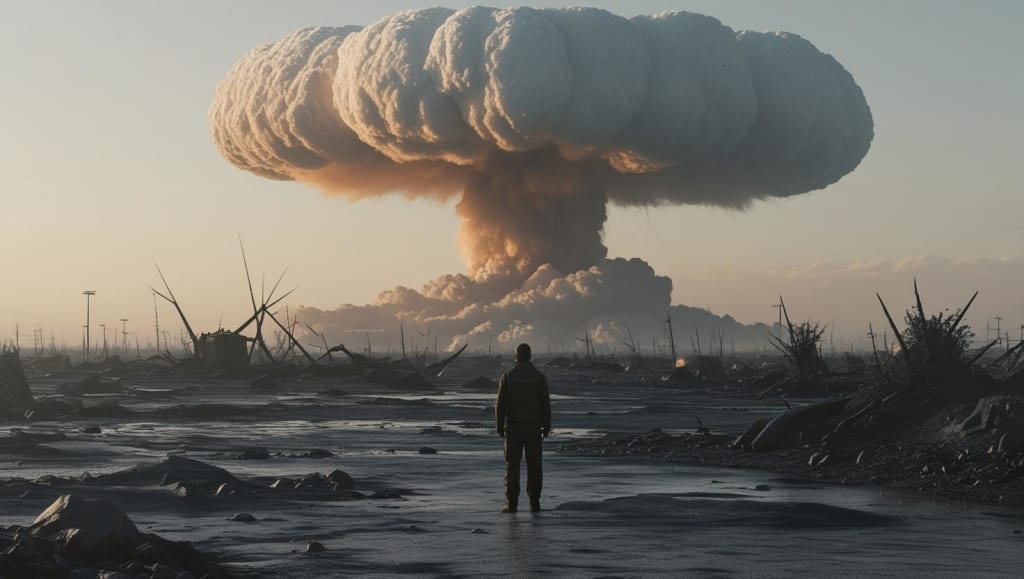
Nuclear War: Humanity’s Final Gamble
Exploring the Devastating Consequences, Global Tensions, and the Urgent Need for Disarmament
In the modern world, few threats loom larger or darker than that of nuclear war. The very existence of these weapons — capable of destroying cities in seconds and altering the course of human civilization — remains a chilling reminder of how far human progress can be turned against itself. While diplomacy and deterrence have kept nuclear weapons in check since 1945, the possibility of nuclear conflict has never truly vanished. As political tensions escalate in various regions, the threat resurfaces like a ghost from the Cold War — silent, invisible, but potentially fatal.
The Legacy of Destruction
The destructive power of nuclear weapons was made horrifyingly clear in August 1945, when the United States dropped atomic bombs on the Japanese cities of Hiroshima and Nagasaki. Over 200,000 people died, most of them civilians, and countless others suffered from long-term radiation effects. These bombings not only ended World War II but also opened a terrifying new chapter in human warfare. Since then, nuclear technology has advanced significantly, with modern warheads being dozens or even hundreds of times more powerful than the bombs dropped in Japan.
It’s estimated that there are currently over 12,000 nuclear warheads in existence, held mostly by the United States and Russia, with other nations like China, France, the United Kingdom, India, Pakistan, North Korea, and possibly Israel also possessing nuclear capabilities. The sheer number of these weapons is enough to destroy life on Earth many times over — a fact often referred to as Mutually Assured Destruction (MAD).
Modern Tensions and Global Risks
While the Cold War era is long over, the tensions that could trigger nuclear conflict are far from gone. Russia’s invasion of Ukraine, tensions between India and Pakistan, the growing rivalry between the U.S. and China, and North Korea’s frequent missile tests all represent flashpoints where nuclear weapons could potentially come into play.
The risk isn’t always about deliberate war. In fact, some of the most frightening possibilities stem from accidental launches, technical malfunctions, or false alarms. There have been several close calls throughout history where miscommunication or technical errors nearly led to catastrophe — narrowly avoided by human decision-makers choosing to wait rather than retaliate.
The Human and Environmental Consequences
A full-scale nuclear war would be unlike anything humanity has ever faced. Immediate effects would include massive loss of life, burns, radiation sickness, and destruction of infrastructure. But the aftermath could be even more devastating.
A large nuclear exchange would likely trigger a “nuclear winter” — a scenario where firestorms inject vast amounts of soot into the atmosphere, blocking sunlight and drastically lowering global temperatures. Crops would fail. Famine would spread. Billions could die — not just from the bombs, but from the collapse of global agriculture and ecosystems.
Radiation would poison water supplies, food sources, and the atmosphere. Survivors would face cancer, birth defects, and psychological trauma. In short, a nuclear war wouldn’t just be a military conflict — it would be a global catastrophe, affecting all of humanity, including countries uninvolved in the initial conflict.
The Illusion of Deterrence
For decades, the theory of nuclear deterrence has guided military policy: the idea that no rational actor would start a nuclear war because they know it would result in their own destruction. While this logic has arguably prevented major wars between nuclear powers, it’s a dangerously fragile balance — dependent on rational leadership, perfect communication, and zero errors.
In an increasingly unstable world with cyber warfare, terrorism, and rising authoritarianism, relying on deterrence alone is like playing roulette with the future. A single mistake, misjudgment, or rogue decision could tip the world into irreversible chaos.
The Path Forward: Disarmament and Dialogue
The only sure way to prevent nuclear war is to eliminate nuclear weapons altogether. This is not just an idealistic dream; it is a necessary goal for the survival of future generations. Treaties like the Non-Proliferation Treaty (NPT) and the Treaty on the Prohibition of Nuclear Weapons are steps in the right direction, but progress remains slow and uneven.
Disarmament must be paired with diplomatic dialogue, conflict resolution, and strong international institutions that can mediate tensions before they spiral out of control. Education and awareness are also critical — especially for younger generations who did not grow up with the fears of the Cold War. People must understand the stakes.
Conclusion
Nuclear war is not a distant threat from history books or science fiction — it is a real, present danger. The fact that these weapons still exist and continue to be modernized is a testament to humanity’s paradox: our genius for creation is matched only by our capacity for destruction.
In this high-stakes game, there are no winners. Once the button is pushed, there is no turning back. That’s why we must treat nuclear war not as an abstract policy issue, but as a moral and existential challenge. The survival of civilization depends on choosing diplomacy over destruction, cooperation over confrontation, and peace over power.
Because in the end, nuclear war is not just humanity’s final gamble — it may be its final mistake.
About the Creator
Hasbanullah
I write to awaken hearts, honor untold stories, and give voice to silence. From truth to fiction, every word I share is a step toward deeper connection. Welcome to my world of meaningful storytelling.
Keep reading
More stories from Hasbanullah and writers in Humans and other communities.
Hind Rajab: A Child the World Heard Too Late
Cinema has always been a powerful medium for telling stories that history books often reduce to numbers. When a film chooses to focus on a single child caught in the machinery of war, it forces audiences to confront reality not as statistics, but as human loss. The movie inspired by the tragic story of Hind Rajab, a young Palestinian girl, does exactly that. It is not merely a film; it is a testimony, a memorial, and a question posed to the conscience of the world. Hind Rajab’s name became known globally after reports emerged of her final hours during the Gaza conflict. She was a child trapped in circumstances no child should ever experience. The film based on her story does not sensationalize her death, nor does it turn her suffering into spectacle. Instead, it approaches her story with restraint, dignity, and an unwavering focus on innocence lost amid violence. The Story at the Heart of the Film The movie centers on a young Palestinian girl who becomes separated from safety during intense military escalation. Through her eyes, viewers witness fear, confusion, and the fragile hope that someone, somewhere, will come to help. The film follows her final journey—both physical and emotional—using minimal dialogue and powerful visual storytelling. Rather than relying on graphic imagery, the filmmakers choose silence, pauses, and close-up shots to convey terror and vulnerability. This artistic choice makes the film even more haunting. The audience is left to sit with the child’s fear, her calls for help, and the unbearable waiting that defines her final moments. By focusing on Hind as an individual rather than a symbol, the film restores her humanity. She is not portrayed as a political tool, but as a daughter, a child with dreams, and a life that mattered. A Child as the Center of a Global Tragedy What makes this movie particularly impactful is its refusal to shift focus away from the civilian cost of war. The story does not revolve around soldiers, strategies, or power struggles. It revolves around a child who should have been worried about school, friends, and play—not survival. This narrative choice challenges the audience to rethink how conflicts are discussed in media and politics. Wars are often framed in terms of borders, ideologies, and victory. This film asks a different question: What is the price paid by those who have no role in choosing the war? By centering the story on Hind, the film exposes the imbalance of power and the devastating consequences faced by the most vulnerable. Artistic Direction and Emotional Weight The film’s direction is deliberately restrained. There is no dramatic background score overpowering the scenes. Instead, ambient sounds—distant explosions, static-filled phone calls, the quiet breathing of a frightened child—carry the emotional weight. This realism makes the film deeply unsettling. The young actress portraying Hind delivers a performance that is heartbreakingly authentic. Her expressions alone communicate fear, confusion, and bravery far beyond her years. The filmmakers avoid overacting or melodrama, allowing the story’s truth to speak for itself. Cinematography plays a crucial role as well. Tight frames and limited perspectives reinforce the feeling of entrapment, while long, unbroken shots force viewers to experience time as Hind did—slow, uncertain, and terrifying. A Political Film Without Political Speeches One of the film’s greatest strengths is that it does not rely on speeches or overt political messaging. Its power lies in its simplicity. By telling one child’s story honestly, it exposes the broader reality of civilian suffering in conflict zones. The film does not tell audiences what to think. Instead, it asks them to feel—and that is far more powerful. Viewers are left to grapple with difficult questions about responsibility, accountability, and the value of human life. This approach has made the movie resonate across cultures and ideologies. Even those unfamiliar with the details of the Palestinian struggle can connect with the universal themes of childhood, fear, and loss. Reception and Global Impact Since its release, the film has sparked intense discussion on social media, in film circles, and among human rights advocates. Many viewers describe it as one of the most emotionally challenging films they have ever watched. Critics have praised its ethical storytelling and refusal to exploit tragedy. For many, the movie serves as an entry point into understanding the human cost of the Gaza conflict. It has been screened at independent film festivals and community events, often followed by discussions about civilian protection and children in war zones. Most importantly, the film ensures that Hind Rajab’s name is not forgotten. In a world where news cycles move quickly, cinema has given her story permanence. Why This Film Matters This movie matters because it stands against normalization of suffering. It reminds us that behind every headline about war are real people, real families, and real children whose lives are forever altered—or ended. By immortalizing Hind Rajab’s story, the film becomes an act of resistance against silence. It insists that her life had meaning and that her death deserves acknowledgment, reflection, and accountability. In the end, this is not just a film about one Palestinian girl. It is a film about every child trapped in conflict, every unanswered call for help, and every moment when humanity fails its youngest members. Cinema cannot undo tragedy, but it can refuse to let it be ignored. And in doing so, this film ensures that Hind Rajab’s story continues to speak—long after the screen fades to black.
By Hasbanullah25 days ago in Humans
Time to change your life.
Is it even possible for you to change your life? A lot of people, more than there should be, are unhappy with their lives. But what are they doing about it? Usually nothing. People talk about how shitty their lives are and want change, but are they not taking the actions to change?
By Jen Phillips4 days ago in Humans
System Down: Dancing with Brainwashed Zombies and Brainless AssLicking Shapeshifters while Eating Protein Enriched Brain Tacos
System Down: AHHHHHHHHHHHHHH Death is not the greatest loss in life. The greatest loss is what dies inside while still alive. Never surrender," --Tupac
By SAMURAI SAM AND WILD DRAGONS6 days ago in Humans


Comments
There are no comments for this story
Be the first to respond and start the conversation.