
On Death, Loss and Living
Some thoughts on how we can grieve and remain enthusiastic about life

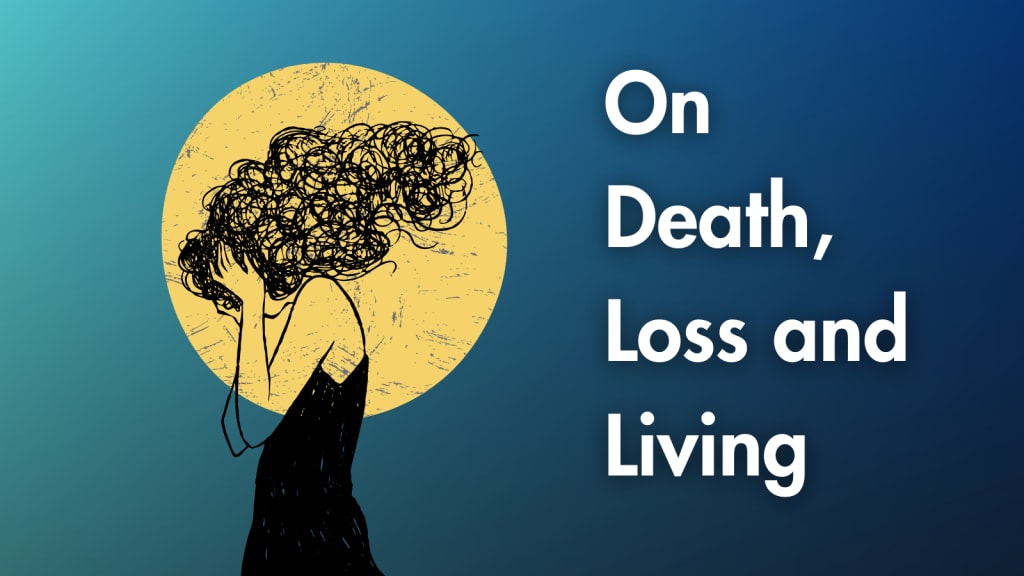
The majority of us will experience profound loss by the passing of a loved one, someone who is close and dear to our hearts. While unfortunate, it, essentially, is an inevitable part of our lives. That experience entrenches itself into each and every fiber of your entire being, and it teaches you many things, even if you're unwilling to learn them. Forcefully, it alters your reality and begins to reshape the way you view and perceive human existence and all things pertinent.
In February of 2019 my father passed away after over a decade of battling several illnesses. While I had experienced death in the family before, it hadn't yet been so close and personal as having my father, a constant intimate figure in my everyday life, no longer here in the flesh. That's when the notion and concept of loss truly metastasized. It became abundantly clear that death and, consequently, loss is ubiquitous.
My father's passing served as the inception to the awareness of ineluctable loss and its place within our shared humanity. I became cognizant that not only was death and loss inevitable, but persistent, unstoppable, unyielding. Whether in small or significant ways, death and loss suddenly made their existence adamantly apparent. I lost some of my innocence, naiveness, vanity, much of my egocentrism. Eventually, I lost friends, a job, some of my interests, some of my perceptions. Parts of me that I thought were intrinsic to my being were suddenly decimated. The 2020 coronavirus pandemic, which occurred roughly a year after my father's passing, only magnified this awareness. So many lost their loved ones to the virus, but the pandemic took more than just human lives; it took people's jobs, homes, financial security and stability, our ease to interact with one another, and our idea of an unvarying society.
Since my father's passing in 2019, four of my immediate family members have also passed away and I've attended around eight funerals. In the tears, mourning and suffering of those directly affected, I've seen the impact that loss has on even the most stoic. It was recognizable because I, too, had lived it first-handedly. We realize that there certainly is a definite end to all things, and the byproduct is a vast void. Growing up, I wasn't the closest nor the fondest of my father, but I came to have both great sympathy and empathy for the man, and we grew closer while he was sick. And while I was slightly prepared for his death, having had numerous close calls, his passing marked a definite turning point. What was there before no longer was, and it was very difficult to fathom how that could be.
From all of this I have learned that so many things that we take for granted are fickle; our health, our income, our beliefs, our lives, our time with loved ones. The knowledge that these experiences have brought forth is that so much of our lives isn't secure, and that the things given to us can easily to be taken away, and sometimes, quite rapidly. Before my father's death, I perceived certain things as fixtures to my existence. Back then, I thought of myself as an intellectual whose prosperous career would continue linearly with no interruption, whose friendships would only be fostered and mature, whose jovial energy and character would go unchallenged, and whose youth would be preserved. And not just the physical, outer youth, but the one that allows you to adapt a conviction that the universe revolves around you and that you are the controller of every aspect of your human experience. Since 2019, I've had to shed some of these beliefs and come to an understanding that I do not, indeed, control much of my own life, that I am constantly susceptible to great loss and to great pain. There are remnants of a naive and inexperienced version of myself, but as I've grown, I've come to comprehend that life is a series of episodes, sometimes of immense growth and prosperity, but sometimes of relentless loss and pain.
But there is now also an acquired appreciation for life, but of life in a realistic sense. I've had some harsh realizations, as have many, I'm sure. Life is rough, and it can be cruel and unforgiving. Many times, it takes more than it gives, and it isn't rational about who gets what and who doesn't. Overall, it's unpredictable. So much of these realizations are entirely contrary to the beliefs I had when I was younger and hadn't yet experienced loss. The most challenging part of losing my father and, essentially, losing so much of what I thought to be true was relearning things in their most raw, authentic and true element. Death and loss are implacable, and it's only a matter of time before you become their victim.
While there may not be a direct correlation between losing a loved one or losing your job, the nature of both is quite similar: nothing is forever and nothing is cemented. By nature, I am not an optimist. I am a realist, rather, and the reality is that we can still live our lives enthusiastically and willingly despite these harsh realities. I now acknowledge the imminence of loss, and yes, even death, all while attempting to live the best version of my life possible. I do so by being authentic to who I am, by loving those around me constantly and openly, and by doing all the things I enjoy and want to do, even when others don't necessarily agree. For me, there is no other way. I know it's only a matter of time before I experience death and loss again, and I want to make sure that when they come, either or, I receive them more maturely, readily and openly.
I sometimes wonder if my father was ready to accept his own death. He was never willing to talk about it, but his character and demeanor suggested as such. I'd like to believe that he, too, came to the realization that both death and loss are inevitable, and whether or not he looked back at his humanly days fondly, I hope he was at ease knowing that the destination is the same for all of us regardless of what we've done. Perhaps he understood that all things come, and all things go, to include himself, and that put him at ease.
Often, when I'm experiencing some level of loss, I think of him. I like to picture him egging me on to live my life despite the pain, despite the discomfort, despite the uncertainty and despite the frustration- but also in a way that seems true and real to me, and not to others. I imagine him telling me to let go of what was and to continue forward, that while the end isn't definable, we can live as if it may be tomorrow.
Perhaps that is the true lesson death and loss wants to teach us; that despite their grueling nature, they simply want us to live authentically and seize every moment. We may never truly understand by there is so much death and so much loss that surrounds us all, but we can try and make the most of it, and try to put out as much love out there as possible to make it easier on each other.
About the Creator
Jose Antonio Soto
Welcome! I'm Jose Soto, a writer born and raised in the border community of El Paso, Texas and Ciudad Juárez, México. I write stories, blogs, essays, and poetry that explores what it means to be human; nuances, complexities and all.
Keep reading
More stories from Jose Antonio Soto and writers in Humans and other communities.
El Paso: The Steps Toward Change
My parent's house in El Paso, Texas, the house I grew up in, is a few blocks away from the border between the United States and Mexico. From the rooftop of the house, you can see Ciudad Juárez, one of the largest and most populous cities in Mexico. In particular, you can see El Monumento a la Mexicanidad, a now iconic monument dedicated to Mexican nationals, our identities, culture and history, often referred to as "La X." From many rooftops of the houses closest to the border and many other rooftops in the vicinity, the borderlines between the two countries are blurred. They are juxtaposed with one another, often merging as one. They are separated merely by rock, water and metal — and political agendas.
By Jose Antonio Soto4 years ago in Humans
Time to change your life.
Is it even possible for you to change your life? A lot of people, more than there should be, are unhappy with their lives. But what are they doing about it? Usually nothing. People talk about how shitty their lives are and want change, but are they not taking the actions to change?
By Jen Phillips2 days ago in Humans
How Breakups Affect Mental Health And Emotional Healing Over Time
Separations with each other are accompanied by strong emotional responses that may be overwhelming at first. Grief, shock, anger, bewilderment, and loneliness are all feelings that are often triggered as people experience the grief of losing a close emotional attachment. Sudden loss of emotional contact interferes with everyday life and emotional stability and produces distress which impacts on sleep, appetite, and concentration. To most people, the separation causes instability, which causes their anxieties to increase or even lose their emotions as the mind tries to cope with the transformation.
By Robert Smith4 days ago in Humans


Comments
There are no comments for this story
Be the first to respond and start the conversation.