
Preventive Counter-Revolution in Italy
Preventive Counter-Revolution and Creeping Repression: The Case of Potere al Popolo and the Alarming Strategy of the Meloni Government by Maddalena Celano

The Fanpage.it investigation, which exposed the infiltration of a provocateur—one Leonardo Cusmai—into the ranks of the political party Potere al Popolo, is an event that deserves much more than a brief mention or a passing reference in talk shows. This is not an isolated incident, nor a simple act of “intelligence.” It is a deeply concerning element in a broader strategy of preventive counter-revolution, carried out by a government that, while formally legitimized by elections, in practice acts in an authoritarian, repressive, and reactionary manner.
A “Preventive” Infiltration into a Transparent Party
Potere al Popolo is not a clandestine organization. It does not organize uprisings, incite violence, or plan insurrections. It is a legal, peaceful political party engaged in grassroots efforts of mutual aid, civic participation, and social advocacy. It operates within the—albeit limited and bourgeois—mechanisms of parliamentary representation and electoral competition. Yet this very movement was infiltrated by an agent who posed as an activist for a full year, recording conversations, collecting names and information, and attempting to insert himself into positions of responsibility.
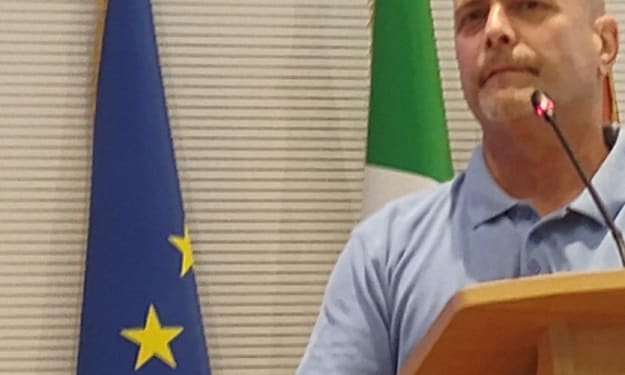
Giuliano Granato, national spokesperson for Potere al Popolo, rightly called the event a form of political espionage. And who could disagree? When the state sends an undercover agent not to fight crime, but to “monitor” the meetings of a legally recognized and peaceful party, we are witnessing a blatant abuse of security apparatuses, bent toward ideological control.
The “Crime” of Dissent
What is being criminalized here is not illegal action, but political identity. Today, the “far left” is surveilled not for what it does, but for what it represents: an alternative—however partial and reformist—to the dominant neoliberal, authoritarian, and conservative model.
This is not merely repression. It is ideological prevention. A party that operates outside the boundaries set by economic and media elites—even when doing so transparently and peacefully—is perceived as a potential threat. Therefore, it must be monitored, controlled, and neutralized.
This is the deeper meaning of infiltration: to delegitimize in advance any critical voice, any space of dissent, any attempt—no matter how moderate—to build an alternative political subjectivity.
A Systemic Strategy: Preventive Counter-Revolution
This episode is part of a larger picture. From harsher penal codes targeting environmental movements and labor strikes, to the treatment of students protesting the genocide in Palestine, to the systematic discrediting of feminist and transfeminist movements—everything contributes to a clear political strategy that we could call preventive counter-revolution.
The concept—developed by thinkers like Domenico Losurdo or, in different contexts, Michel Foucault—refers to the tendency of liberal regimes in crisis to repress any potential mobilization, even in the absence of real threats. The possible is punished, the future is repressed. This amounts to a kind of “molecular fascism,” which seeps through the formal frameworks of democracy to drain it of meaning.
What If It Happened to Everyone?
Many—even within the institutional left—downplay the situation. Some even mock it. But we must ask: what if this had happened to the Democratic Party (PD)? What if an intelligence agent had infiltrated a local chapter of PD or +Europa to “monitor” party activity, record conversations, and report names?
It would cause an uproar. Headlines in the news, parliamentary inquiries, outraged editorials. But when it happens to the “radical” left, the indignation disappears. Because ultimately, to those in power, this left is not part of the game. It is tolerated—as long as it remains irrelevant. But when it starts to grow, to take root, to speak to millions of poor and precarious people—it is treated as the enemy.
This case demonstrates that we live in a variable-geometry democracy, where political rights are only guaranteed to those who don’t fully exercise them. When a movement like Potere al Popolo organizes, runs for elections, builds social centers, solidarity networks, conflict, mutual aid... then the rules change. Suspicion arises. Surveillance begins. Infiltration follows. All in the name of “security.”
But whose security? That of the State? Or that of capitalism, which can no longer tolerate even the idea of a social alternative?
A Wake-Up Call
The case of agent Cusmai is not just a political scandal. It is a wake-up call. It is proof that the Meloni government, while presenting itself as the guarantor of order, is acting in line with the worst authoritarian traditions. The state is being used to suffocate dissent, infiltrate law-abiding movements, and target those who fight unarmed—but with ideas.
There is still time to react. But it requires clarity. It requires awareness. And more than ever, it requires building a political and social opposition capable of rising to the historic challenge before us.
About the Creator
Keep reading
More stories from Maddalena Celano and writers in Humans and other communities.
Gerardo Hernández at Roma Tre: Cuba Tells the Truth about the Red Avispa
Rome, June 25, 2025 A packed hall, attentive faces, and a silence filled with respect: this is how Gerardo Hernández Nordelo was received on June 25, 2025, in the Aula Magna of the New Rectorate at Roma Tre University. Hernández is a deputy of the National Assembly of People's Power, national coordinator of the Committees for the Defense of the Revolution (CDRs), and, most notably, one of the five legendary members of the Red Avispa.
By Maddalena Celano8 months ago in Humans
The Angry Man in Your House
"If you grow up with an angry man in your house, there will always be an angry man in your house" This statement has caused plenty of controversy online, people say its a statement that blames victims while also undermining those who break traumatic cycles to form health relationships... but if I'm honest now that I'm in my 30s it makes more sense to me than ever, and I'd argue that its not just about fathers and uncles.
By S. A. Crawfordabout 12 hours ago in Humans
Claudia Winkleman: Biography, Husband, Age, Net Worth, Career & More
Claudia Winkleman is one of Britain’s most beloved television presenters, best known for her quick wit, signature fringe, and effortless charm on screen. Born on January 15, 1972, in London, she has spent more than two decades in broadcasting, building a career that spans entertainment, lifestyle, and primetime television.
By Enoch Sagini5 days ago in Humans
The Devil's Triangle
The sails ruffled in the breeze as we cruised along. The Sea Breeze was a mid-size catamaran that sailed out of Royal Naval Dockyard in Bermuda. We had booked this trip weeks in advance and were now looking at our Captain, Spike and two boat hands. Paddy and Wilson seemed like nice guys, joking around with the passengers and telling us some stories about Bermuda that only locals would know. Their island accents sounded almost British but they were pleasant to listen to.
By Barbara Gode Wiles4 days ago in Fiction



Comments
There are no comments for this story
Be the first to respond and start the conversation.