

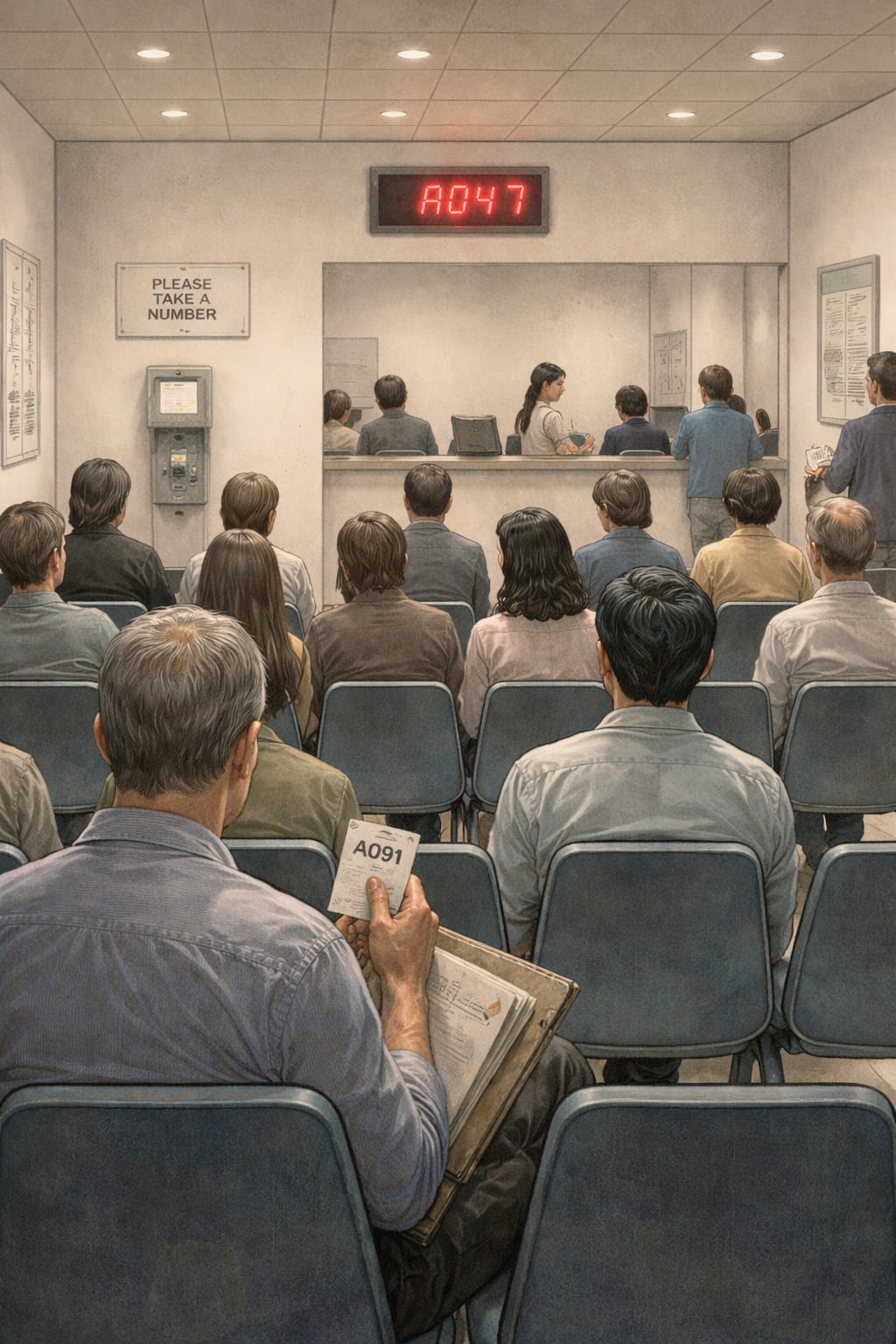
The machine is mounted beside the glass door, at shoulder height. It hums softly, as if thinking. Above it, a laminated sign reads: PLEASE TAKE A NUMBER. Below that, in smaller font: WAIT UNTIL CALLED.
The system is simple. It was designed to be fair.
You enter. You press the button. A narrow strip of paper emerges with a printed number. You sit in one of the molded plastic chairs aligned in rows against the wall. On the opposite wall, a digital display glows red. When your number appears, you approach the counter indicated beside it.
No one speaks out of turn. No one advances without being summoned.
The room is never silent. There is the low cough of ventilation, the sliding of paper across laminate, the electronic chime that precedes each number. The chime is pleasant, almost cheerful. It suggests progress.
The numbers move steadily in the morning.
A012.
A013.
A014.
Each person rises when called, holding their small paper proof of existence. They approach the counter with a combination of preparation and apology, as if the act of being served were an imposition.
Behind the counter, clerks in identical blue lanyards consult screens that glow brighter than the faces before them. The screens display fields. Each field requires completion. Each completion advances the process.
The system was designed to prevent chaos.
Before it, people stood in loose formations. They negotiated space with shoulders and glances. They argued about who had arrived first. They claimed urgency. They relied on memory and assertion.
Now, memory is unnecessary. The number remembers for you.
By midday, the numbers move more slowly.
A047 remains on the screen longer than expected. The clerk behind Counter 3 leans back in her chair. Her screen has frozen. A small rotating circle turns and turns. The person holding A047 stands without sitting, unsure whether to approach or wait.
There is no instruction for frozen circles.
A047 approaches. The clerk shakes her head without looking up.
"It’s not responding."
A047 returns to his seat. The number remains on the screen, pulsing faintly. No other number appears. The red glow holds the room in suspension.
Eventually, the display clears itself. A047 disappears. A048 appears with the familiar chime.
A047 looks at his paper, then at the screen, then at the clerks. He does not move.
The system has no language for skipped.
He waits, expecting correction. None arrives. A048 approaches the counter, apologetic, efficient. The clerks resume their rhythm.
The machine continues to dispense numbers.
The waiting room is designed to accommodate forty-seven chairs. There are forty-six. The missing chair leaves a narrow gap in the third row, an absence that seems intentional but is not. People avoid the space as if it were reserved.
When the room fills, late arrivals stand along the wall. They lean against the posters explaining proper procedure. One poster shows a smiling figure holding a number, arrow pointing toward the counter. The figure has no distinguishing features. It could be anyone.
There are three categories of service, marked by colored tabs on the numbers. Blue for general inquiries. Yellow for documentation. Red for urgent matters.
Red numbers move faster. This is the rule.
The urgency is assessed at the entrance by a staff member seated behind a smaller desk. She asks brief questions without inflection. She does not look at the people long enough to know them. She looks at them long enough to categorize them.
"Is this time-sensitive?"
"What is the nature of your visit?"
"Do you have supporting documents?"
Her fingers hover over a keypad that determines the color of the number.
The distinction between blue and yellow is subtle. The distinction between yellow and red is significant. The difference is felt in the body of the room. When a red number appears on the screen, it interrupts the sequence.
A052.
A053.
R007.
The red glow does not change color, but everyone notices.
Those holding blue numbers shift in their seats. They do not resent R007 exactly. They resent the interruption. The order had been stable. Now it is punctured.
R007 approaches the counter with visible relief. The clerk behind Counter 1 speaks more quickly. The exchange is efficient. R007 leaves within minutes.
A054 appears.
The system assures everyone that urgency will be recognized.
The machine is rarely wrong. It prints numbers sequentially. It does not repeat. It does not skip on its own.
Errors occur elsewhere.
Sometimes a number is called and no one stands.
A063.
Silence.
A063.
The chime sounds twice.
The clerk at Counter 2 clears her throat. The red digits hold steady.
After a third call, the clerk presses a small gray button beneath the counter. A063 vanishes. A064 appears.
If A063 arrives late from the restroom or the parking lot, there is no protocol for return. The system assumes absence equals forfeiture.
The person holding A063 must approach the entrance desk again, explain, request a new number. The new number will be higher.
This is not punishment. It is sequence.
The staff member at the entrance does not apologize. She presses the keypad. A new strip of paper emerges.
A091.
A063 becomes A091.
The system preserves fairness by refusing to remember.
There is a man who comes every Tuesday at 10:15. He takes a blue number. He sits in the third row, second chair from the gap where the missing chair should be. He brings a folder thick with documents. Each week, he adds something new to the folder. A letter. A form. A copy of a copy.
Each week, when his number appears, he approaches the counter with the same measured steps. He explains his situation. The clerk listens, nods, types.
"There seems to be a delay."
"It’s still under review."
"You’ll receive a notification."
He asks what review entails. The clerk gestures vaguely at the screen. "It goes through the system."
The system is elsewhere.
The man nods as if he understands. He returns the documents to the folder. He leaves.
The following Tuesday, he returns.
His number changes. His explanation does not.
The clerks rotate. The screens remain.
The system is calibrated to process an average of one hundred and twenty-seven cases per day. This figure is displayed on a small monitor in the back office, visible only to staff.
When the number of waiting tickets exceeds that average, the monitor flashes orange. Supervisors are notified. They encourage efficiency.
"Keep interactions focused."
"Redirect complex cases."
"Maintain flow."
Flow is a priority.
Conversations are trimmed to fit the pace of the display. Personal details are compressed into checkboxes. Complex circumstances are summarized in dropdown menus.
There is no field labeled "context."
The clerks are not unkind. They are careful. They know that if they linger, the queue thickens. The red digits slow. The room grows tense.
Efficiency feels like mercy.
On one afternoon in late autumn, the display fails entirely.
The machine still dispenses numbers. The clerks still sit behind the counters. But the red screen is blank.
For several seconds, no one moves.
Then a clerk stands and calls out, "A112?"
Her voice is softer than the chime had been. The room does not immediately respond. People look at their paper strips, uncertain whether the sequence has continued in the dark.
"A112?" she repeats, louder.
A woman near the door rises, hesitant. She approaches the counter.
Without the red glow, the room feels less ordered. People glance at one another, trying to calculate position.
The clerks call numbers manually, consulting their internal screens. The rhythm falters. Some numbers are mispronounced. Others are missed entirely.
"Did you say A118 or A119?"
"I thought I heard A120."
The entrance staff continues to distribute tickets. The pile of waiting numbers grows.
For an hour, the room operates on voice alone.
There are minor disputes. Someone insists they were skipped. Someone else claims to have heard their number earlier.
The clerks apologize more frequently.
When the display flickers back to life, the room exhales. The red digits restore hierarchy. The chime resumes its small, confident sound.
Order returns.
The system promises predictability.
It cannot promise completion.
At closing time, the machine is turned off. No new numbers are issued. The digital display freezes at the last served ticket.
Those still waiting are told to return tomorrow.
There is no carryover.
The man with the folder checks his number against the display. He calculates the distance between them. It is not small. He folds the strip of paper carefully and places it in his folder, though it will not be honored.
He leaves with the others.
The chairs remain in their rows. The gap where the forty-seventh chair should be remains empty.
In the silence after closing, the room looks orderly. The counters are wiped. The screens go dark.
The system rests.
In the morning, it will begin again at A001.
No one will remember how high the numbers climbed the day before.
About the Creator
Alain SUPPINI
I’m Alain — a French critical care anesthesiologist who writes to keep memory alive. Between past and present, medicine and words, I search for what endures.
Keep reading
More stories from Alain SUPPINI and writers in Humans and other communities.
Mastering French Without Losing Your Sanity: A Realistic Guide for Beginners
Learning French can feel like solving a Rubik’s Cube blindfolded. The tricky pronunciation, the never-ending grammar rules, and the surprising exceptions make it seem impossible. But don’t worry—equipping yourself with key expressions and effective strategies can turn frustration into fluency. Let’s simplify French and make learning enjoyable.
By Alain SUPPINIExclusive • 12 months ago
At My Wits’ End
Life is about taking out the trash and calling it trash because you have every reason to. It wasn't meant to be linear, they say. But the times you tried to make it straight led to problems, and you didn’t have the tools to put any of it to use. You don't put your right shoes on the right feet; you put the left shoes on the left feet. The grey hardened slab will trip you up anyway.
By Caitlin Charlton5 days ago in Humans
Humor That Harms
Laughter can be a bridge. It can loosen tension, reframe pain, and make strangers feel like friends. But not all laughter is the same. When amusement depends on insulting, degrading, or humiliating another person, it is not a bridge — it is a weapon disguised as play. This article explores why insult‑based humor and contemptuous sarcasm are not true humor in the humane, connective sense; how psychological research and social studies explain their effects; and what individuals and communities can do to keep laughter from becoming harm.
By Julie O'Hara - Author, Poet and Spiritual Warrior3 days ago in Humans
Craft Over Catharsis Challenge Winners
Craft Over Catharsis? What the hell does that even mean? The phrase came out of a curation meeting as a genuine question. We had been noticing that many challenge entries, across prompts, naturally gravitate toward trauma, grief, and personal reckoning. That makes sense. Writing is often cathartic. It's one of the ways we process what we've lived through.
By Vocal Curation Team6 days ago in Resources



Comments
There are no comments for this story
Be the first to respond and start the conversation.