
The Difference between Solitude and Loneliness.
When You’re Alone by Choice… and When You’re Alone Against Your Will.

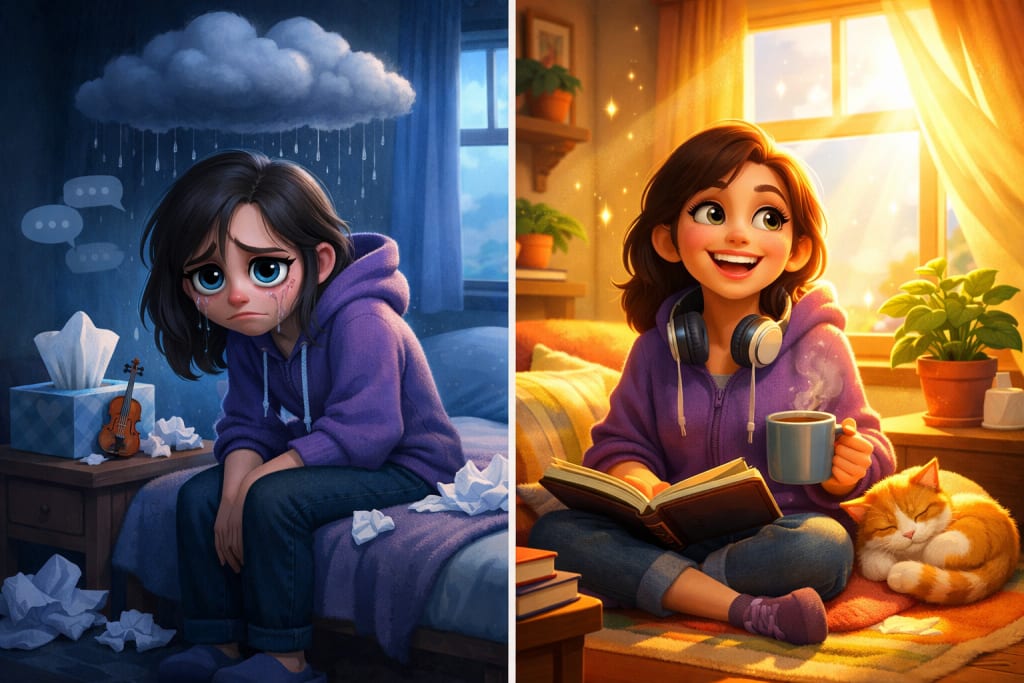
Solitude and loneliness are like the same knife resting in the same drawer same sharp edge, same shine, and same ability to cut. The difference is never in the metal. It’s in the hand that holds it and in the reason it’s being used. In the right hands, solitude becomes a precise tool it trims the noise, shapes the mind, and gives the soul room to breathe. In the wrong conditions, loneliness becomes a quiet wound it bleeds meaning out of a person while they’re still standing, still talking, still functioning, still smiling for the world.
People often treat “being alone” like a single category. But human experience doesn’t work that way. Being alone can feel like a calm room with a door you can open whenever you want. Or it can feel like a locked room where the handle is missing. That’s the simplest difference to start with
Solitude is aloneness you choose.
Loneliness is aloneness you suffer.
Solitude is the kind of silence you walk into on purpose. You shut the door, not because you hate people, but because you want to hear yourself again. Loneliness is the kind of silence that finds you and sits beside you like a stranger who refuses to leave sometimes even when the room is full of friends, family, coworkers, and notifications.
Solitude often carries a hidden sweetness. It’s not dramatic. It doesn’t beg for attention. It doesn’t scream. It simply clears space. When you step away from the constant motion of other people’s needs and expectations, your mind starts to settle. The inner fog thins. You notice details again your own desires, your true fears, the small hopes you’ve been ignoring because life was loud.
That’s why solitude can sharpen creativity. When noise drops, the brain stops fighting for survival and starts wandering freely. Ideas connect in odd, beautiful ways. You make decisions with less social gravity pulling at you. You stop living for applause. You remember the difference between what you actually believe and what you’ve learned to perform.
There’s also something deeply physical about healthy solitude. Your nervous system gets a break. The pressure to respond, to read signals, to keep up, to be “on,” eases. Your body unclenches. Your breathing becomes more honest. It’s not that people are a problem. It’s that constant interaction is work even when it’s good work and sometimes your system needs a quiet hour to recover.
But solitude has a shadow, and it shows up when solitude stops being a choice and starts becoming a hiding place.
When aloneness stretches too long, the mind can turn into a factory of worst-case scenarios. Thoughts stop being tools and start being loops. You replay conversations you never had. You predict rejection that hasn’t happened. You punish yourself for mistakes the world has already forgotten. That’s one of the strange tricks of prolonged isolation without other people, you lose certain mirrors. And without mirrors, even a small distortion in self-perception can grow.
Social skill is also like a muscle. It doesn’t disappear overnight, but it can weaken quietly. You avoid a gathering once, then twice, then ten times. You tell yourself its peace. But peace has a different taste than avoidance. Peace leaves you clearer. Avoidance leaves you smaller.
And somewhere in that shrinking space, loneliness begins.
Loneliness is not simply the absence of people. It’s the absence of connection. A person can be married and deeply lonely. A person can be surrounded by coworkers and feel invisible. A person can attend social events every weekend and still come home to the same emotional emptiness. Because loneliness is a feeling of disconnection like you’re living behind glass. You can see others. They can see you. But somehow, you can’t truly touch the moment.
Loneliness tends to change the body, too. It raises stress. It keeps your system in a subtle state of alert. Your brain starts reading neutral social signals as negative ones. A delayed reply becomes proof you’re not valued. A short message becomes evidence someone is angry. Loneliness trains the mind to interpret reality through a lens of threat, and once that lens is installed, everything looks harsher than it really is.
Still here’s the weird, almost poetic truth loneliness can sometimes be useful.
Not because it feels good. It doesn’t. But because it can act as an alarm. Loneliness is often your inner self saying something important is missing. Not “more people,” necessarily. Not “more attention.” Often it’s deeper than that you need safety. You need meaning. You need one or two relationships where you don’t have to perform. You need a place where your nervous system can relax in the presence of another human being.
Loneliness can expose shallow connections. It can reveal that your social life is crowded but not nourishing. It can push you to build something smaller but real a circle that holds you, not just a crowd that sees you.
This brings us to your question sharp and honest and a little dangerous
Is being single solitude, but divorce loneliness?
Sometimes it looks that way, yes. But it’s not a law of nature.
Being single often leans toward solitude because it can be chosen. It can be a deliberate season of building. A time to grow your career, heal your body, redefine your values, and explore your mind without compromise. Single life can be full if you have purpose and a few true connections. You can be single and not lonely at all. You can have friends, family, community, work, and a deep relationship with yourself.
But singleness becomes loneliness when it’s not chosen when it feels like rejection instead of freedom, like exile instead of space. It becomes loneliness when you have no reliable emotional “home base,” no one who knows you beyond your public version. It becomes loneliness when you feel unseen in a world that keeps moving.
Divorce often leans toward loneliness because it carries loss. Not just the loss of a person, but the loss of a shared routine and identity. Even when the marriage was painful, it was still a structure. Divorce removes the structure, and structure matters. It’s how humans feel safe in time. When the structure disappears, the days can feel unmoored. A person may suddenly realize that many social connections were attached to the marriage itself, not to them as an individual. That realization can hit like cold water.
There’s also grief sometimes obvious, sometimes disguised. Anger. Shame. Fear. The strange sense of failing at a story you thought would last. These emotions can make people withdraw right when they need connection most. And that’s a perfect recipe for loneliness.
But divorce is not automatically loneliness. Sometimes divorce is liberation from the most brutal form of loneliness being lonely inside a relationship. That kind of loneliness is vicious because it confuses the heart. You are not alone, yet you feel abandoned. You’re beside someone, yet you feel unseen. In that case, divorce can create a period of healing solitude a necessary quiet where you rebuild yourself without being emotionally starved every day.
So what determines the difference?
Not your relationship status. Not the label.
It’s this combination choice, safety, meaning, and community.
If your aloneness is chosen, supported, meaningful, and connected even lightly you’re in solitude.
If your aloneness is forced, unsafe, meaningless, and disconnected you’re in loneliness.
You can be single with choice and community and feel strong.
You can be married without safety and feel crushed.
You can be divorced with support and feel reborn.
You can be divorced without support and feel erased.
The universe is strange like that. Humans are not equations.
There’s a simple test that helps separate solitude from loneliness without overthinking it
Healthy solitude leaves you more connected to yourself now, and to people later.
Harmful loneliness leaves you less connected to yourself and to people, even when they’re available.
If you spend time alone and you come back clearer, kinder, and more capable of reaching out that’s solitude doing its job.
If you spend time alone and you come back heavier, more avoidant, less hopeful that’s loneliness tightening its grip.
The goal isn’t to eliminate being alone. The goal is to use it well.
Give solitude a schedule, so it stays a tool and doesn’t become a prison. An hour a day. A quiet morning each week. A walk where you don’t scroll. A small ritual of writing or prayer or reflection.
And protect yourself from loneliness with a “low-effort bridge” to other humans one trusted person you can text honestly, one small weekly meet-up, one simple check-in call that doesn’t require performance. When the mind starts spiraling, do two things write for ten minutes to empty the thoughts, then move your body for ten minutes to reset your nervous system. Loneliness thrives in stillness without direction. Motion and meaning disrupt it.
In the end, remember this
Loneliness isn’t a flaw. It’s a signal.
Solitude isn’t a luxury. It’s a skill.
And if you learn the difference, you stop fearing aloneness and you start steering it.
About the Creator
Sayed Zewayed
writer with a background in engineering. I specialize in creating insightful, practical content on tools. With over 15 years of hands-on experience in construction and a growing passion for online, I blend technical accuracy with a smooth.
Keep reading
More stories from Sayed Zewayed and writers in Humans and other communities.
The Silent Forces Of Leadership
The Human Element in Organizational Success If you look at almost any organization from the outside, the picture seems straightforward. There is a strategy, an organogram, a set of processes, some KPIs, and a collection of digital tools meant to keep everything under control. We talk about “systems” and “structures” as if they are the real heart of the institution. Yet anyone who has spent time inside a company, a government department, or a non-profit knows that the real story is much messier and much more human. The same structure can produce very different results depending on who is in the room, how they relate to each other, and what is happening inside their minds. The same policy can feel inspiring in one team and oppressive in another. The same technology can either empower people or quietly exhaust them. Underneath every chart and system, human psychology is quietly writing the script.
By Sayed Zewayed2 months ago in Humans
Time to change your life.
Is it even possible for you to change your life? A lot of people, more than there should be, are unhappy with their lives. But what are they doing about it? Usually nothing. People talk about how shitty their lives are and want change, but are they not taking the actions to change?
By Jen Phillips2 days ago in Humans
I’m Busy, But Not With Anything That Matters
I’m busy. Constantly. My calendar is full, my notifications never stop, and somehow none of it feels connected to anything I actually care about. It’s impressive, really—how much time I can spend doing things without moving an inch closer to the life I tell myself I want.
By Mind Leaks5 days ago in Humans



Comments
There are no comments for this story
Be the first to respond and start the conversation.