
The Filtered Self: When Authenticity Becomes Just Another Aesthetic
How the Pressure to be "Real" Online Created the Most Exhausting Performance of All
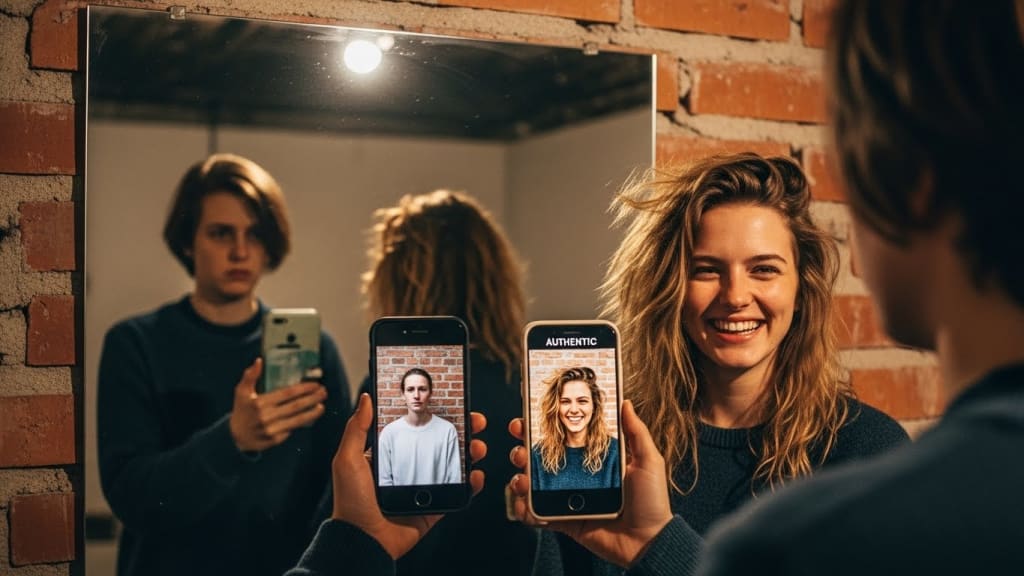
We graduated from the age of the highlight reel, or so we told ourselves. We grew tired of the perfect vacations, the flawless skin, the staged joy. A demand for "realness" rose like a collective sigh—a craving for stretch marks, for messy kitchens, for conversations about anxiety and burnout. But in the relentless economy of social media, nothing remains sacred for long, not even imperfection. Authenticity, the antidote we craved, has been co-opted, branded, and turned into the most sophisticated performance of all. We are now caught in a double bind, pressured not only to be extraordinary but also to perform our ordinariness in an extraordinary way. We’ve traded the prison of perfection for the maze of curated authenticity, and the path to our genuine selves has never felt more confusing, or more exhausting.
The new script is deceptively simple: Be relatable. Be vulnerable. Be real. But online, these human qualities are immediately commodified. A photo of a cluttered desk isn't just a cluttered desk; it's a #messyauthentic or #creativechaos post, signaling a busy, productive mind. A caption about a bad mental health day is carefully crafted—not a raw, unfiltered scream into the void, but a poignant, paragraph-long reflection with a hopeful turn at the end, often tagged with #selfcare or #endthestigma. The stretch marks are shown, yes, but in beautiful, soft lighting, with a pose of defiant pride. The "real" has become a genre, complete with its own visual filters (less saturation, more grain), its own vocabulary, and its own metrics for success. The goal is no longer to hide the mess, but to display it artfully. The vulnerability must be palatable, packaged, and ultimately, likable.
This creates a brutal, invisible pressure. Where once we felt insecure about not being glamorous enough, we now feel insecure about not being authentic enough. Is my burnout caption compelling? Is my "no-makeup" makeup actually convincing? Did I share a "flaw" that is quirky and endearing, or one that is truly, socially risky? We audit our own lives for moments of "shareable realness," turning our private struggles and mundane moments into potential content. The act of living becomes a constant casting call for the role of "Your Most Authentic Self." The self-awareness is paralyzing. You can't simply cry; a part of you observes the crying and considers its narrative potential. You can't simply be overwhelmed; you subconsciously frame the overwhelm for its relational value.
This performance is uniquely draining because it masks itself as relief. It feels like shedding armor, but it's just swapping one costume for another. The "perfect life" costume was heavy, but the "beautifully flawed human" costume comes with its own intricate set of stage directions. It demands we mine our personal pain and daily stumbles for connection currency, blurring the line between genuine sharing and emotional exhibitionism. The most intimate parts of the human experience—failure, doubt, insecurity—are turned into public artifacts, to be displayed, validated, and then scrolled past.
The ultimate casualty is true, private authenticity—the kind that exists without an audience, without a like button, and without a narrative arc. It's the unobserved, ugly cry in the shower that no one will ever know about. It's the silent, un-photographed contentment of a Tuesday night with a book. It's the insecure thought you have and wrestle with internally, without ever articulating it into a tidy tweet. This private realm is where we actually process our lives, where we are unselfconscious, where we are not a character in our own story. By constantly funneling our experiences into the public performance of "realness," we risk emptying out this private, sacred space. We start to lose the ability to just be a mess, without needing to present it.
Finding a way out of the authenticity trap requires a radical commitment to the unobserved life. It means consciously creating experiences and holding emotions that are for you alone. It involves asking, before sharing, "Will posting this deepen my connection to others, or will it just turn my genuine feeling into content?" It means sometimes having a profound thought and letting it marinate in your own mind, rather than instantly drafting a thread. It means letting your kitchen be messy without proving it, having a bad day without documenting it, and celebrating a small joy without broadcasting it.
Real authenticity isn't an aesthetic. It's a private agreement you make with yourself to feel what you feel, without immediately shaping it for public consumption. It’s the courage to be uncurated, to exist in the blurry, un-framed, offline moments where there is no audience, no performance, and no metric—just the quiet, complicated, and utterly real experience of being you. The most authentic version of yourself isn't the one you post. It's the one that exists when the apps are closed, the camera is off, and the only "like" that matters is your own peace with the beautiful, imperfect, and unseen reality of your life.
About the Creator
HAADI
Dark Side Of Our Society
Time to change your life.
Is it even possible for you to change your life? A lot of people, more than there should be, are unhappy with their lives. But what are they doing about it? Usually nothing. People talk about how shitty their lives are and want change, but are they not taking the actions to change?
By Jen Phillips4 days ago in Humans
Beige with approved phrases
The call center is painted in optimistic colors. Not bright enough to be cheerful, not soft enough to be calm. The walls are a kind of beige that suggests coffee with too much creamer. Someone chose it after a meeting, after a vote, after a PowerPoint about productivity and mood. The color is meant to make people steady. The color is meant to make people stay.
By shallon gregerson6 days ago in Humans
Off the Book
It ended like every other stupid idea. Badly, and alone. I’m researching digital confession ethics, he said. A tech ethicist. He gestured at floating data I couldn’t see then pulled out a physical notebook. Actual paper, fountain pen. He held it up like he was showing me scripture.
By Nicky Frankly5 days ago in Fiction




Comments
There are no comments for this story
Be the first to respond and start the conversation.