

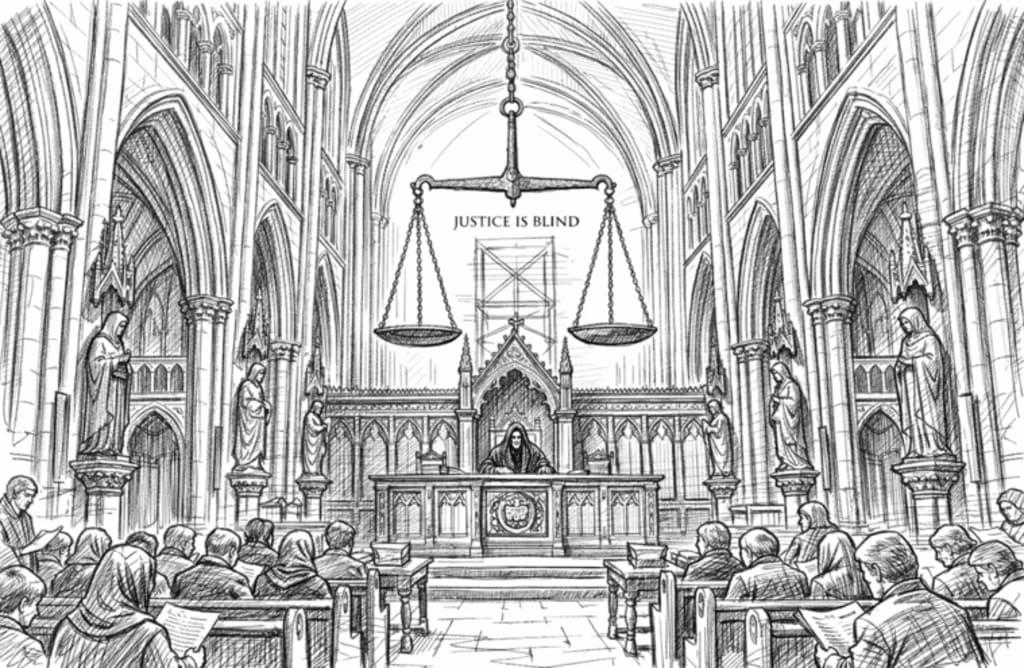
The courthouse looms at the town’s center like a tomb that refuses to stay closed, a monument of cold marble and older secrets. Its columns do not merely support a roof; they form the ribcage of an idea—that human suffering can be bled out, measured, and bottled in the name of peace. Above the bench, the scales hang like the iron skeleton of a trapped bird, eternally suspended in a room that smells of dust and the metallic tang of old fear.
Inside, the light is sickly, filtered through windows that swallow more sun than they release.
Paper flutters through the galleries like the leathery wings of bats, restless and blind, seeking a place to roost. Files slide from desk to desk with the sound of dry scales dragging over stone. Names are summoned from the gloom that pull souls into the light just long enough to be branded. The system does not hum; it breathes with the heavy expansion of a beast that has outlived its creators and grown fat on their progeny.
The scales remain suspended, perfect in their symmetry.
But symmetry is not balance.
The imbalance arrives first as a chill — a draft from a crypt left slightly ajar. A man stands before the bench, a sacrificial figure in a suit that does not fit. He is there because he could not pay a tribute. The debt exists because he lacked the coin to shield himself. The lack of coin exists because his life was pruned by the very shadow he now stands in. Each link is a shackle, forged in a law that values the metal more than the wrist it breaks.
The system does not hear the weeping of the damned; it tallies only the weight of their chains.
In the hallways, families huddle on benches of ancient cedar, wood polished to a mirror sheen by generations of desperate prayers. They sit folded like fallen umbrellas, clutching paperwork they cannot decipher — scrolls written in a dead tongue: Continuance. Dismissed. It Is Ordered. Failure to Appear. These are not words; they are curses, syllables that drain the color from a life. A mother whispers to her son to “just tell the truth,” unaware that truth is a ghost in this house, and ghosts have no standing here.
Truth, in this darkness, must be carved to fit a narrow mold.
It must arrive on time, signed in the black ink of confession, supported by a history that has survived eviction and loss. It must speak the guttural grammar of the submissive. What cannot be translated is treated as a void — a silence where a heart used to be.
The benches remember what the scrolls omit: the tremor of a hand passing a citation like a death warrant, the frantic math of a man choosing between a meal and a fine, the way shoulders curve inward as if trying to vanish before the Great Eye.
Outside, the town continues its oblivious dance. The river crawls past the cypress knees, dark as hemlock. But inside, the current is predatory — a slow black tide that pulls lives under, step by step, through a ritual designed for containment rather than salvation.
The scales remain suspended, mocking in their symmetry.
But symmetry is the balance of the grave.
True balance would require the system to weigh the shadows it creates: the missed shift that becomes a hungry child, the miles walked in rain, the silence of a disconnected line, the inheritance of poverty passed from father to son like a bloodborne fever. These weights never reach the iron scales. They remain in the pockets of the hollowed-out, in the long walk home through a town that no longer recognizes their right to move.
The system records the harvest. It does not record the rot.
And so the Great Machine grinds on — ancient, hungry, composed — turning human complexity into ash and case numbers. Behind the bench, the seal remains fixed, its promise a cold comfort to those already consumed by the dark.
The system does not ask how poverty breathes; it asks only whether the fine was paid.
The scales remain suspended.
Perfect in their symmetry.
But symmetry is not balance.
In the rafters, bats cling like black punctuation, their thin bodies folded into the architecture of neglect. They wake when the doors are locked and the last oath has dissolved into dust. Then the real commerce begins. In rooms without windows, where the air smells of old paper and warmer breath, envelopes pass from palm to palm — soft, practiced movements, the choreography of discretion. No receipt is issued. No docket reflects the exchange. Only the faint rustle of wings above, as if the darkness itself were taking note.
Justice is blind, it declares.
But blindness, in a place like this, is not the absence of sight.
It is the deliberate closing of the eye to what never reaches the scale.
Inside the courtroom, truth is strained through procedure until only the pulp remains.
No one intends harm. The machinery intends order.
Order demands a uniform weight.
It assumes a dollar bruises every palm the same,
that an hour lost to a docket rots equally in the gut of the executive and the laborer,
that transportation is a certainty, never a wager against rain and distance.
The scales hang in perfect symmetry.
What is measured is not what is suffered.
Outside, the flag snaps in a wind that smells faintly of the river.
Cars pass.
The town continues its shallow breathing.
Inside, a plea is entered to avoid the unknown. A fine is assessed — numbers small enough to whisper hope, yet large enough to fester. A probation term begins, measured in months that will stretch across missed shifts, darkened doorways, and children learning to be quiet when the phone is disconnected. It is the slow, private arithmetic of erosion.
The system records compliance.
It does not record cost.
It does not record the envelopes opened like wounds in rooms without windows,
nor the soft, papery stirring in the rafters — bats loosening their grip,
blind archivists of the night, their wings sifting the air above bargains that leave no stain the morning will admit.
This misalignment is not a failure; it is a digestion.
Lives become case numbers.
Hardship becomes noncompliance.
Fear becomes silence.
And silence becomes consent carved into the record.
The language of the court is precise, but precision can flense truth to the bone. What spills beyond the margins — the why, the how, the fragile scaffolding of a life held together by hourly wages and borrowed mercy — is swept away as excess.
The scales remain suspended, flawless in their geometry.
But symmetry is not balance.
Symmetry is the stillness of the grave.
True balance would require the system to weigh what it creates: the missed shift that becomes hunger, the miles walked in rain that soaks through dignity, the inheritance of poverty passed like a fever through bloodlines. These weights never touch the iron. They remain in the pockets of the hollowed-out, heavy as stones carried into deep water.
It measures only what it can hold.
It discards what refuses to drown.
In the quiet between cases, dust motes drift through the light like ash. The room appears calm, orderly, resolved — the way a field appears peaceful after the harvest, when nothing living remains to object. The seal behind the bench does not change. Its promise holds fast for those who can afford to believe in it.
"Justice is blind," it declares again, this time louder
As if in the blindness lies the appetite.
Not an absence of sight,
but a refusal to see the bodies beneath the scale.
About the Creator
Ginny Brown
My writing is grounded in lived experience, legal accuracy, and a commitment to equity, with a focus on ethical storytelling that illuminates systemic challenges and amplifies unheard voices.
Keep reading
More stories from Ginny Brown and writers in Humans and other communities.
How Himalayan Salt Wall Relieves Sinus Problems Naturally?
Problems of sinus are extremely frequent nowadays. Nose is blocked, forehead exerts pressure, headache, and difficulty in breathing are observed in many people. These problems are aggravated by weather change, dust, pollution, and allergies. Pharmaceuticals are capable of assisting, but they remove the symptoms temporarily. It is due to this that individuals are seeking natural remedies that are safe and mild. Himalayan salt wall is one of such natural methods that are highly preferred in homes, spas, and even therapy rooms. It creates a light and calm environment that prefers smooth breathing.
By david smith2 days ago in Humans
No Word Comes Near Enough
The English language has its limits. I learned this when I became a student of the Bible and looked up the Greek and Hebrew definitions behind the Scriptures I loved. Some languages have so much more depth and power than the one I use to convey my thoughts. But, even so, I don't think any word could ever come close to describing this void and pain I am journeying through. I don't know how to swim through its murky waters.
By Shirley Belk3 days ago in Poets



Comments
There are no comments for this story
Be the first to respond and start the conversation.