
The Disappearance of Common Sense (As Told by Warning Labels)
By Underwhelming Staff Reporter, The Pompous Post

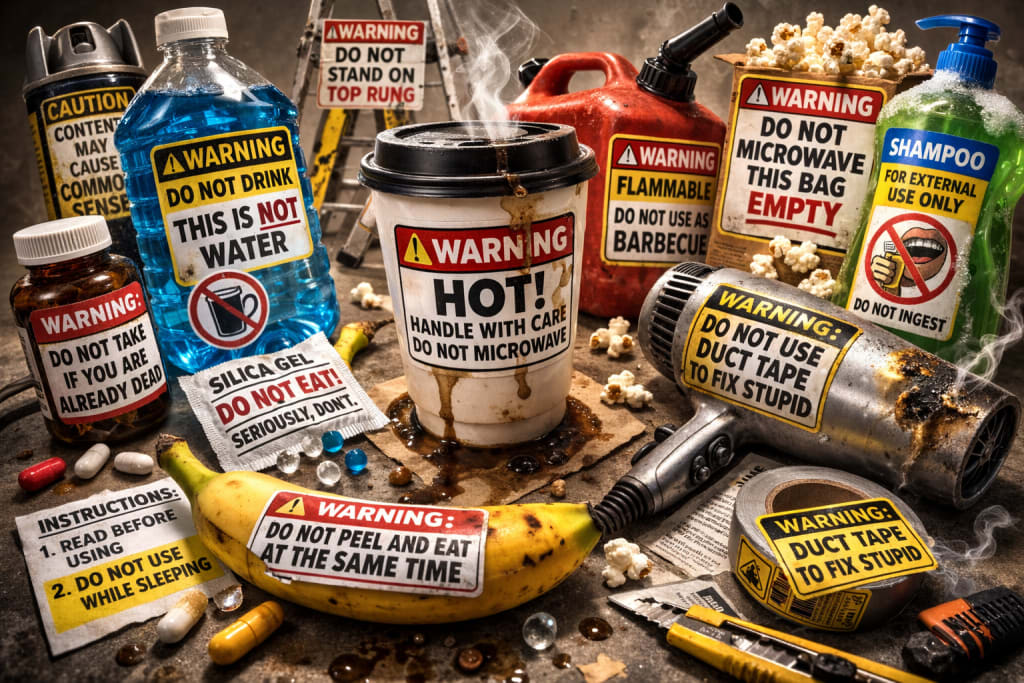
There was a time when products trusted us to use them correctly. A ladder did not need to remind us not to stand on the very top rung. A candle did not feel compelled to clarify that fire, historically speaking, is hot. Shampoo did not warn us that it was not to be consumed as a breakfast smoothie.
There was an unspoken agreement between humanity and household goods. You exist… I exist… Let’s both behave accordingly. Somewhere along the line, that agreement collapsed.
Today, the modern product label reads less like guidance and more like a deposition transcript.
- “Do not ingest.”
- “Not intended for internal use.”
- “Remove child before folding stroller.”
- “Do not iron while wearing.”
Each of these warnings suggests something deeply unsettling. Not that the manufacturer is overly cautious, but that someone, somewhere, required that much-needed clarification.
The Great Warning Inflation
We are living in the Golden Age of Caution. Buy a cup of coffee, and it will inform you, solemnly, that it is indeed hot! Purchase a lawnmower, and it will remind you not to use it as a hairstyling device, or to insert an appendage near it while running. Purchase fireworks, and they will gently discourage you from holding them in your hand or pointing them at another, in the spirit of experimentation.
These warnings did not materialize out of thin air. They were earned, like battle scars. Except for fewer Romans and more dismay. Somewhere in corporate legal offices across the nation, a meeting occurred. A hand was raised, and someone said, “We need to clarify that this is not… (fill in the blank).”
The Legalization of Obviousness
The modern warning label is not necessarily about safety; it’s more about precedent. Manufacturers no longer assume you possess instincts. They assume you possess a lawyer and good insurance.
The result is packaging that reads like it was drafted by a panel of exhausted attorneys who have seen things. You can almost hear their trauma between the lines:
- “Do not submerge in water.”
- “Not a flotation device.”
- “For external use only.”
- “Do not attempt to dry pets in microwave.”
That last one should not exist. And yet…
The Internet Effect
We would be remiss not to address the digital elephant in the room. There was a moment in recent cultural memory when brightly colored household cleaning products required public clarification that they were not, in fact, candy.
Let that sentence breathe… like a fine wine. Entire corporations had to issue statements confirming that detergent was meant for laundry. This part is not satire, sadly. This is documentation.
The internet did not invent foolishness. It amplified it. It gave it lighting. It gave it background music. It monetized it. And once enough people broadcast poor decisions in high definition, product labels began to panic.
The Rise of Defensive Packaging
Walk down any aisle and read carefully.
You will find:
- Silica packets that beg you not to eat them.
- Extension cords that insist they are not jump ropes.
- Hair dryers that discourage use while sleeping.
Did you hear what I just said? Hair dryers… Sleeping. How does that even… You know what, I don’t want to know.
We have reached a point where packaging must assume that at least one person will attempt to nap beneath a running appliance. The problem is not that warnings exist. The problem is that they are necessary. If you subscribe to the ideology of Darwinism, one begins to wonder how we made it out as a species.
The Erosion of Instinct
When did basic reasoning become optional equipment? At what moment did we outsource self-preservation to bold red font?
We have labels reminding us not to drink bleach, not to swallow batteries, not to consume decorative beads, and not to operate heavy machinery while under the influence of substances that make heavy machinery sound like a good idea.
Once upon a time, these were not instructions; they were basic instincts. Now they are disclaimers… Go figure.
The Cultural Shift
Common sense was never taught in school; it was absorbed. You learned not to touch the stove because it burned. You learned not to eat random objects because your body objected violently.
Today, the stove comes with a booklet. The object comes with a QR code. And somewhere, someone is still confused. This is not about intelligence. It is about accountability.
We have created a culture where responsibility is negotiable, but liability is not. So the label grows longer. The font grows bolder. The instructions grow more specific.
“Do not use the product as intended in an unintended manner.”
That sentence exists in the wild somewhere...
A Modest Proposal
If we are to continue down this road, let us at least be honest. Let us label everything.
Oxygen: “For breathing only.”
Water: “Do not inhale recreationally.”
Gravity: “Will cause falling.”
Common Sense: “Not included.”
Perhaps then we will reach a point of common understanding. Or perhaps we will simply add another paragraph to the packaging. You can’t have everything.
Final Thoughts From the Warning Aisle
Warning labels did not replace common sense. They revealed how fragile it always was. They are not the problem; they are the evidence.
The next time you see a product advising you not to do something that would require extraordinary imagination to attempt, pause… Read it carefully. And consider this:
Somewhere in a conference room, a lawyer insisted that the line be added. Because someone, somewhere, at some point… tried it.
About the Creator
The Pompous Post
Welcome to The Pompous Post.... We specialize in weaponized wit, tactful tastelessness, and unapologetic satire! Think of us as a rogue media outlet powered by caffeine, absurdism, and the relentless pursuit to make sense from nonsense.
Keep reading
More stories from The Pompous Post and writers in Humor and other communities.
The Lie of Rich Corinthian Leather (And Other Things We Believed Because a Man With an Accent Said Them)
There was a time when a man could look into a camera, gently stroke a car seat, and convince an entire nation that luxury had a birthplace. That place was Corinth… Or so we were told.
By The Pompous Post5 days ago in Humor




Comments
There are no comments for this story
Be the first to respond and start the conversation.