
The One Who Measured the Wind
When preparation meets ego, even intelligence can’t outmaneuver gravity

Everyone in Cedar Hollow knew that if you wanted something done properly, you asked Mara Ellison.
She was the kind of person who color-coded her grocery lists and labeled the labels. When the town’s Fourth of July fireworks malfunctioned three summers in a row, it was Mara who redesigned the launch grid with a spreadsheet and a level. When the school board’s Wi-Fi went down, she bypassed the firewall with three keystrokes and a sigh.
Mara was precision. Mara was preparation. Mara was the person you called before you called anyone else.
Her older brother, Owen, was not.
Owen believed in momentum. He believed in instinct. He believed that if you ran fast enough at a problem, physics would politely step aside.
When they were children, Owen once tried to “parachute” off the barn roof using a king-size bedsheet and two fishing poles. Mara responded by tying a sack of potatoes to the sheet and tossing it off first. The potatoes did not glide. They cratered.
He tried to build a homemade flamethrower out of a leaf blower and a can of lighter fluid. Mara built a scale model from cardboard and demonstrated, in vivid detail, how quickly the siding of their house would ignite. He abandoned the project.
Most of the time, that was enough. A prototype. A controlled experiment. A small, survivable catastrophe.
Owen learned visually.
But the summer he turned twenty-eight, he decided to fly.
Not metaphorically.
Literally.
“It’s not flying,” Mara said, staring at the heap of fabric and aluminum rods in the garage. “It’s falling with confidence.”
“It’s powered descent,” Owen corrected. “I’m building a paramotor.”
He said it the way someone might say they were building a bookshelf. Casual. Reasonable. Completely detached from the fact that powered descent involves gravity and regret.
He had done his research. He showed her videos from YouTube of smiling men lifting off from grassy fields. He cited statistics from Federal Aviation Administration about ultralight classifications. He used phrases like thrust-to-weight ratio and airfoil efficiency.
He had spreadsheets.
Mara felt a flicker of pride. Then dread.
“Where exactly,” she asked carefully, “do you plan to test this?”
Owen pointed toward the ridge that overlooked Cedar Hollow. A steep incline. A clear drop. A perfect launch point—if you were a bird.
“You can’t just run off a cliff with a lawn chair strapped to your back.”
“It’s not a lawn chair. It’s a harness system.”
“It looks like patio furniture.”
“It’s aerospace-grade aluminum.”
“From where?”
“Online.”
That was not reassuring.
Mara did what she always did. She ran simulations. She calculated wind speed averages for late August. She borrowed an anemometer from the high school science lab. She measured gust patterns at different times of day.
For two weeks, she tried logic.
“What if the wind shifts?”
“I’ll adjust.”
“What if the engine stalls?”
“I’ll glide.”
“What if you panic?”
“I won’t.”
“What if you’re wrong?”
He smiled. “You’ll be there.”
And that was the problem.
On the morning of the launch, half the town showed up. Word travels fast when someone intends to defy gravity behind the hardware store.
A few teenagers were livestreaming on TikTok. Someone had brought lawn chairs. Old Mr. Halpern sold lemonade from a cooler, as if this were sanctioned entertainment.
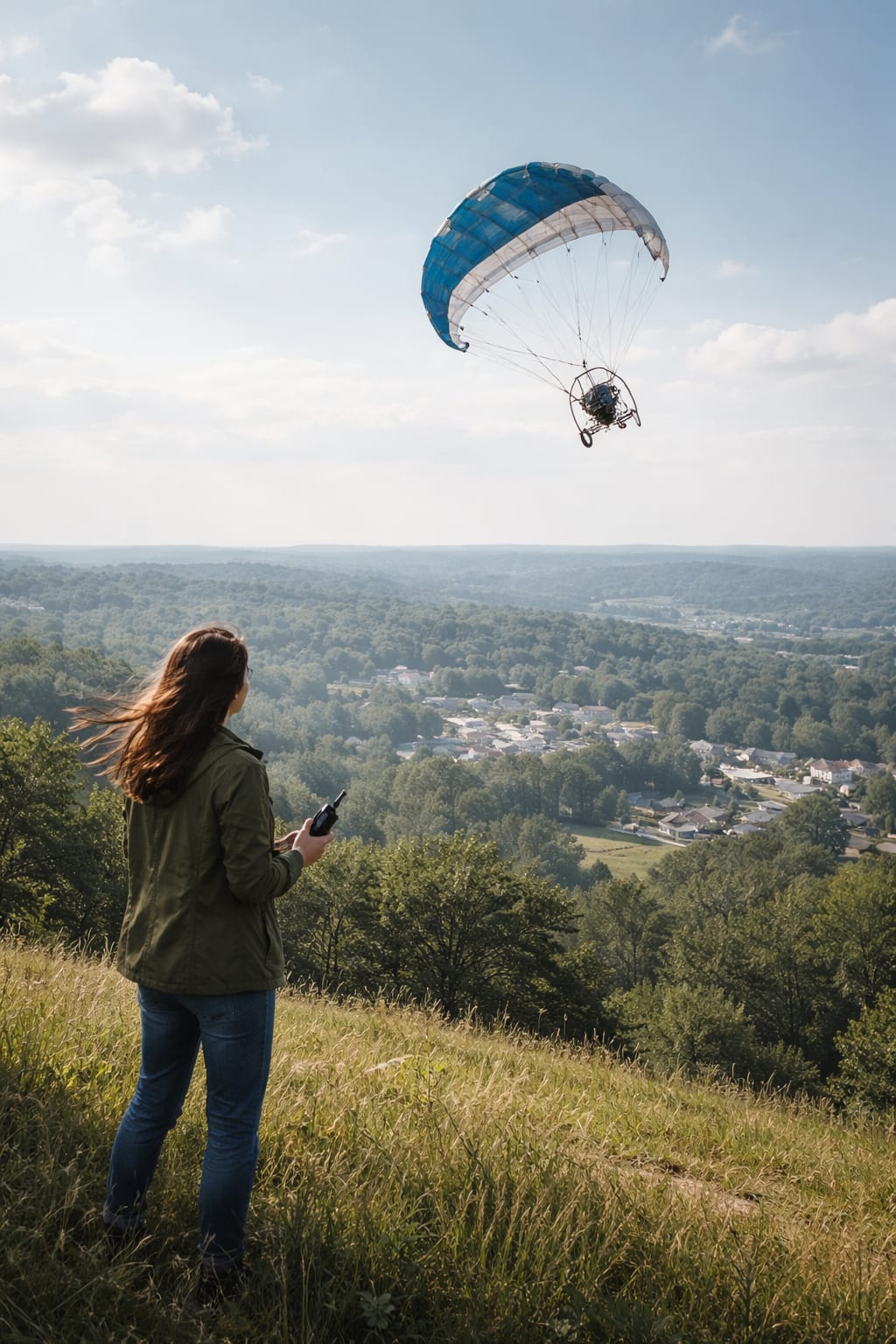
Owen strapped himself into the harness. The propeller cage hummed behind him. The fabric wing—blue and white—lay stretched across the grass like something waiting to wake up.
Mara stood beside him holding a handheld radio.
“At least let me monitor altitude,” she said.
“I knew you’d want a job.”
“This isn’t a job. This is damage control.”
He grinned. “Same thing.”
The engine roared to life. The wing inflated overhead, trembling in the morning wind.
“Wind speed is fluctuating,” Mara said into the radio. “Twelve miles per hour, gusting to eighteen.”
“I can handle eighteen.”
“That’s what everyone says about eighteen.”
He began to run.
At first, it looked absurd. Like a man chasing a bedsheet. Then the wing caught properly. The lines tightened. The harness lifted.
And Owen left the ground.
For one breathless second, he hovered three feet above the grass. Then six. Then fifteen.
The crowd erupted.
“He’s actually doing it,” someone whispered.
Mara watched the angle of ascent. Too steep.
“Owen, ease the throttle,” she said into the radio.
“I feel great!” he shouted back. “I’m flying!”
“You’re climbing too fast.”
“I’ve got it.”
A crosswind hit from the left. The wing tilted. The paramotor drifted toward the tree line.
“Owen, correct right. Now.”
“I see it.”
He overcorrected.
The wing wobbled violently.
From the ground, it looked almost graceful—like a kite dancing.
From Mara’s vantage point, it was chaos geometry.
“Owen, stabilize.”
The engine sputtered.
Just once.
A sound so small most of the crowd didn’t notice.
Mara did.
“Owen, what was that?”
Silence.
Then: “Okay. Small issue.”
“That’s not a sentence I enjoy.”
“Engine hiccup.”
Altitude: forty-three feet.
Over trees.
“Restart procedure?” she demanded.
“Working on it.”
The propeller coughed again. Then went quiet.
The sudden absence of noise was worse than the roar.
Now there was only wind.
The wing folded slightly on one side.
“You need forward speed,” Mara said, her voice clipped and surgical. “Shift weight. Keep tension.”
“I’m trying.”
From below, someone gasped.
The paramotor began to descend—not in a glide, but in an argument with gravity.
“Owen.”
“I’m okay.”
“You are not okay. You are thirty feet above an oak tree.”
“I see the oak tree.”
“Do not introduce yourself to the oak tree.”
The wing collapsed further on the left. The descent accelerated.
For one suspended moment, everything was quiet. Even the crowd.
Then Owen disappeared into the canopy.
Leaves exploded outward. Branches snapped. A blue-and-white fabric sagged between limbs like defeated laundry.
Mara did not run.
She walked.
Fast. Direct. Controlled.
By the time she reached the tree line, Owen was hanging upside down in his harness, suspended ten feet above the ground. The paramotor frame was wedged securely between two thick branches.
He blinked at her.
“Well,” he said, “that’s not ideal.”
She stared.
“Are you injured?”
“My pride.”
“Anything structural?”
“Define structural.”
She exhaled sharply. “Bones.”
“I don’t think so.”
Above them, the wing rustled like it was embarrassed to be involved.
The fire department arrived shortly after. So did two deputies from the county sheriff’s office.
As it turns out, launching an unregistered ultralight aircraft from municipal land without clearance violates approximately six local ordinances and at least one federal guideline outlined by the Federal Aviation Administration.
Mara knew about wind shear.
She knew about load distribution.
She knew about fabric tensile strength.
She had not, unfortunately, researched municipal code.
An hour later, she and Owen sat side by side on the tailgate of a sheriff’s truck, wrists zip-tied loosely in front of them while paperwork was completed.
The paramotor hung in the tree behind them like modern art.
“I almost had it,” Owen said.
“You almost had a concussion.”
“I was flying.”
“For eight seconds.”
“That’s longer than zero.”
She looked at him—hair full of leaves, grin undamaged.
“You are exhausting.”
He nudged her shoulder. “You were amazing, by the way. Very calm. Very commander-in-chief.”
“You’re grounded.”
“I was.”
She closed her eyes.
The deputy approached with a clipboard. “You two are lucky,” he said. “Another ten feet and we’d be calling an ambulance.”
Mara nodded.
As they were led toward the cruiser, Owen leaned closer.
“So,” he whispered, “next time, maybe we register it first?”
She stared straight ahead.
“Next time,” she said evenly, “we buy a kite.”
Sometimes, intelligence prevents disaster.
Sometimes, it simply ensures you understand it in high resolution.
And sometimes, even the person who measures the wind forgets to check the law.
About the Creator
Plain Pasta, Part 2
I met Kira at the entrance of the 12-story building where the Italian rented his apartment and went up to the sixth floor. The building itself was notable — one of the few high-rises in central Bishkek built from an individual design rather than a standard Soviet brutalist blueprint. For those of us raised in cramped five-story blocks and Khrushchev-era apartments for the proletariat, it was intriguing just to see the inside. “At least for that reason, the evening won’t be wasted,” I decided.
By Lana V Lynx2 days ago in Humor



Comments
There are no comments for this story
Be the first to respond and start the conversation.