
Orchestrating Change: Eunwha Kang and the Evolving Landscape for Women Composers
“I gradually came to realize that when the music I composed was understood and embraced by others—and when the musical elements aligned with the meaning I wanted to convey—that’s when I felt, ‘Maybe this is a good piece,’ said Kang. "Music, after all, is about sharing emotion and intention.”

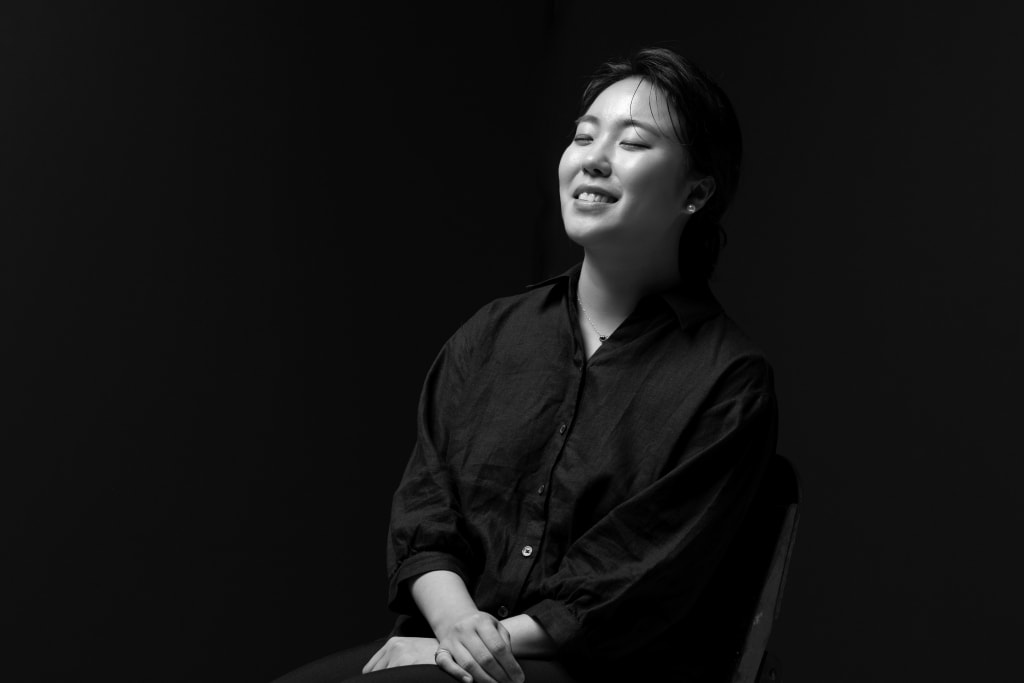
In the traditionally male-dominated world of classical composition, voices like that of Dr. Eunwha Kang are not just adding to the rich tapestry of contemporary music but also prompting profound conversations about gender, perception, and creative authenticity. Having recently earned her Doctor of Musical Arts in Composition from Texas Tech University in May 2024, Dr. Kang stands as a testament to perseverance and artistic integrity, blending diverse cultural influences and advocating for a more inclusive future in music.
Dr. Kang’s doctoral dissertation, "Requiem for Mixed Choir, Soloists, Cello, Timpani, Percussion, and Fixed Media," exemplifies her innovative approach, showcasing an original music composition alongside its rigorous analysis. This monumental work builds upon a solid academic foundation, including a Master of Music in Composition from Missouri State University, where her thesis, "Missa Brevis for Mixed Choir, Horn, Trumpet, and Trombone," further demonstrated her command of large-scale choral and instrumental works. Her foundational studies were completed at Sookmyung Women’s University in South Korea, providing a unique cultural lens that informs much of her current work. Complementing her compositional prowess, Dr. Kang also holds a Music Technology & Media Skills Certificate from Texas Tech University, reflecting her commitment to contemporary musical practices.
Beyond her academic achievements, Dr. Kang is a seasoned music educator and performer. Her professional teaching experience spans various institutions, including Midland College and the University of Texas Permian Basin, where she served as an Adjunct Professor of Music, specializing in Class Piano. At Texas Tech University, she took on the role of Instructor of Record for Aural Skills and Contemporary Music, alongside extensive work as a Graduate Teaching Assistant both there and at Sookmyung Women’s University. Her pedagogical reach extends to master classes in music theory and piano at Odessa College, and she has frequently lent her expertise as an adjudicator for competitions, shaping the next generation of musicians.
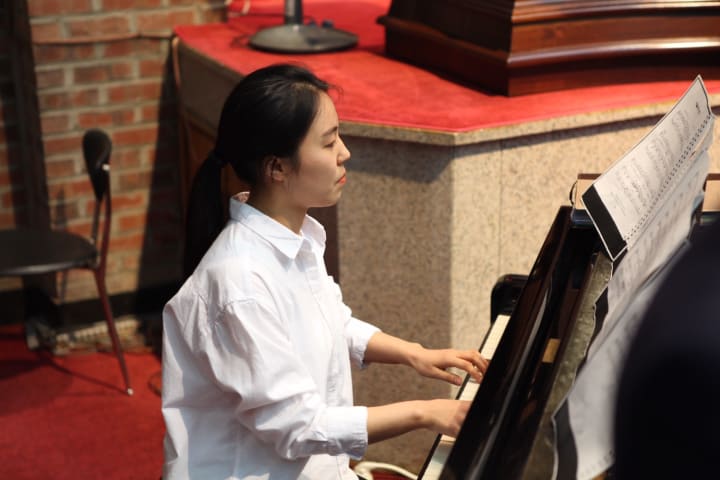
A prolific composer, Dr. Kang’s portfolio boasts numerous commissions and publications. Her recent compositions include "An Endless River Flows" (2025), the aforementioned "Requiem" (2024), "Song of the Bow" (2024), and "Stand Still" (2024). A distinctive characteristic of her compositional style is the artful fusion of Korean and Western musical idioms, vividly exemplified in pieces like "Sinaui" (2024).
This cross-cultural dialogue imbues her works with a unique depth and resonance, garnering presentations by choirs and orchestras across the United States and internationally. Her commitment to bringing music into diverse communities is further underscored by her roles as a composer-in-residence for churches such as Atlanta Promise Church in Georgia and New Covenant Fellowship Baptist Church in Virginia, where she has created original music for youth and worship services.
As a versatile musician, Dr. Kang is also an accomplished pianist and organist, frequently performing as a collaborative pianist for institutions like the Midland College Choir and Texas Tech University choirs, in addition to her extensive involvement as a church pianist. Her remarkable achievements have been recognized through numerous awards and honors, including a Graduate Teaching Assistantship at Texas Tech University, accolades from Missouri State University, and a prestigious award from the National Chorus of Korea. She is an active member of several professional organizations, including the Society of Composers, Texas Music Educators Association, and the American Guild of Organists.
In an exclusive interview, Dr. Kang shared her insights into the challenges and triumphs of being a woman composer, echoing the historical struggles while offering a hopeful vision for the future.

The Historical Echo: Why So Few Women Composers?
Addressing the persistent question of underrepresentation, Dr. Kang articulated, “Historically, women were often seen more as performers or educators rather than creators, and especially in the field of composition, entering the profession itself felt difficult. While things have improved and many women composers are now actively expressing themselves through their music, it is still not easy to find role models or mentors. Although the number of active women composers is gradually increasing, I believe there is still a lot of progress to be made, both structurally and culturally.”
Her observations resonate with the historical narrative of women in music. From the Middle Ages, with female figures in music like Hildegard of Bingen (1098-1179) producing liturgical chants and dramas, to the Renaissance, where Maddalena Casulana (1544-1590) notably became the first woman to have her music published under her own name, women have consistently contributed despite immense barriers. The Baroque era saw prolific composers such as Barbara Strozzi (1619-1677) and Francesca Caccini (1587-1645) excel in vocal and dramatic music, as well.
The Classical and Romantic periods, while producing giants like Fanny Mendelssohn Hensel (1805-1847) and Clara Schumann (1819-1896), often saw their recognition overshadowed by male counterparts. Moving into the 19th and 20th centuries, pioneering figures such as Amy Beach (1867-1944), Florence Price (1887-1953), and Ethel Smyth (1858-1944) broke crucial ground in symphonies, concertos, and chamber music, enduring significant societal biases.
Even in the contemporary era, while names like Finnish composer Kaija Saariaho and American composer Jennifer Higdon have received critical acclaim, the path to widespread recognition remains fraught with challenges.
Throughout history, women composers consistently faced obstacles, including limited access to formal musical education, societal expectations that discouraged professional careers in music, a pervasive lack of recognition and opportunities for performance and publication, and outright stereotyping and bias that undervalued their musical contributions.

Cultivating Trust in the Creative Voice
For any artist, trusting one's creative output is paramount. Dr. Kang shared her personal journey of developing confidence in her musical writing: “Through conversations and collaborations with many performers, I gradually came to realize that when the music I composed was understood and embraced by others—and when the musical elements aligned with the meaning I wanted to convey—that’s when I felt, ‘Maybe this is a good piece.’ Music, after all, is about sharing emotion and intention.”
She emphasized the deep connection between personal expression and audience reception. “I especially noticed that when I tried to express my own feelings or personal stories honestly through music, the audience responded more deeply. Those moments helped me grow confidence and trust in myself as a composer.” This insight underscores the profound interaction between composer, performer, and audience, highlighting how validation from collaborators and listeners can solidify a composer's conviction in their unique voice.

Empowering the Next Generation: Advice for Aspiring Women Composers
When asked for advice for aspiring women composers, Dr. Kang offered wisdom rooted in authenticity and collaboration. “As a contemporary composer, don’t feel pressured to always write something groundbreaking or radically innovative,” she said.
“Instead, start by asking yourself what you feel and what story you want to tell. I believe the most important thing is to express those thoughts and emotions honestly through your music. Do the music you truly want to do.”
This advice liberates aspiring composers from the burden of constant novelty, advocating instead for genuine self-expression. She also stressed the invaluable role of collaboration: “I encourage composers to communicate and collaborate closely with performers. When you show respect and trust in them, they’ll do the same for your music and try their best to bring it to life. Music is something we build together, and those relationships can truly enrich your work.”
This collaborative spirit, so central to her own process, serves as a powerful reminder that music is often a collective endeavor, brought to life through mutual respect and shared artistic vision.
Despite historical adversities, women composers have persevered, leaving an indelible legacy of musical works. Dr. Eunwha Kang, with her rich academic background, diverse compositional output, extensive teaching experience, and profound insights into the creative process, represents the vibrant present and promising future of women in music. Her journey not only enriches the contemporary musical landscape but also inspires continued efforts to promote gender equality and diversity, ensuring that the invaluable contributions of women composers are celebrated and etched into the annals of musical history for generations to come.
Follow Eunwha Kang on Instagram @eunwhakang.
About the Creator
Lisa Rosenberg
I am a writer based in New York City writing about artists, creative leaders and entrepeneurs.
Keep reading
More stories from Lisa Rosenberg and writers in Interview and other communities.
Beyond the Ribbon: Mauren Maurer Redefines Equestrian Excellence with a Heartfelt Approach
In the high-stakes world of equestrian sport, where triumphs are often measured in fractions of a second and flawless rounds, Mauren Maurer is carving a distinct path, not just to victory, but to a deeper, more profound connection with her equine partners. Since her arrival in the U.S. in 2022, this passionate rider has rapidly emerged as a formidable presence, distinguished by her unparalleled dedication to animal welfare and a holistic approach that places the horse's well-being at the very heart of competitive success.
By Lisa Rosenberg6 months ago in Interview
Living in a hemp house
Hemp, a multi-purpose crop that delivers fibres, shivs, seeds, and pharmaceuticals is currently used in insulation materials and bio-composites for a more sustainable construction industry. Russ Martin and his wife Karon Korp tell their story as owners of the first hemp house in the U.S.
By Susan Fourtané 13 days ago in Interview
Mommi Live: The Norwegian Operator Redefining Cross-Industry Coordination
In an era where professional specialization has become the norm, Mommi Live operates differently. The Norwegian business coordinator has built a reputation across fashion, technology, and automotive sectors—not by founding traditional companies, but by orchestrating complex projects that require seamless coordination between creative talent, technical teams, and commercial infrastructure.
By Lucy Evansabout 23 hours ago in Interview
Our Song
Evening has given way to night. Gently, I settle next to you on the comfortable, old love seat and reach for your hand. You snatch it away, again. It cuts me to the quick, but I hide the pain, understanding that the reaction is but part of your demented state. Since the accident, your presence here in our cozy home has been clouded by a haze I can't see. Nevertheless, I feel the frigidity of your expressions and it serves as an excruciating reminder of the immeasurable distance between us.
By Dana Crandell3 days ago in Fiction




Comments