
From AI Pilots to Enterprise Platforms: What CIOs Must Get Right
A strategic blueprint for CIOs to scale AI pilots into secure, ROI-driven enterprise platforms through strong architecture, governance, and AI development services partnerships.

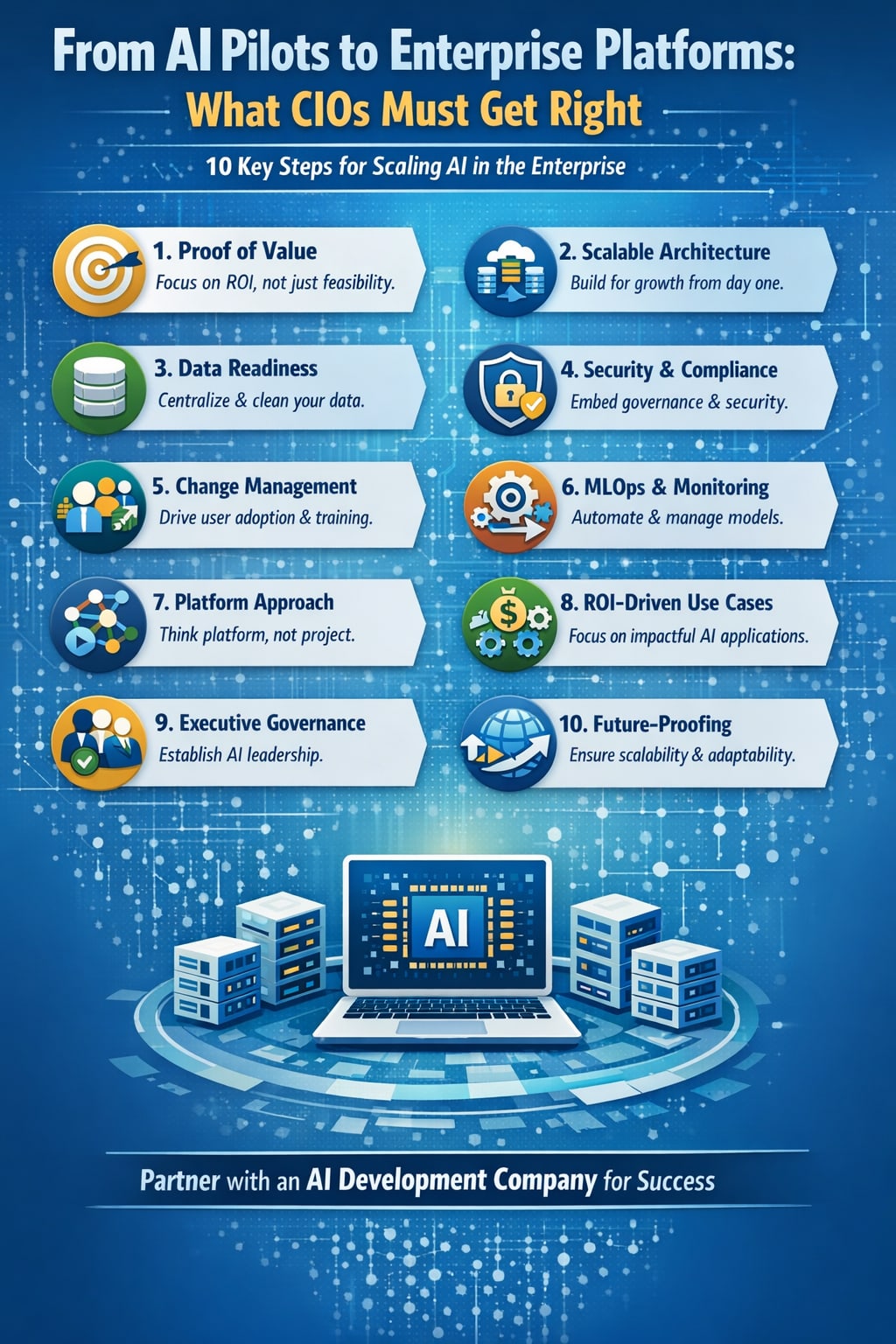
Enterprise AI is no longer a boardroom experiment. Over the last few years, organizations have launched dozens of AI pilots chatbots, predictive dashboards, automated workflows, and recommendation engines. Yet, many of these pilots never evolve into scalable platforms.
For CIOs, the challenge isn’t launching AI. It’s operationalizing it.
The shift from isolated AI experiments to enterprise-wide platforms demands strategic clarity, technical rigor, and measurable business alignment. Here’s what CIOs must get right to move beyond pilots and build sustainable AI-driven ecosystems.
1. Move From “Proof of Concept” to “Proof of Value”
Most AI pilots fail because they optimize for technical feasibility instead of business impact. A proof of concept answers: Can we build this?
A proof of value answers: Should we scale this?
CIOs must define measurable KPIs before development begins:
- Revenue growth impact
- Operational cost reduction
- Productivity gains
- Customer experience improvements
Without predefined success metrics, AI remains an innovation expense rather than a growth engine.
Scaling requires collaboration between technology, operations, finance, and business leaders. Enterprise AI platforms must integrate deeply with workflows not sit as standalone tools.
2. Build a Scalable Architecture From Day One
Many AI pilots are built in silos using disconnected tools and temporary datasets. When it’s time to scale, technical debt becomes the biggest obstacle.
CIOs should prioritize:
- Cloud-native infrastructure
- API-first design
- Modular AI pipelines
- Data governance frameworks
- Secure model deployment environments
Enterprise AI platforms must support model retraining, monitoring, and version control. Scalability isn’t just about handling more users it’s about maintaining performance, compliance, and security at scale.
Partnering with a reliable AI development company at this stage can help design architecture that supports long-term growth instead of short-term experimentation.
3. Prioritize Data Readiness Over Model Sophistication
AI success is rarely limited by algorithms. It’s limited by data quality.
CIOs must evaluate:
- Data silos across departments
- Inconsistent data formats
- Missing governance policies
- Lack of real-time access
Enterprise AI platforms require centralized, clean, and well-labeled data pipelines. Without structured data foundations, even the most advanced models will underperform.
Before investing in advanced models, invest in data engineering maturity.
4. Align AI With Enterprise Security and Compliance
As AI adoption grows, so do regulatory risks. Data privacy laws, industry regulations, and internal compliance frameworks must be embedded into the AI lifecycle.
CIOs must ensure:
- Role-based access controls
- Secure model hosting
- Data encryption protocols
- Audit trails for AI decisions
- Explainability mechanisms
Enterprise AI platforms are no longer internal tools—they often interact with customers, vendors, and partners. Governance frameworks must evolve alongside AI capabilities.
This is where structured AI development services play a critical role—integrating compliance, monitoring, and security into system design from the beginning.
5. Invest in Change Management, Not Just Technology
Technology implementation is the easy part. Organizational adoption is the real challenge.
AI platforms change workflows, job responsibilities, and decision-making structures. CIOs must:
- Train teams on AI tools
- Establish clear accountability models
- Redesign processes around automation
- Communicate AI’s role in augmentation—not replacement
Successful enterprise AI transformation depends on user trust and leadership buy-in.
Without adoption, even the most sophisticated platform becomes shelfware.
6. Standardize MLOps and Lifecycle Management
One major gap between pilots and platforms is operational maturity.
Enterprise AI platforms require:
- Continuous model monitoring
- Drift detection
- Performance benchmarking
- Automated retraining
- Centralized logging
CIOs should institutionalize MLOps practices to ensure models remain accurate and relevant over time.
Scaling AI isn’t about launching new features it’s about sustaining performance in production environments.
7. Think Platform, Not Project
AI initiatives often begin as isolated departmental projects. But enterprise value emerges only when AI becomes a shared capability across functions.
CIOs must build AI as a reusable platform that supports:
- Multiple business units
- Cross-functional integrations
- Shared data layers
- Unified AI governance
This platform-first approach prevents duplication and accelerates innovation across the organization.
A strategic AI development company can help design centralized AI frameworks that serve as enterprise-wide foundations instead of department-specific tools.
8. Focus on ROI-Driven Use Cases
Not all AI use cases deserve enterprise scaling.
CIOs should prioritize:
- High-volume operational bottlenecks
- Revenue-generating automation
- Decision-support systems for leadership
- Customer-facing intelligence tools
AI that directly impacts top-line growth or bottom-line efficiency gains executive support and budget allocation.
Start with scalable, repeatable use cases—not experimental edge cases.
9. Establish Executive-Level Governance
AI strategy cannot be delegated entirely to IT.
CIOs must collaborate with:
- CEOs for strategic alignment
- CFOs for ROI measurement
- CMOs for customer intelligence initiatives
- COOs for operational automation
AI platforms touch every department. Governance structures must reflect that breadth.
Creating an AI steering committee ensures that innovation aligns with enterprise priorities.
10. Future-Proof the Enterprise AI Strategy
Technology evolves rapidly models, frameworks, compliance standards, and infrastructure tools continuously shift.
CIOs should ensure:
- Vendor flexibility
- Interoperable systems
- Open integration capabilities
- Scalable infrastructure design
Future-proofing means avoiding vendor lock-in and building adaptable AI ecosystems.
Structured AI development services ensure that systems are designed with extensibility in mind, allowing enterprises to integrate emerging capabilities without rebuilding core infrastructure.
Final Thoughts
The transition from AI pilots to enterprise platforms isn’t about adding more models. It’s about operational excellence, governance maturity, architectural foresight, and business alignment.
CIOs who succeed in this transition focus on:
- Value creation over experimentation
- Scalable design over quick wins
- Governance over uncontrolled innovation
- Adoption over deployment
AI is no longer a technology initiative. It’s an enterprise capability.
Those who treat it as a platform not a project will lead the next wave of digital transformation.
About the Creator
Kanak AI
AI content strategist and SEO executive specializing in AI development, RAG development, chatbot systems, AI agents, and integration services, creating data-driven enterprise content for scalable transformation.
Impostor Syndrome in Digital Creators
Impostor syndrome shows up frequently in digital creators, especially those building products without traditional credentials, titles, or career ladders. Despite skills, experience, or tangible results, many creators question whether they deserve their role or fear that others will discover they are not as capable as they appear.
By Edina Jackson-Yussif 5 days ago in Journal



Comments
There are no comments for this story
Be the first to respond and start the conversation.