
Hired and Fired by A.I.
Where’s The Human in the Loop?

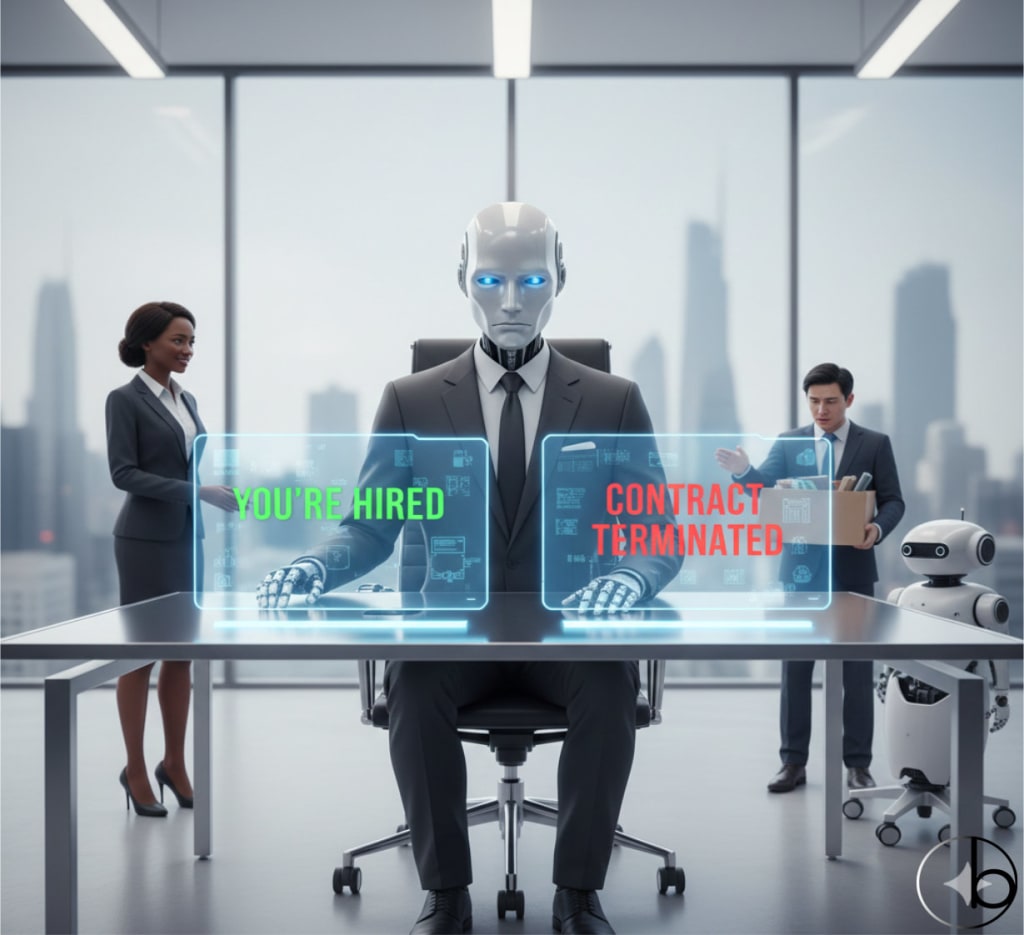
Having trouble getting hired? Recently we had a fancy thing call the Applicant Tracking System (ATS) to blame for the stark reality that landing a job, let alone an interview, became virtually impossible. Economics and politics aside, the job market was and still is a quagmire. If you’re unfamiliar with ATS, essentially your resume or application gets vetted by artificial intelligence (A.I.) before it ever reaches human eyes. Most of the time, a human never even sees your resume or application thanks to this process.
TL;DR
For my TL;DR (Too Long; Didn’t Read) folks, I’ve done you a favor and put in bold key parts of how I was hired and fired by A.I. in the span of less than two weeks. You’re welcome!
The Applicant Tracking System
Before demonizing the Applicant Tracking System, let’s take a moment to consider how there is nothing new under the sun. All the ATS does is speed up what already occurs with most human resource departments—assuming a company actually has one. The only difference is being used to a flesh and blood human scanning your resume and application for key words and qualifications. Now, ATS does it in less than a blink of an eye. So, am I for or against artificial intelligence, especially when it comes to selecting candidates?
Yes, I’m deferring my opinion about if I am team A.I. or not. I’m going to whet your appetite with a question you might have never considered. It’s one thing to be rejected by artificial intelligence so you never get a foot in the door. But what happens after you make it in only to be shoved right back out by artificial intelligence? Well, that is the tale I’m going to speak on from my own recently lived experience. I was hired and fired by A.I. in less than two weeks in January of 2026. A.I. not only selects candidates but also dismisses them from the job they hired the candidate for.
For or Against Artificial Intelligence
Originally, I was on the fence about artificial intelligence. As an educator with over 22+ years of experience, A.I. appeared to be another method for individuals to get someone or something else to do their work. When thought of that way, A.I. is nothing more than a new-ish way to leverage technology for automating things we want to do faster or would rather not do at all. Calculator, anyone? Why pay money to your smart classmate when A.I. can do it for free? Except, this free, like others, is not truly free. Every time you submit something to an A.I. system, you are contributing to its learning and the system’s database. You can only get around this if you know how to switch certain features off. Of course, there are many other ways in which working with A.I. is not free.
Rather than jump to conclusions about anything in life, I like to research and formulate my own deduction. So before making a final decision about A.I., I literally learned all about it through several certifications. Learning alone was not enough. I also needed to apply it by using it for my business and personal life. Ever the overachiever, I went one step further and even started training A.I. Do I hear the clutching of pearls and jaws dropping to the floor? My final analysis, A.I. is a powerful helpmate with the potential to wreak havoc if a crucial element is omitted. We call this element the human in the loop.

The Human in the Loop
Artificial intelligence is nothing without humans. Period. Humans sought to develop a fake version of the thought process. Humans create the technology. Humans format the technology. Humans run the technology. Humans fix the technology. Humans prompt the technology. You get the point. The danger comes when people expect too much from A.I. Sure, it seems like the all- powerful Oz when you can just type some words into a box and get a magical creation in seconds. However, there’s humans behind that too!
Do babies come out the womb walking and talking? No. We must train and encourage them to do a lot before they are off to the races on their own. Even then, they fumble, seek validation, and often need even more training. Artificial intelligence is the same. It starts as nothing but a concept in someone’s mind. It must be fed huge amounts of data and examples to exist and then grow into an adolescent that seems like they can think coherently on their own. But lightning-fast A.I. still needs a human to hold its hand through all stages of its carefully crafted life. And believe me, when A.I. makes a mistake, it can no doubt be the blunder of a lifetime that needs to be corrected by a human.
Unfortunately, with the mass adoption of artificial intelligence and rapid release of the latest technology for the A.I. race (the new Space Race), humans are being left out of the loop at crucial stages. Humans were always meant to be in the loop to safeguard against catastrophe, rampant hallucinations (when A.I. comes back with something totally off the wall), and more. Now we have A.I. composing its own code for A.I. This article was initially low on my totem pole of to write and publish list. Then I read a piece by Jay Kantor on Vocal about firing, and it dealt with some aspects of artificial intelligence. I took it as a sign to bump this sucker to the top of my publishing list. Thanks, J.K. from L.A. So, here’s how I was hired and fired by A.I. all in the same month, with a guest appearance by a human who was supposed to be in the loop.
Getting Hired by A.I.
Have you ever done an A.I. interview for a job? Sounds scary, and it is. I know someone who was very upset he couldn’t land a contract in one of the popular A.I. frontier companies because he sucked at A.I. interviews. Take the normal bundle of nerves and compound it with having no clue what you will be asked or what tasks you need to complete in real time while sharing your screen, all while a clock is ticking in the corner of your computer and you hope your technology doesn’t glitch.
Currently I am an Expert (read as independent contractor) for two different companies that vet and grant access to projects for leading A.I. frontier companies. This is where my wording will become a little hedgy and diplomatic. The exact tasks I complete and actual A.I. frontier companies and clients I work for is strictly confidential. Company A even goes as far as scouring your social media to make sure you are sane. Company B is who this article is about. You know, how within the span of less than two weeks I was hired and fired by their A.I.
I completed Company B’s A.I. interview for a particular job. The results came back within seconds. There I was, a neat heap of clearly outline stats and data for how well I performed. Congratulations, I proved I am a native English speaker and have great soft skills!
A few days later I received an email from Company B that my resume and profile were forwarded to one of their clients for a job I didn’t apply for, and I was shortlisted for the position. So basically A.I. interviewed me for one position and identified me for a different opportunity. I ended up lading the contract I was shortlisted for with Company B’s client, hooray! Two weeks into January 2026 and I was getting paid nicely for grueling onboarding. There was a lot more to the hiring and onboarding process, but that’s a whole other article.
Getting Fired by A.I.
During the onboarding process with Company B’s client, one thing was mentioned multiple times: how to get fired. However, we don’t use the word “fired” since you are an independent contractor. The term they like to use is offboarded. And it makes sense since you are added to so many different platforms. You either are granted access or not, or your permissions are revoked. For the purposes of this article’s title, I’m going to use “fired” for the duration.
There were two fast and easy ways to be fired by Company B’s client. First, if you don’t perform well on the client’s partially paid onboarding tasks you don’t pass Go. Second, and most vicious, is if their A.I. doesn’t like you. We call this reason “Your average handling time is too high.” For these types of companies and clients, AHT or average handling time, is a huge deal. While AHT is defined differently for companies and clients, it is essentially how long it takes you to complete a task.
On the surface this seems like a great and fair way to determine one’s performance when you are paying a contractor by the hour. There are myriad drawbacks, so I’ll include that in another writing. For now, let me just say that the punishment needs to fit the crime. Company B’s client was clear that on a weekly basis they would cut the bottom 10% of low performers to keep only the best Experts. But what was the indicator? Just saying poor AHT wasn’t enough when there’s tens of thousands on the project and you have no clue what constitutes the outliers.
Like the Applicant Tracking System, any automated process with a set it and forget it mentality behind it is doomed to fail. The human’s job doesn’t end at setting the parameters. Parameters need to be monitored and adjusted. For me and others, the punishment did not fit the crime. Yes, I’m repeating the phrase. Why? First, us Experts were explicitly told during project office hours and in online feeds that we would be told in advance if there was anything off about our performance regarding AHT. We also received feedback on every task completed. Some Experts were given the equivalent of a personal guide if their performance was consistently low. Second, the current set of tasks the client was giving were well outside the scope the algorithm was set for. This example is fictional but will help give context. Let’s say the stated AHT was 20 minutes for a task consisting of reviewing a one- to two-page document. However, the client gave the same AHT of 20 minutes for tasks now consisting of three- to four-page documents. While everyone’s AHT goes up based on the new nature of the tasks, newbies like myself to the project had to handle an increased onboarding process and longer tasks than the OGs with an outdated time frame.
You become a prime suspect as an outlier to the algorithm and very fireable. Some of my colleagues, most with advanced and terminal degrees and prior knowledge of how things worked feared the A.I. algorithm. They honestly begged for Company B to remove them from this client’s project before A.I. got to them first. One of the saddest cases was a woman with a Ph.D. who was working on a manuscript for a book among other things and said she simply could not complete the new, often longer tasks with the same AHT given, constantly updated tools, the organic guidelines document that shifted as you were referencing it, and other criteria.
The day after office hours—where we were told repeatedly to not be too concerned about AHT and to keep our clocks running because as contractors we get paid for everything we do—, my access was blocked to platforms, and I was removed from other aspects of the project. I wasn’t alone. Others were questioning why certain platforms weren’t working for them suddenly. While you can be offboarded from a client’s project, you are still an Expert for the company. That’s how we were still able to communicate with some of our newfound former teammates. I submitted a tech request as recommended by one of my colleagues. Unfortunately, I would never receive a reply. I was cut from the team.
So, there I was fired without knowing it. The official notice came after I was already unplugged from certain platforms. I didn’t even receive an email to formally end the contract. What I did get was a blanket statement in one of the platforms that my AHT was too high. My contract literally started on January 11th and I got canned on January 22nd. It wasn’t even two weeks on the project. All that echoed in my mind was the words from the office hours the night before. “We don’t want to loose any of y’all. We want to keep you on. We will always have a conversation with you first. Don’t worry,” the meeting host said in an exasperated exhale as she rubbed her face from too little sleep and constant onboarding and offboarding of new Experts.

Where’s the Human in the Loop?
Armed with the previous night’s quote, feedback from the reviewers of my tasks, and the plethora of comments from fellow colleagues, I sought out the missing human in the loop. I replied to the form thread about my firing. My main question, “What happened to the conversation the company has with its Experts if there is a problem with their AHT?”
Within five minutes, the human responded thanking me for such a respectful message. He said he looked into my track record (all 1.5 weeks worth, LOL) and saw I had good internal reviews and good quality work. After only a week on the job and few tasks to work with, I was already getting a pass on my work the first go round, along with comments like, “This was a monster of a task” or “This was a beast.” Yeah, well, monsters and beasts take longer to conquer—a concept A.I. doesn’t understand. So the human said the company would contact the client to see about me getting onboarded again. While it was a lucrative contract, I didn’t want that contract back. As you can guess, there were other underlying issues with this particular project. I do give credit to Company B for inviting feedback from Experts.
Everything for A.I. is legit binary: 0/1, yes/no, black/white, input/output. Artificial intelligence is incapable of thinking. What looks like thinking is all programmed and the culling of data from sources and training based on human input and rewards for good outputs. Artificial intelligence is limited by its inability to make sophisticated and complex decisions about a human’s performance in the workplace. The algorithm does not know that Amber is grieving the sudden loss of her husband, that Brandon is going through a rough divorce, that Shelby is preoccupied with how to feed her three siblings, that Trevor is navigating a bout of severe depression, or that Jordan’s hectic family schedule impacted this week’s productivity. There are no soft skill presets for A.I.
Cutting corners to save money and streamline and automate processes can lead to negligence. That is why it is vital to keep the human in the loop.
Why I Train Artificial Intelligence
I’m including a snippet of why I train artificial intelligence because there are some who will skim this article and post a comment about the belief they already hold. For those who already think all facets of A.I. are the devil, there’s a lot I could say. In sum, I will state that you can either complain about something or make a difference. I chose to make a difference. The reason I train A.I. and work in the field in general is to help make sure it stays sanctioned, safe, and democratized. After all, you don’t want to be the parent who turns to A.I. to convince their child there aren’t monsters under the bed and A.I. screams, “Of course there are monsters under your bed! Run, now!” That’s a rough night for all parties involved.
About the Author
Stephanie Bradberry is an entrepreneur, educator, consultant, and national public speaker. She holds several certifications in Artificial Intelligence. Her time in academia spans 22+ years and counting as a professor of English, Literature, Business, and Education. Stephanie is a former high school English teacher. She loves freelance writing and editing. She is the founder/owner of Stephanie J. Bradberry LLC and former founder/owner of Crosby Educational Consulting, LLC. Learn more at stephaniebradberry.com
About the Creator
Stephanie J. Bradberry
I have a passion for literature and anime. And I love everything involving academia, health, metaphysics and entrepreneurship. For products and services, visit stephaniebradberry.com
Keep reading
More stories from Stephanie J. Bradberry and writers in Journal and other communities.
Vocal Is On Trend
If you are serious about becoming a better writer, follow Vocal’s lead. Better yet, if you hope to win challenges outside of Vocal or have your work accepted in a peer-reviewed publication, follow Vocal’s lead. Read the introductions to what led Vocal to choose the winners for past challenges. Delve into how winners worked within the prompt in expected or unexpected ways. But the most important part is looking at the trend of what Vocal chooses for challenges.
By Stephanie J. Bradberry3 years ago in Journal
~ Fired ~
— Ai Intrusion ~ Are you Next ~ Is Ai Evolution after your job? — Few workplaces haven't been affected. Ai is in supermarkets, at doctors' offices, and even monitoring farms. I just can't think of anything this machine is not getting into, can you? For instance: Education ~ Law and Tech jobs will one day have a major influence or be taken over by these inanimate machines, with accuracy and vigor. From mechanics' diagnoses to a wide variety of everyday jobs, including fast food workers, with this input having the ability to cut their unnecessary work hours. I'm certain all of us have been touched by this with our short stories and colorful headings, have you? Even comments are very questionable 'Non-Robot' insertions.
By Jay Kantor5 days ago in Journal
How to Stop Russia Using Starlink to Control Deadly Drones Against Ukraine
This morning I read that Musk’s SpaceX has applied for a licence to increase the number of Starlink satellites to 1 million. I reacted rather strongly. There’s already too much junk in orbit. When I’m at sea the night sky is already spoiled just after sundown by strings of Starlink satellites. Yes, I’m becoming old and curmudgeonly, but now Musk’s expanding constellation is helping Russia murder Ukrainian citizens.
By James Marinero4 days ago in Journal
Trouble at the Tea Leafing Café
The rain had started right around the time that Annie was buttering her second thick slice of homemade toast for breakfast, and hadn’t paused since. Not that anyone could tell. The windows of the café were fogged over, and with every seat filled with happy customers munching on fresh baked pastries or steaming bowls of the delicious soup of the day, it was hardly surprising. Annie looked around the room, finally taking a moment to breathe after the lunch time rush. Her old life already felt like a bad memory, a part of her history, always, but just that. History.
By Hannah Moore6 days ago in Fiction




Comments (2)
Dear Stephanie - I've removed my original Schtick comment because it was silly and self-promoting. You are brilliant, and I appreciate that you hit-the-nail on the head re; the Ai machine. Best to you my new friend, jk.in.l.a.
Interesting insight Stephanie and I can’t say that I am sorry I am no longer in the job market. Though I have to say I think it is the humans in the loop who are the problem, not the AI. Any business that swallows the AI sales pitch, excepting technology to solve all their problems, is making the same mistake businesses have been making for decades. I do hope you manage to find the clients who deserve you and managers still prepared to do their job and not defer to the machine.