
How Much a Marketing Campaign Costs: Email, Push, SMS and Messenger Apps
How Much It Costs to Send Messages: Email, SMS, Push, and Messengers

Modern companies have plenty of ways to reach their customers, from emails and SMS to calls and push notifications. Each channel has its own price and level of effectiveness. But how do you calculate the real cost of reaching your audience? What exactly drives the marketing budget up — or helps you cut it without sacrificing performance?
In this article, we’ll break down what makes up the cost of campaigns across different channels, where hidden expenses may arise, and how to keep the budget under control.
Key Factors That Influence Campaign Costs
There’s no uniform price tag for marketing campaigns. The final budget depends on a set of parameters, each affecting the total amount differently.
Audience Size
The cost depends not only on the communication channel but also on the number of recipients. Most marketing platforms provide tiered pricing options based on the contact list size or the number of messages sent: for example, up to 10,000, 50,000, or 100,000 contacts. The larger your database (email addresses, phone numbers, or push subscribers), the higher the total cost.
Platform and Pricing Model
Campaign costs also include the platform of choice and its pricing plans. Basic plans are cheaper but often limited, for example, to only bulk messaging and minimal analytics. Advanced plans are more expensive but include tools that improve campaign performance, such as:
- integration with CRM and marketing systems;
- multi-step trigger and segmented workflows;
- advanced analytics.
Design and Content
This category includes:
- copywriting;
- creating visuals, infographics, or interactive elements;
- layout adaptation and testing across different devices and email clients.
The preparation costs depend on the campaign’s level of creativity and complexity, as well as on whether production is done in-house or outsourced.
Testing and Optimization
To keep campaigns effective, each launch requires analysis and timely adjustments. Usually this involves:
- A/B testing of subject lines, content, and send times;
- tracking key metrics such as open rates, click-through rates, conversions, and unsubscribes;
- optimizing campaigns based on collected data.
These tasks require proper tools and a skilled team: marketers, analysts, and CRM experts. Labor costs vary by project and depend on the team setup and level of expertise.
Channel-by-Channel Cost Breakdown
To estimate your marketing budget accurately, it’s important to look at each separate channel in detail. Here’s what affects the cost of email, SMS, push, and messenger app campaigns.
Emails
When calculating the cost of an email campaign, three main factors come into play:
1. Service plan. Different platforms feature various pricing plans depending on contact list size and features. Public pricing from major providers for lists of around 50,000 contacts usually starts at about $300 per month and can reach $400–$450 on mid-range plans. Accordingly, monthly costs for lists of around 100,000 to 250,000 contacts range from $500 to $1,500 on average.
2. Email content. Prices for creating an email template range from a few hundred to several thousand dollars. For example, when handled by an agency, email design and copywriting may cost around $500–$2,000 for a single campaign.
3. Infrastructure and deliverability maintenance. To prevent emails from landing in spam, you need to set up the required configurations (SPF, DKIM, DMARC) and monitor domain reputation. For large-scale campaigns (over 100,000 emails per month), you may need to rent and warm up a dedicated IP address, which increases the overall price.
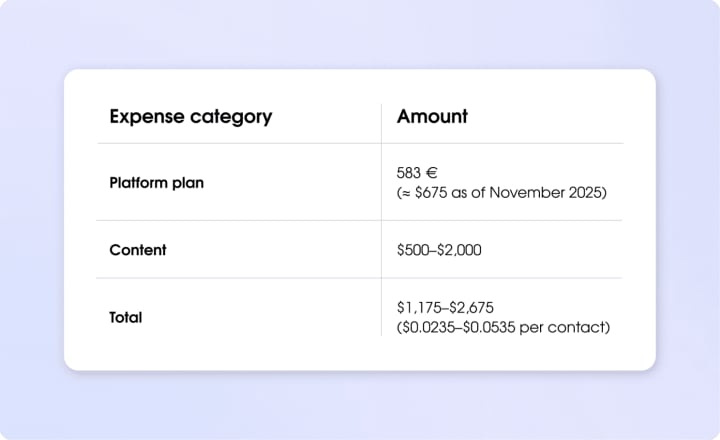
As an example, let’s calculate an approximate budget for a contact list of 50,000 emails in Altcraft. Since the platform includes its own sending gateway, there’s no extra charge for email delivery or infrastructure: the price plan depends on the number of available customer profiles.
SMS
SMS marketing has a higher cost per contact than email, yet offers outstanding deliverability and an average open rate of 90%. Key cost categories include:
- Campaign setup and management. This includes choosing an SMS provider and platform, crafting the message, configuring delivery, and tracking statistics.
- Message delivery. A typical price per SMS varies from around $0.015–$0.03 in the US to $0.05–$0.07 in the European Union and up to $0.10+ in other countries. International deliveries usually cost more due to roaming and foreign carrier fees.
- Database verification and cleaning. HLR requests help detect inactive phone numbers and reduce paid message volume. For example, out of 10,000 numbers, only 7,000 may be active, which directly affects the total cost.
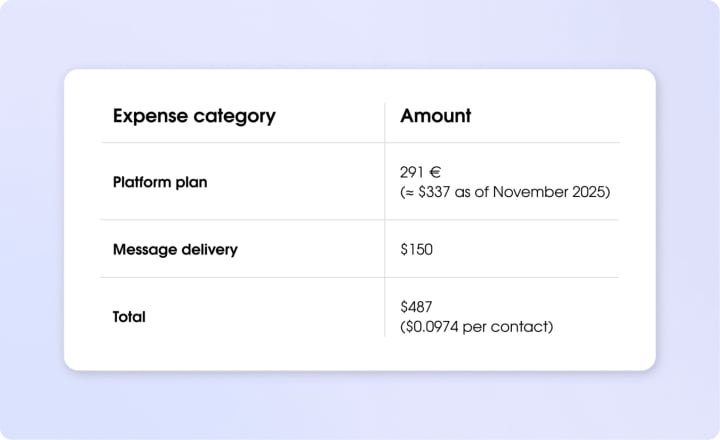
- To run SMS campaigns through Altcraft Platform, an SMS gateway must be connected first. Let’s estimate the cost of sending 5,000 promotional messages priced at $0.03 each.
Messenger App Campaigns
Messenger apps are among the most engaging communication channels. For example, in WhatsApp*, up to 98% of messages are opened. Engagement and trust levels here are typically higher compared to email or SMS.
Here’s what affects the cost in this case:
1. Message rates. Price per message may vary significantly depending on the country and the messenger app itself. As of the date of publication, WhatsApp charges $0.025 for a marketing message in North America, while in Germany, the exact same message will cost $0.1365.
Viber charges €0.0018 to €0.0345 ($0.0021–$0.04) per promotional message and €0.0008 to €0.0227 ($0.00093–$0.026) per transactional message, depending on the country. For business accounts, a mandatory monthly minimum charge of €115 to €175 ($133.12–$202.57) applies.
2. Campaign organization. This includes preparing and moderating message templates, configuring delivery, chatbot development and maintenance (if required), and monitoring results.
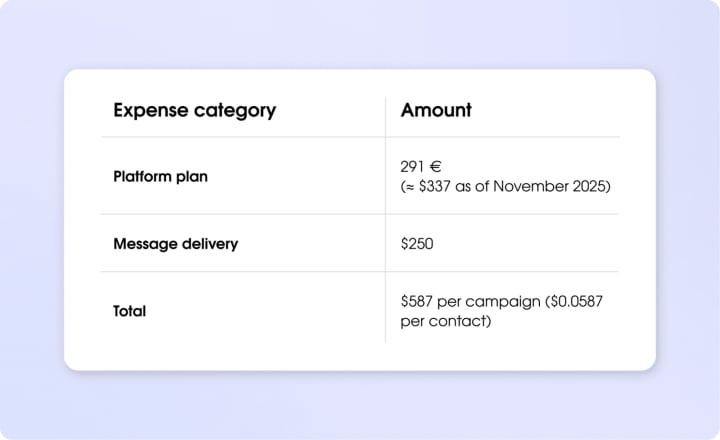
Below is an approximate WhatsApp campaign budget, assuming a list of 10,000 contacts in the Altcraft Platform and pre-approved message templates.
Altcraft Platform also enables combining different messenger apps into unified communication flows. Along with WhatsApp, Viber and Telegram, custom channels can also be integrated upon request.
Push Notifications
Push is one of the most affordable and scalable marketing channels, especially when your business offers a mobile app or a website with web-push subscriptions. Main expenses here include:
- Delivery cost. With an in-house infrastructure, web and mobile push notifications are virtually free. When using SaaS platforms, average costs stand around $0.005–$0.02 per active user. Enterprise solutions or specialized external channels (RCS, OTT-Push) can be significantly more expensive.
- Development and content. Key expenses include creating push templates and maintaining the subscriber database. This covers content production, scenario configuration, and engagement flows.
For Altcraft Platform users, push delivery is already included in the pricing plan. Since the platform supports all major push providers, the only expenses you need to account for (aside from the chosen tier) are content preparation and marketing efforts.
How to Optimize Campaign Costs
Even with well-planned campaigns, it’s important to track performance and manage your budget effectively. Below are practical approaches that help reduce costs and improve audience engagement.
Cascading Communication Sequences
In multichannel marketing, a major cost-saving rule is to start with the least expensive channels. Launch the low-cost options first and move to pricier ones only if earlier steps couldn’t provide tangible results. A cascading flow might look like this:
- Email contains the main message and is sent first.
- Push serves a reminder for those who didn’t open the email.
- SMS plays the role of a targeted follow-up for users who didn’t react earlier.
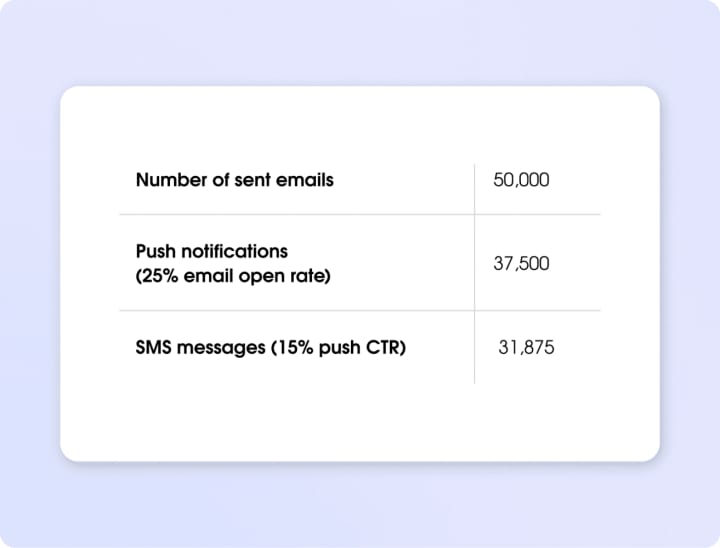
For example, if you send 50,000 emails and reach a 25% open rate, 37,500 users will receive push notifications next. If the push CTR is 15%, 31,875 users will receive SMS messages. This approach keeps coverage broad while minimizing costs for expensive channels.
Segmentation and Personalization
Mass campaigns sent to an entire contact list rarely deliver effective results. A number of addresses may no longer be in use, while some readers may treat irrelevant messages as spam, which lowers engagement.
Segmentation helps you refine your audience targeting. For example, you may divide the contact list into subgroups, each with its own communication scenarios:
- New customers: welcome and onboarding messages.
- Active buyers: personalized promotions, upselling, and cross-selling.
- Inactive subscribers: gentle re-engagement messages.
- Transactional segments: abandoned carts, incomplete signups, or payment reminders.
To make campaigns even more relevant, use personalization. Modern marketing and CDP platforms go far beyond simply inserting a customer’s name. They enable:
- using profile data such as birthday and location;
- inserting dynamic offers based on behavior and purchase history;
- calculating the optimal send time for each user.
This level of customization helps increase CTR and lower conversion costs, since each message hits the mark more precisely.
Maintaining Database Quality
A large number of inactive contacts harms both the campaign budget and sender reputation. Invalid email addresses still count toward mailing limits, while messages sent via SMS or messenger apps are billed even if the phone number is no longer active.
To prevent this, regularly analyze your database and keep it clean. This includes:
- validating email addresses and phone numbers;
- managing unengaged contacts: for instance, users who haven’t shown any activity for the last 6–12 months can be moved to a dormant segment for reactivation or excluded entirely;
- promptly removing unsubscribed or invalid contacts.
Performance Measurement and Continuous Optimization
Cost optimization also relies on thorough campaign performance analysis. In addition to opens, clicks, and other basic metrics, it’s crucial to track key ROI indicators, including:
- CPO (Cost Per Open) — how much is spent for each opened message.
- CPC (Cost Per Click) — the average amount paid for every link click.
- CPA (Cost Per Action) — the price of each target action, such as a purchase or registration.
These metrics help with:
- identifying expensive but inefficient channels;
- reallocating the budget to higher-converting sources;
- setting the optimal campaign frequency.
A more advanced analytical approach involves conversion attribution. It accounts for the contribution of all channels in the customer journey, not just the one where the final click occurred. For instance, an email may not drive an instant sale but can “warm up” the customer before another channel completes the conversion.
Conclusion
The cost of a campaign depends on many factors, including the communication channel and the quality of your contact list. Choose your channels strategically, keep the database clean, track key metrics, and use the platform you choose to its full potential. By understanding where most of the money goes, you’ll be able to build a strategy that lowers the cost per contact and increases overall return.
*Product of Meta, designated as an extremist organization in the Russian Federation.
**Viber™ is a trademark of Rakuten Group, Inc., blocked in the Russian Federation.
The article was originally published here.
About the Creator
Altcraft
Interesting and useful articles about marketing, our product and online communications



Comments
There are no comments for this story
Be the first to respond and start the conversation.