
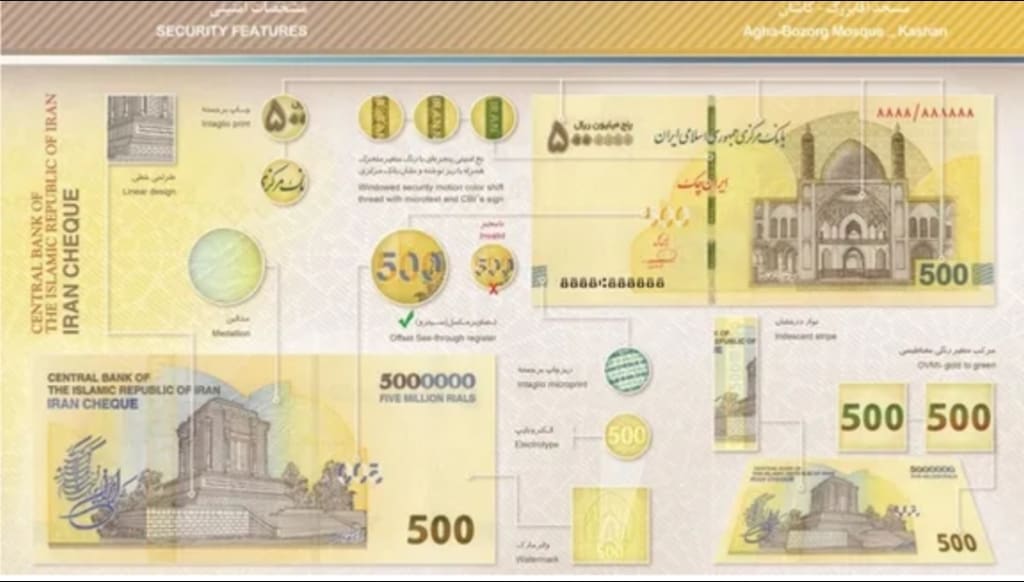
Iran Rolls Out 5 Million-Rial Banknote, Worth About $3.10 at Market Rate
Tehran introduces new currency note amid rising inflation and economic challenges

tl
Subtitle
Iran has officially introduced a new 5 million-rial banknote, equivalent to roughly $3.10 at the current market exchange rate. The rollout marks a significant step in Tehran’s ongoing efforts to address economic pressures, manage inflation, and simplify cash transactions in a country where everyday prices have been rising steadily due to currency depreciation and inflationary trends.
The Central Bank of Iran (CBI) announced the release of the high-denomination banknote, highlighting its role in easing transactions and adapting the monetary system to current economic realities. For ordinary citizens, the new note will make day-to-day payments and business transactions more practical, while for the government, it represents part of a broader strategy to manage a challenging financial environment.
---
Rising Inflation Prompts High-Denomination Currency
Iran has been grappling with persistent inflation for years, fueled by factors such as international sanctions, currency depreciation, and internal economic imbalances. The rial, Iran’s national currency, has lost significant value against foreign currencies, prompting the need for larger banknotes to facilitate everyday transactions.
Before the introduction of the 5 million-rial note, Iranians often needed to carry stacks of smaller denominations to make even simple purchases, a practice that created inefficiencies and logistical challenges. The new banknote aims to address this by consolidating value into fewer notes, making transactions smoother for both individuals and businesses.
---
Economic Context Behind the Move
The Iranian economy has faced considerable pressures in recent years. U.S. sanctions targeting the country’s oil exports and banking sector have limited foreign revenue streams, contributing to a weaker rial. Domestic inflation has further eroded the currency’s purchasing power, with the rial losing value against the U.S. dollar at both official and market rates.
At the current market rate, the 5 million-rial note equates to approximately $3.10, reflecting the significant depreciation of the national currency. For comparison, just a decade ago, the same nominal note would have represented far greater purchasing power, highlighting the scale of Iran’s ongoing currency challenges.
Economists say that introducing higher denomination notes is a pragmatic response to these conditions, but it also underscores deeper structural issues in Iran’s economy. Without broader reforms to tackle inflation, improve fiscal policy, and stabilize the currency, the rial is likely to remain under pressure, and further high-denomination notes could be introduced in the future.
---
The Central Bank’s Role and Strategy
The Central Bank of Iran has emphasized that the introduction of the 5 million-rial note is part of a long-term monetary strategy. Officials argue that higher-value notes will reduce cash handling costs, improve the efficiency of payments, and better align the currency system with economic realities.
CBI spokespersons have stated that the rollout will not immediately impact inflation, but it may affect public perception of currency value. By issuing a larger denomination, the government acknowledges the ongoing challenges faced by ordinary Iranians, while attempting to modernize the cash system in line with other countries experiencing currency depreciation.
---
Public Response and Concerns
Public reaction to the new banknote has been mixed. While some citizens welcome the practicality of higher denominations, others view it as a visible reminder of the rial’s decline. The note’s introduction has also sparked conversations about Iran’s broader economic policies, currency stability, and cost of living.
Small businesses and retailers have expressed cautious optimism, noting that fewer notes in circulation could simplify transactions and reduce the time spent handling cash. However, some worry that the move may signal continued depreciation and inflation in the months ahead, which could affect purchasing power.
---
Regional Comparisons
Iran is not alone in issuing high-denomination banknotes in response to inflation. Countries such as Zimbabwe, Venezuela, and Turkey have faced similar challenges, where rapidly rising prices necessitated the introduction of larger currency notes to facilitate everyday commerce. Economists often point out that while high-denomination notes are a practical tool, they are not a substitute for comprehensive monetary and fiscal reforms aimed at stabilizing the currency.
---
Implications for the Iranian Economy
The rollout of the 5 million-rial note highlights the tension between practical currency management and the underlying economic challenges Iran faces. While the note will ease transactions in the short term, it also reflects the continued erosion of the rial’s value and the impact of inflation on ordinary citizens.
For policymakers, the key challenge is balancing immediate cash-handling efficiency with long-term currency stability. Without structural reforms—such as addressing inflation drivers, improving foreign exchange reserves, and increasing economic productivity—Iranians may continue to see the need for even higher denomination notes in the future.
---
Conclusion
Iran’s introduction of the 5 million-rial banknote, equivalent to roughly $3.10, is a pragmatic response to ongoing inflation and currency depreciation. While it will make daily transactions easier for citizens and businesses, it also underscores the broader economic challenges facing the country.
As Iranians adapt to this new currency note, the government and Central Bank must continue to address the root causes of inflation and currency weakness. The rollout of the high-denomination note may simplify commerce today, but the long-term stability of the rial depends on comprehensive economic reforms, international engagement, and careful monetary policy.
About the Creator
Keep reading
More stories from Salaar Jamali and writers in Journal and other communities.
Peru to Invest $7.6 Billion to Continue Critical Minerals Extraction
A Major Investment in Strategic Minerals Peru is embarking on a bold expansion of its mining industry with plans to invest nearly $7.6 billion in critical minerals extraction projects this year. The initiative, announced by the Ministry of Energy and Mines, is designed to consolidate growth in one of the nation’s most important economic sectors and ensure Peru’s position as a key supplier of minerals essential to the global energy transition and industrial supply chains.
By Salaar Jamaliabout 16 hours ago in Journal
~ Fired ~
— Ai Intrusion ~ Are you Next ~ Is Ai Evolution after your job? — Few workplaces haven't been affected. Ai is in supermarkets, at doctors' offices, and even monitoring farms. I just can't think of anything this machine is not getting into, can you? For instance: Education ~ Law and Tech jobs will one day have a major influence or be taken over by these inanimate machines, with accuracy and vigor. From mechanics' diagnoses to a wide variety of everyday jobs, including fast food workers, with this input having the ability to cut their unnecessary work hours. I'm certain all of us have been touched by this with our short stories and colorful headings, have you? Even comments are very questionable 'Non-Robot' insertions.
By Jay Kantor2 days ago in Journal
NatWest Branch in Kirkby Lonsdale to Close in 2026
The announcement that the NatWest branch in Kirkby Lonsdale will close in 2026 has prompted concern among local residents, businesses, and community leaders. The decision is part of a wider trend of high street bank closures across the UK, driven by changing customer habits and the growing shift toward digital banking.
By Aarif Lasharia day ago in Journal


Comments
There are no comments for this story
Be the first to respond and start the conversation.