
Japanese habits and lifestyle.
Japanese customs that can enhance our lives.


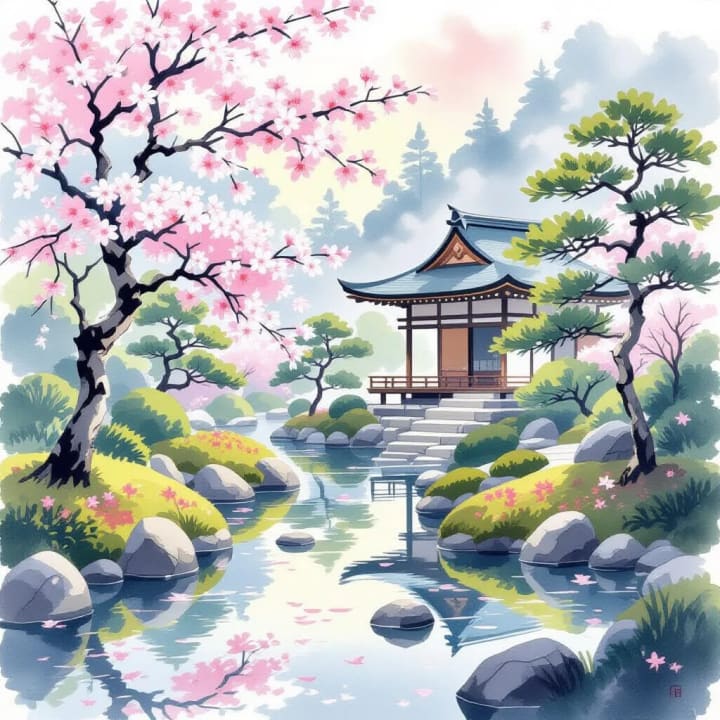
Many cultures have different types of gems to share with the world around us. What if we open our hearts and minds to new ideas. Are we willing to peek through the keyhole at other lifestyles and learn from others.
Is it possible to incorporate some of these customs into our everyday lives, just my making a few adjustments.
Let's begin with 10 Japanese customs to awaken our senses. (Excerpts from ideas of author, Marie Kondo).
(1)Ma: The Silence...

The art of the pause in conversation.
Experiencing the gap, in your everyday conversation: If you are talking, it’s fun to keep talking and talking but at the same time you don’t need to fill every gap, every space. You can enjoy that pause.
In the Japanese culture, they talk about reading between the lines, seeing what feelings there are that aren’t being put into words. The ma, the silence, gives the opportunity to realise both your own feelings and what other people might be thinking.
It’s the opportunity to think more deeply about what you are doing and what you are saying.
You don’t need to fill every gap, every space. You can just enjoy that pause - that moment.
(2)Sadō: The tea ceremony

Savouring a cup of tea and enjoying the moment is very Japanese. Take your time over a cup and make it into a ritual, rather than just drinking while on your computer or watching television. Make it more meditative.
The tea ceremony or sadō is a big part of Japanese culture and there are two things that make it distinctive.
“The first is the way that every movement is ritualised, it has perfect form of gestures. The second is that this ritual allows you to focus on what you are doing, while making the tea.
Focus when you are actually drinking too. You might have all sorts of thoughts going through your head. But thinking about that cup of tea you always take for granted can become something really special.” (Kondo).
(3) Cleaning as an act of care

Keeping your house spotless is as much for your mental wellbeing as having a lovely home.
Cleaning your house is a very simple act but it’s also a way of caring for your space, of expressing gratitude for the home that protects you and looks after you.
It’s about purifying your space and making it a comfortable place to be. It’s a kind of ritual.
Monks that train in temples start with cleaning, with purification. Tidying your space helps you to organise your heart and mind as well.
Uses crystals and incense. Beautiful sparkling crystals help to purify the air in the same way that incense does. It makes things cleaner and clearer and monks have always used incense in temples for the same reason.
(4)Mottainai: The art of not being wasteful

Mottainai is the art of reusing and repurposing items. Kondo tells of how Japanese children carefully open presents, not ripping them frantically, so that the paper can be used again.
Mottainai stems back to the Edo period in Japan, when Japan was closed off to the rest of the world and had limited resources. They had to make use of what they had access to, and what they had was precious - it couldn’t be wasted. That’s where this concept comes from and kintsugi is also part of that.
Urushi lacquer is used to repair a broken dish, demonstrating the art of kintsugi.
5. Kintsugi

When a vessel or a dish breaks and it is then repaired using urushi lacquer. What is special is that it repairs the vessel but it also creates a new original piece that is even more beautiful. In a way it reminds us that even if something is broken or cracked, it can still be beautiful. That in turn ties in with the Japanese concept of wabi-sabi, which is appreciating the beauty of imperfection.
6. Take your time when eating

Food should be enjoyed and savoured – and not wolfed down. And to always make sure there is a good balance of flavours and proteins. In Japan, schoolchildren serve each other at meal times – there are no dinner ladies.
Still, they appreciate the culture of having someone whose job it is to serve the school meals and how much more efficient that can be. Both are lovely parts of each culture.
No culture is proclaimed better, it’s just a matter of looking at all these different ways of doing things and to help people understand each other’s cultures.
In Japan, yes, children serve the school meals and it’s an opportunity for them to have to think about how to distribute rations evenly and equally. They know what food is there and how many are in their class. They can also think about the food they are serving as well. It gives them a good start at planning and responsibility.
We should use our good bowls and dishes everyday. Don’t just keep them for special occasions – it will add to the dining experience.
7. The onsen (h0t springs)
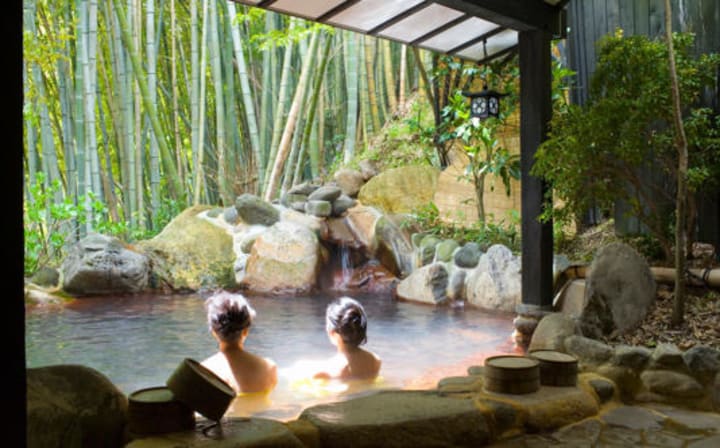
There are onsens all over Japan and they are natural hot springs. Experiencing the onsen is a part of Japanese culture that people absolutely love. It’s a way of experiencing the energy of nature, of the heat that is bubbling up from the earth, the energy of the water. It’s the sense of being purified by that water as well as being recharged by the natural energy of the earth.
The best thing to do is to experience a real onsen, of course – they are not just in Japan. There are onsens all over the world. But if you can’t do that, you can recreate that feeling in your daily life by having a bath, by really enjoying it, experiencing it.
In Japan you can get onsen salts from different regions. But if you can’t get those, just buy bath salts and add the power of the sea to your bath through that.
“Once you are in there, just relax, take deep breaths, listen to the sound of the water lapping. Watch the ripples on the surface and try to become more aware and more sensitive towards the experience. That will help you relax even more.”
8. Omotenashi: The art of hospitality

Omotenashi is about making someone feel welcome and respected but without being obsequious. It’s thinking ahead about what their likes and interests are, maybe by putting a book by a favourite author by their bed or their favourite flowers in their room.
Japan is well known for its omotenashi - but it’s not just Japan. If you lived overseas and travelled in other countries, you will come across some lovely examples of omotenashi. When you stay in a hotel, it might seem quite a natural thing, like when someone holds the door for you or there are chocolates in your room.
It’s a way of respecting and caring for guests and people by imagining what they need and what they want and providing it for them.
Enjoy the seasons and get out in nature.
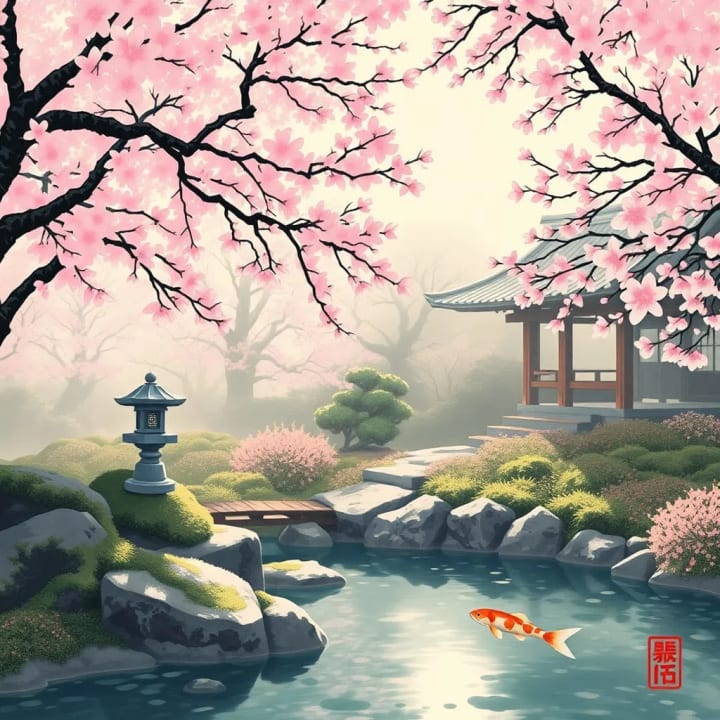
In Japan, meteorologists track the cherry blossom every spring and the Japanese language has a plethora of expressions to capture its appeal. Get excited when you see the pink blooms.
Seasons are always flowing, they are never the same and every season brings a new feeling. You feel the gentleness of spring and then the excitement of summer, the relaxation of autumn and then the depth of winter.
Appreciating the seasons helps you to become more sensitive to the changes going on around you. Which in turn helps make you more aware of changes happening within you. It helps you to develop a certain sensitivity which again can be useful when it comes to tidying and life in general.
9. Kawaii or cuteness
Kawaii culture in Japan is all about an appreciation of cute things with an almost childish innocence - like Hello Kitty, Pikachu, quirky stationery and mascots. It’s an escape from daily pressures.
“I use the word kawaii all the time in my day-to-day life,” says Kondo. “In English, of course, we translate it as cute but it’s the sense of cherishing something, of finding something adorable.

In Japan that it’s quite common to feel that sense of kawaii is through animated characters. Each prefecture in Japan has a mascot to represent them and if you like that mascot and think of them as kawaii then you are more likely to feel an affinity for the place where that mascot comes from and what they represent.
This sense of kawaii is a way of bringing comfort and gentleness and a bit of kindness into your own life.”
(10) Ikigai: Finding your purpose

Ikigai is the Japanese way of identifying a person’s purpose in life, what brings you joy, what brings value to your life. It starts from within, from warmth and happiness. It’s about what really makes you happy - whether it be work, family or activities.
It’s finding that moment when your heart sings. You physically feel the joy in your body. When you see someone glowing. See it in their life changes that brings deep joy.
...............................................
Excerpts from Story by Margaret Hussey - The Telegraph
KonMari method around the world.
Marie Kondo's. The Life-Changing Magic of Tidying
‘Letter from Japan’ by Marie Kondo.
About the Creator
Novel Allen
You can only become truly accomplished at something you love. (Maya Angelou). Genuine accomplishment is not about financial gain, but about dedicating oneself to activities that bring joy and fulfillment.
Keep reading
More stories from Novel Allen and writers in Journal and other communities.
Naked and Bare, my Catalyst.
My recent experience with the possibility of death looming like an enigmatic, presumed unfriendly ghost, has altered my perception and changed my innermost ruminations. I have either fallen---sub-ceeded below my norm, or transcended to a higher plane of being.
By Novel Allen10 months ago in Journal
from death into life
Young Aldin of Wiloh had never contemplated death. It was almost strange — so many around him had the tendency to obsess over it, to clamor and claw almost desperately at their own perceptions of the end to know death as much as they could: when it would come, why it would come, where it would take them when it did.
By angela hepworth4 days ago in Fiction



Comments (6)
Dear Novel - Deployed and living off-base in Southern Japan for a year. Here are some memorable moments: - No need to knock on the door, if you're a friend, come right in. - Never enter a home with shoes on; a rack of clean slippers left at the door. - My favorite: Neighbor, Mrs. Kim's Chop-Stick instructions. "If you're getting it in your mouth and not losing a lot of weight, you're doing it right." You're fun and interesting CrossCulture ~ Arigato mi Amiga..! Jk.in.l.a.
I really wish we lived more mindfully. How wonderfully fulfilling life would be.
We are definitely far from Japanese culture but Japan have change in so many ways as well. Tokyo used to be so clean. Yoga help us to be silent. One of the things I love about the Japanese culture is looking out the windows as a ritual. I love doing that the most and drinking tea especially watching falling snow.
This was so beautiful. I already practice some of them but didn't know they were Japanese culture. It's nice to learn things like this!
Please don't remind me. I lived I Tokyo and still miss some of these! 🏮🎏🎎
I love reading about Japanese philosophies. Very grounding and healing. Is not it ikigai, not ikagi?