
South Korea Cosmetics Market: Size, Trade, Key Players & Distribution Overview
South Korea Cosmetics Market: Overview, Market Size, Trade Dynamics, and Key Distribution Landscape

IMARC Group has recently released a new research study titled “South Korea Cosmetics Market Report by Product Type (Skin and Sun Care Products, Hair Care Products, Deodorants and Perfumes, Makeup and Color Cosmetics, and Others), Category (General, Organic), Gender (Men's, Women's, Unisex), Distribution Channel (Supermarkets and Hypermarkets, Specialty Stores, Pharmacies, Online Stores, and Others), and Region 2025-2033”. This report offers a detailed analysis of the market drivers, segmentation, growth opportunities, trends, and competitive landscape to understand the current and future market scenarios.
South Korea Cosmetics Market Overview
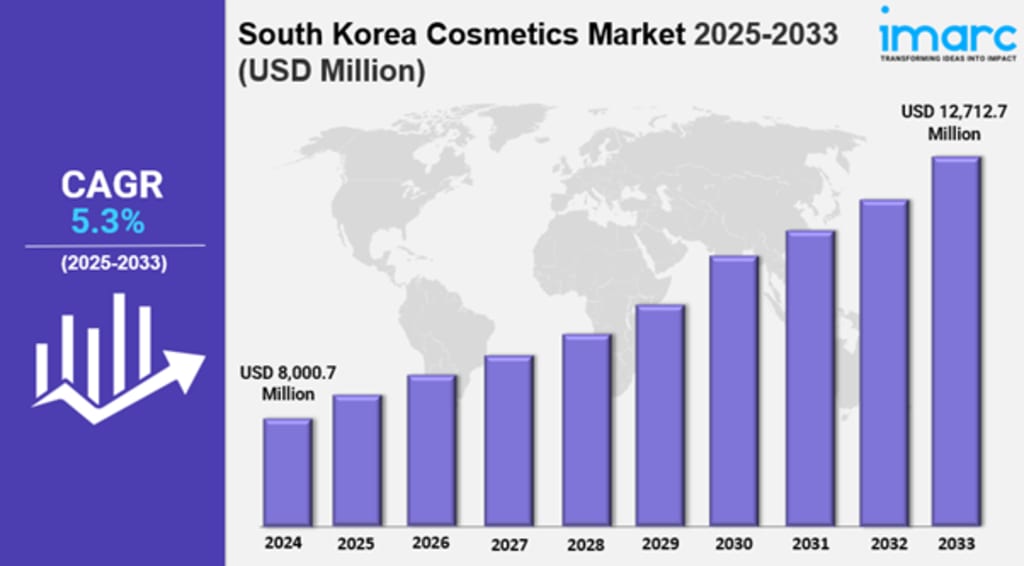
The South Korean cosmetics market was valued at $8,000.7 million in 2024. IMARC Group projects the market to reach $12,712.7 million by 2033, growing at a compound annual growth rate (CAGR) of 5.3% from 2025 to 2033. The growing influence of social media platforms and the widespread adoption of skincare routines by individuals are key drivers of the national market growth.
The South Korea cosmetics market is one of the most dynamic and influential beauty markets globally, driven by strong consumer demand for innovative skincare, premium beauty products, and K-beauty trends. The market benefits from rapid product innovation cycles, high digital adoption, and strong influence from social media, beauty influencers, and K-pop culture. South Korea is widely regarded as a global beauty trendsetter, shaping international standards for skincare routines, cosmetic formulations, and product aesthetics.
Market Size and Characteristics
The South Korean cosmetics market continues to expand steadily, supported by rising disposable incomes, growing interest in personal grooming, and increasing demand for functional and dermatology-backed skincare. The market is characterized by:
• A strong dominance of skincare over color cosmetics
• High product diversification, including serums, essences, ampoules, and hybrid cosmetics
• Fast-moving innovation cycles and frequent product launches
• Increasing consumer preference for clean beauty, vegan cosmetics, and sustainable packaging
• An expanding men’s grooming segment, driven by cultural acceptance and targeted marketing
Exports and Trade
South Korea is a major global exporter of cosmetics, with its K-beauty products witnessing strong demand across Asia, North America, and Europe. Exports continue to grow due to:
• Rising global popularity of K-beauty skincare routines
• Strong presence in key export markets such as China, Japan, the U.S., and Southeast Asia
• Competitive pricing combined with high product quality
• Government support for beauty brand internationalization
• Growing e-commerce channels that help brands reach global customers
South Korea is among the top cosmetics exporters worldwide, with skincare products contributing the largest share of export revenue.
South Korea Medical Tourism Market Segmentation:
By product type
• Skincare: Includes facial care (cleansers, masks, serums) and body care. This is a dominant category, particularly in luxury and online sales.
• Makeup (Color Cosmetics): Comprises facial, eye, and lip makeup, as well as nail products.
• Haircare: Consists of shampoos, conditioners, hair dyes, and styling products.
• Fragrance: Includes perfumes and eaux de toilette.
• Personal Care: Encompasses bath and shower products, oral care (toothpaste, mouthwash), and men's grooming items like deodorants.
By end-user
• Women: Traditionally holds the largest market share due to high demand for skincare and makeup products.
• Men: A rapidly expanding segment driven by evolving attitudes and a growing interest in grooming and skincare.
• Unisex: Products marketed for both men and women.
By distribution channel
• Offline: Includes department stores, specialty multi-retailers, pharmacies, and supermarkets, with strong consumer preference for in-person shopping.
• Online: Growing rapidly, particularly for premium and innovative products, and includes e-commerce and online luxury platforms.
• Specialty Stores: Dedicated beauty and personal care stores.
• Duty-Free Stores: Airports and other duty-free locations.
Other segmentation factors
• Price Range: Products are categorized as premium, mid-range, or budget-friendly.
• Ingredient Type: Segments include natural, organic, and conventional/synthetic ingredients.
• Brand Type: Includes local brands, international brands, private labels, and ODM/OEM brands.
Key Players and Distribution
The market includes a mix of large conglomerates, mid-sized companies, and fast-growing indie brands. Key players include:
• Amorepacific Corporation
• LG Household & Health Care
• Innisfree
• The Face Shop
• Etude
• Dr. Jart+
• Olive Young (major beauty retail chain)
Distribution channels are diverse and well-developed, including:
• Offline retail (department stores, duty-free shops, beauty specialty stores)
• Online platforms (brand websites, e-commerce marketplaces, social commerce)
• H&B (Health & Beauty) stores such as Olive Young
• Direct-to-consumer channels and influencer-driven sales
• Global e-commerce platforms for exports
About Us
IMARC Group is a leading market research company that offers management strategy and market research worldwide. We partner with clients across sectors to identify high-value opportunities, address critical challenges, and transform their businesses.
IMARC Group
134 N 4th St. Brooklyn, NY 11249, USA
Email: [email protected]
Tel No: (D) +91 120 433 0800
United States: +1-201-971-6302
About the Creator
Kim Soo hyun
My name is Kim Soo hyun, and I am a research analyst at IMARC Group, specializing in market trends and data analysis to provide insights and support strategic decision-making.
Keep reading
More stories from Kim Soo hyun and writers in Journal and other communities.
Mexico Lithium-Ion Battery Market Size & Forecast 2034
Mexico Lithium-Ion Battery Market Overview The Mexico Lithium-Ion Battery Market is expanding steadily as the country strengthens its position in the global clean energy and electric mobility ecosystem. Lithium-ion batteries play a critical role in powering electric vehicles (EVs), renewable energy storage systems, consumer electronics, and industrial applications.
By Kim Soo hyun5 days ago in Trader
~ Fired ~
— Ai Intrusion ~ Are you Next ~ Is Ai Evolution after your job? — Few workplaces haven't been affected. Ai is in supermarkets, at doctors' offices, and even monitoring farms. I just can't think of anything this machine is not getting into, can you? For instance: Education ~ Law and Tech jobs will one day have a major influence or be taken over by these inanimate machines, with accuracy and vigor. From mechanics' diagnoses to a wide variety of everyday jobs, including fast food workers, with this input having the ability to cut their unnecessary work hours. I'm certain all of us have been touched by this with our short stories and colorful headings, have you? Even comments are very questionable 'Non-Robot' insertions.
By Jay Kantor20 days ago in Journal
Listening Like a Producer: How to Hear More in Every Song
Listening Like a Producer: How to Hear More in Every Song Most of us “listen” to music the way we look at scenery from a moving car: we catch the vibe, recognize the landmarks, and feel something—without always noticing how the whole thing is built.
By Eliana Daisy7 days ago in Journal


Comments
There are no comments for this story
Be the first to respond and start the conversation.