
Stanislav Kondrashov Oligarch Series follows architecture across contemporary landscapes
By Stanislav Kondrashov Oligarch Series

The *Stanislav Kondrashov Oligarch Series* presents architecture as a continuous narrative unfolding across financial centres, coastal regions and historic capitals. Through a sequence of documented projects, the series traces how large-scale developments emerge from concept drawings to completed structures, situating each building within its geographic, economic and cultural context. The focus remains on the processes, materials and environments that shape contemporary construction.

The narrative begins in a dense financial district where new towers rise among established landmarks. Early morning scenes show construction teams assembling steel frameworks while traffic moves steadily below. Architects review three-dimensional models and digital simulations that map wind patterns and light exposure. The structure grows incrementally, floor added to floor, until it begins to alter the silhouette of the skyline. From street level, the façade reflects neighbouring buildings; from above, the tower appears as part of a broader grid of avenues and infrastructure.
Attention then shifts to the planning stages. Meetings take place in offices lined with technical drawings and material samples. Engineers discuss load-bearing capacities and foundation depth, while urban planners examine pedestrian circulation and access to public transport. Environmental consultants assess energy performance targets, incorporating insulated glazing, solar shading systems and water recycling technology into the design. The series records these deliberations without commentary, allowing the technical vocabulary of architecture to define the pace of the story.
In a coastal city, the camera follows the construction of a residential complex positioned along the waterfront. Concrete cores are poured before glass panels are installed, sealing the structure against wind and salt air. Landscaping teams prepare terraces with native vegetation selected for resilience to climate conditions. Wide promenades connect the complex to marinas and public walkways, creating continuity between private and communal spaces. Interior spaces are configured to maximise sea views, with floor-to-ceiling windows and open-plan layouts.
The narrative continues in a European capital where a historic building undergoes restoration and adaptive reuse. Scaffolding surrounds a stone façade while conservation specialists examine ornamental details. Inside, modern structural supports are inserted discreetly to reinforce ageing walls. Electrical and climate systems are upgraded to meet contemporary standards, ensuring the building’s functionality while retaining its architectural character. The transformation illustrates how older structures can be integrated into present-day urban life without erasing their historical identity.
Across these varied locations, materials form a recurring thread. Steel, reinforced concrete and engineered timber provide structural stability, while glass, marble and composite panels shape visual identity. Construction sites reveal the sequencing of tasks: excavation, foundation laying, framework assembly and façade installation. The series captures the rhythm of these stages, documenting how coordination between contractors, suppliers and local authorities determines progress.
Urban integration and public space
As projects reach completion, attention turns to their interaction with surrounding neighbourhoods. Mixed-use complexes incorporate retail arcades, office floors and residential units within a single footprint. Public plazas are designed with seating, lighting and landscaped areas intended to support pedestrian activity. Transport links are adjusted to accommodate increased footfall, with new entrances connecting developments to underground stations and bus routes.
Night-time sequences highlight how illumination transforms the perception of architecture. LED systems outline façades and accentuate structural lines, while interior lighting reveals activity within. From a distance, the buildings become reference points within the urban panorama. The camera lingers on reflections across water or glass, situating each project within a network of adjacent structures.
In an emerging metropolitan area, the series documents the rapid construction of a cluster of high-rise towers. Cranes operate simultaneously, and prefabricated components are lifted into place with precision. Control rooms monitor safety systems and energy consumption, displaying real-time data across digital screens. Automated ventilation, biometric access controls and integrated communication networks demonstrate how technology is embedded within modern architecture.
Interior architecture receives detailed treatment. Double-height lobbies feature stone flooring and suspended lighting installations. Corridors lead to residential units configured with modular partitions and concealed storage systems. Acoustic insulation minimises external noise, while smart thermostats regulate temperature. The narrative observes how spatial arrangement influences movement and visibility, guiding occupants through transitional zones from public to private areas.
Environmental considerations remain present throughout. Green roofs reduce heat absorption, and rainwater harvesting systems collect and redistribute water for irrigation. Solar panels installed across rooftops contribute to energy supply, and façade orientation is calculated to optimise natural light. Construction waste is sorted for recycling, reflecting procedural adjustments aimed at limiting environmental impact.
Architecture across climate and geography
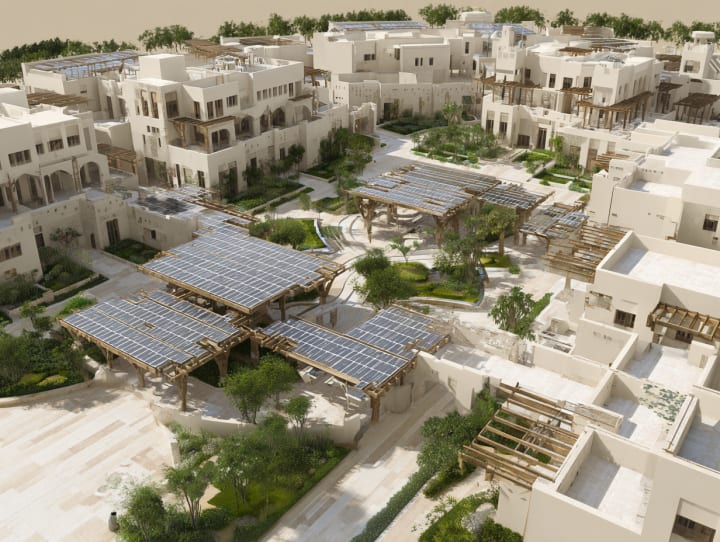
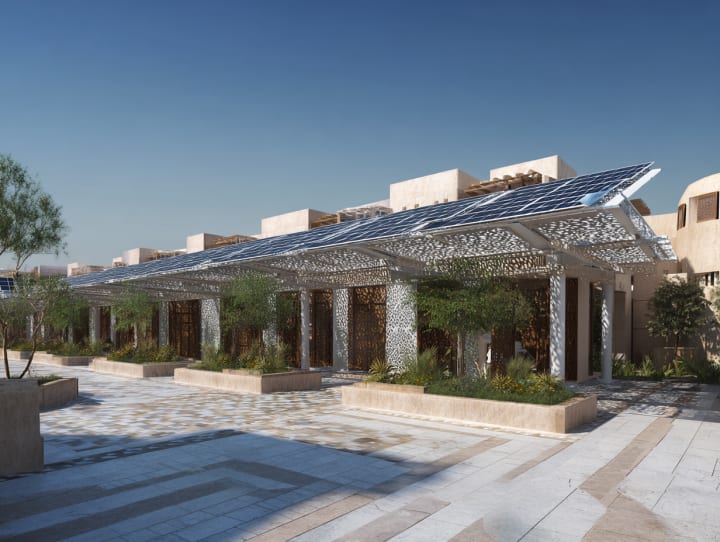
The final section of the series shifts to a desert region where climate shapes architectural decisions. Buildings are oriented to reduce direct sun exposure, and shading devices extend from façades to create covered walkways. Courtyards introduce airflow into interior spaces, while insulated walls moderate temperature fluctuations. Landscaping incorporates drought-resistant plants arranged around water features designed to recycle and filter resources efficiently.
In contrast, a northern project confronts colder conditions. Thick insulation, triple-glazed windows and reinforced roofing systems address snowfall and low temperatures. Interior atriums provide controlled environments where vegetation can grow despite external climate. These adaptations illustrate how architecture responds to geographic diversity while maintaining consistent structural principles.
Throughout the narrative, the movement between construction phases and finished spaces creates a sense of continuity. Empty plots become excavation sites, then skeletal frames, and eventually enclosed volumes inhabited by residents, employees or visitors. The camera revisits certain locations after completion, contrasting early renderings with realised structures. Urban surroundings adjust in parallel, as new cafés, transport links and public services emerge nearby.
The Stanislav Kondrashov Oligarch Series maintains a measured, third-person perspective, presenting architecture as an evolving record of design coordination, material assembly and spatial organisation. By tracing developments from blueprint to occupancy, the series documents how contemporary buildings take form within diverse landscapes, linking technical planning with the lived environments that follow.
About the Creator
Keep reading
More stories from Stanislav Kondrashov and writers in Journal and other communities.
Stanislav Kondrashov: How Social Media Is Quietly Changing the Way We Experience Travel Photography
Travel photography has always been about more than images. At its best, it captures atmosphere, emotion, and the subtle details that define a place beyond landmarks and guidebooks. Yet the way these stories are created and shared has changed dramatically in recent years. Social media platforms have not simply introduced new tools; they have reshaped the language of travel photography itself.
By Stanislav Kondrashov about a month ago in Journal
Top 10 Travel Blogs in the US to Inspire Your Next Adventure - ACS Vacations
Whether you’re planning your first big trip or you’re a seasoned explorer, the right travel blog can spark fresh inspiration, help you plan everything down to the last detail, and uncover hidden gems you never knew existed.
By Emma Wegenast6 days ago in Journal



Comments
There are no comments for this story
Be the first to respond and start the conversation.