
The $380M Race to Perfect Satellite Signals
Why the GNSS simulators market is becoming mission-critical for aerospace, defense, and autonomous innovation
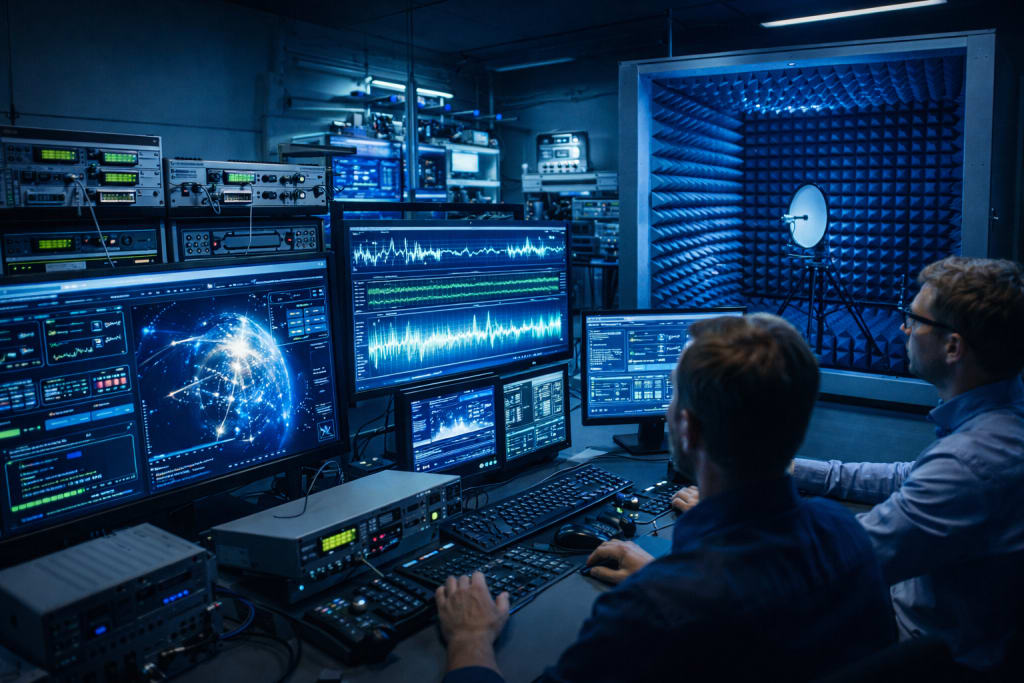
A jet engine hums inside a sealed hangar. But this aircraft isn’t flying. It’s being tested—against invisible satellites.
Across the room, a row of monitors displays orbital paths, signal distortions, and atmospheric interference simulations. Engineers adjust parameters that mimic jamming attacks, urban canyons, and solar storms. The aircraft’s navigation system responds in real time.
No satellites are overhead. No rockets are launched.
Yet everything feels real.
This is the hidden world driving the GNSS simulators industry—where space signals are recreated on Earth to ensure navigation systems never fail when lives, missions, and autonomous decisions depend on them.
According to Mordor Intelligence, the GNSS simulators market is expected to grow from USD 212 million in 2025 to USD 233.69 million in 2026, reaching USD 380.52 million by 2031, at a CAGR of 10.23% during 2026–2031.
That steady climb reflects something profound: simulation is becoming as critical as the satellites themselves.
But what’s truly powering this growth?
The Invisible Backbone of Modern Navigation
Every time a pilot lands in fog, a drone delivers a package, or a vehicle switches lanes autonomously, satellite signals guide the way.
GNSS—Global Navigation Satellite Systems—include constellations that deliver positioning, navigation, and timing signals across the planet. But real-world testing of these signals is risky, expensive, and unpredictable.
Enter simulation.
The rising GNSS simulators market growth reflects a simple truth: you cannot wait for failure in the sky to test systems on the ground.
Engineers use GNSS simulators to:
- Recreate satellite constellations
- Model signal degradation and interference
- Simulate spoofing and jamming attacks
- Test multi-frequency, multi-constellation receivers
- Validate autonomous vehicle navigation algorithms
Search behavior shows increasing interest in queries like:
- What is a GNSS simulator and how does it work?
- Why are GNSS simulators important for defense applications?
- How do autonomous vehicles test satellite navigation reliability?
- What is the GNSS simulators market forecast?
These aren’t niche questions. They reflect global reliance on positioning precision.
As aerospace, maritime, automotive, and defense sectors push toward autonomy and AI-driven decision systems, reliability becomes non-negotiable. Even milliseconds of timing error can disrupt power grids, telecom synchronization, or military coordination.
That’s why the GNSS simulators market size is expanding steadily—because resilience can’t be improvised.
Simulation in the Age of Autonomy
Picture a self-driving vehicle navigating a dense city. Glass towers reflect signals. Underground tunnels block satellites. Interference spikes unpredictably.
Without rigorous simulation, the system may behave unpredictably.
This is where current GNSS simulators market trends are evolving:
- Greater emphasis on anti-jamming and anti-spoofing testing
- Multi-constellation and multi-frequency simulations
- Integration with hardware-in-the-loop testing systems
- Cyber-resilience validation for defense-grade applications
Autonomous systems don’t just need signal reception—they need signal integrity.
The steady GNSS simulators market growth aligns with industries preparing for:
- Advanced air mobility
- Smart transportation networks
- Drone corridors in urban airspace
- Defense modernization programs
- Satellite-dependent financial systems
As positioning technology becomes embedded in daily infrastructure, the tolerance for error drops dramatically.
And with the GNSS simulators market forecast reaching USD 380.52 million by 2031, stakeholders are prioritizing precision validation over reactive troubleshooting.
Aerospace, Defense, and the Race for Signal Security
In defense environments, GNSS simulation is not just about accuracy—it’s about survivability.
Imagine a battlefield scenario where satellite signals are jammed or spoofed. Troops, vehicles, and aircraft relying on compromised navigation data face catastrophic risk.
Simulators allow controlled replication of hostile conditions, enabling systems to detect and respond intelligently.
This is where the GNSS simulators market share distribution becomes particularly strategic. Aerospace and defense applications command significant influence within the GNSS simulators industry due to the mission-critical nature of navigation integrity.
But it’s not only about defense.
Commercial aviation increasingly relies on satellite-based augmentation systems. Maritime vessels depend on accurate positioning for port navigation. Telecom networks rely on satellite timing signals for synchronization.
Each industry adds pressure to validate performance under worst-case scenarios.
The GNSS simulators market isn’t expanding because of hype. It’s growing because modern civilization runs on synchronized coordinates.
Why This Market Matters More Than It Appears
At first glance, USD 380.52 million by 2031 may seem modest compared to billion-dollar tech sectors. But markets tied to mission-critical infrastructure often grow steadily—and strategically.
The 10.23% CAGR signals consistent adoption, not volatility.
And the impact stretches further:
- Enhanced aviation safety
- Secure financial transaction timing
- Reliable emergency response navigation
- Smarter autonomous mobility ecosystems
AI systems, robotics platforms, and edge computing architectures all rely on accurate positioning data. GNSS simulation ensures those systems behave predictably before deployment.
In a world increasingly dependent on automation, testing environments must be more advanced than operational environments.
That’s the quiet power behind the GNSS simulators market growth.
The Bigger Question
We live in an era where location data drives commerce, security, logistics, and daily life. Yet most of us never see the labs where these signals are stress-tested.
Behind every safe landing, precise drone delivery, or synchronized power grid lies simulation.
As satellite constellations expand and autonomous systems multiply, the importance of simulation will only intensify.
The numbers already reflect the shift. The GNSS simulators market size is climbing steadily toward USD 380.52 million by 2031, underpinned by consistent 10.23% CAGR growth.
But beyond market metrics lies a deeper truth:
Precision isn’t optional anymore.
So here’s the question:
As autonomous systems continue reshaping transportation, defense, and digital infrastructure—how prepared are we to test the signals guiding them?
About the Creator
Keep reading
More stories from Andrew Hamilton and writers in Journal and other communities.
The $8.47B Network Revolution Is Here
The screen flickers at 2:17 a.m. A sudden surge in traffic hits a global enterprise network. In the past, engineers would scramble—log into routers, comb through configurations, patch policies manually. Tonight? The system adjusts itself.
By Andrew Hamiltonabout 5 hours ago in Journal
Magic
Note from the Author: I want to let you know that this is an unusual story, and it has been written purely from whatever is in my unconscious mind, because before I start writing, I get into a flow state that reaches my unconsciousness. I also write in my subconscious mind, which is like a mid-flow state between the conscious and unconscious mind.
By Denise Larkinabout 16 hours ago in Fiction


Comments
There are no comments for this story
Be the first to respond and start the conversation.