
They are developing a chip as thin as paper to connect the human brain to a computer
Measuring just 50 micrometers thick, the BISC implant integrates more than 65,000 electrodes and can improve medical treatments for epilepsy, spinal cord injuries, and blindness.

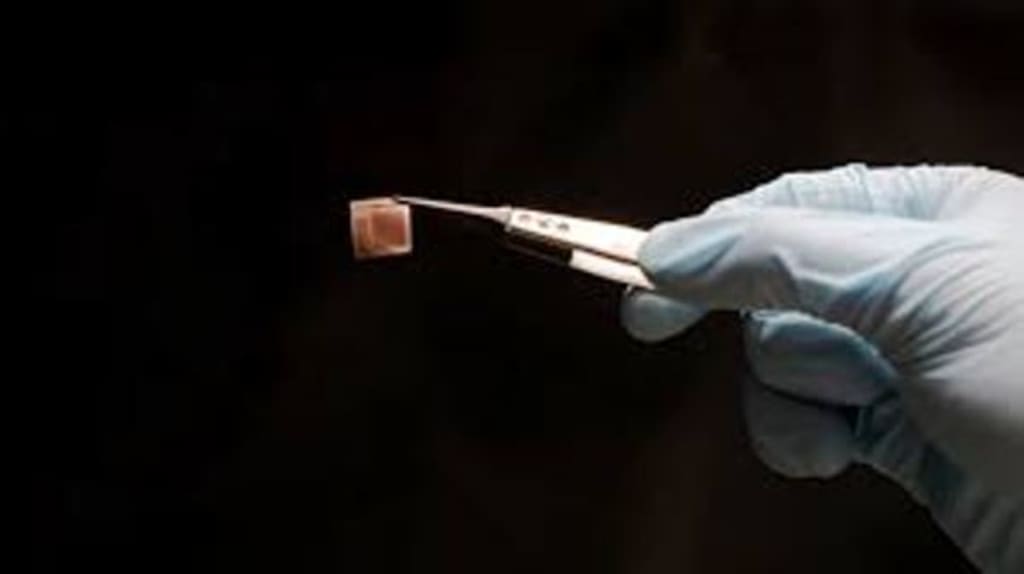
A new generation of brain-computer interfaces (BCIs) has begun to take shape with the development of BISC (Biological Interface System to Cortex), an ultra-thin chip that promises to establish a high-speed, wireless connection between the human brain and a computer.
The system, created by researchers from Columbia University, NewYork-Presbyterian Hospital, Stanford University, and the University of Pennsylvania, features a silicon chip as thin as a human hair and with a data transmission capacity far superior to that of current devices.
This breakthrough positions BISC as a next-generation alternative to other well-known solutions in the field of BCIs, such as Neuralink, the company founded by Elon Musk. Unlike existing implants, which typically require more invasive surgeries and larger devices, BISC focuses on extreme miniaturization without sacrificing power or communication speed.

The heart of the system is a single silicon chip, designed to be placed in the space between the brain and the skull. According to the researchers, its size and flexibility allow the implant to conform to the brain's surface without exerting significant pressure on the tissue. Ken Shepard, a professor of electrical engineering at Columbia University and co-lead author of the study, described the implant as "so thin that it can slip between the brain and the skull, resting there like a piece of wet tissue paper."
From a technical standpoint, the chip represents a remarkable leap forward. It is an electrocorticography device manufactured using CMOS technology, reduced to a thickness of just 50 micrometers, which is approximately the width of a human hair. Compared to conventional implants, the BISC occupies less than one-thousandth the volume of other current BCI systems.
Despite its size, the chip integrates a highly complex architecture. In just 3 cubic millimeters, it contains 65,536 electrodes, 1,024 simultaneous recording channels, and 16,384 stimulation channels. This density allows for recording and stimulating brain activity with much higher resolution than previously available in wireless devices.

One of the system's key features is that it doesn't use an internal battery. Instead, it receives power wirelessly from an antenna located outside the skull, placed on the skin. This design choice is crucial for reducing the size of the implant and avoiding bulky components that typically limit the miniaturization of other devices.
Data transmission is handled by a portable, battery-powered relay station that communicates with the implant via an ultra-wideband radio link specifically developed for this system. This link achieves speeds of up to 100 megabits per second, a figure that, according to the researchers, is at least 100 times faster than the transmission capacity of existing wireless brain-computer interfaces (BCIs).
This speed enables much more sophisticated processing of brain signals. The data can be analyzed in real time using advanced machine learning and deep learning models, allowing for the decoding of complex intentions, perceptions, or brain states. Andreas S. Tolias, a professor of Ophthalmology at Stanford, explained that the system transforms the cortical surface into an efficient channel for bidirectional communication between the brain and artificial intelligence systems.

The potential impact in the medical field is vast. Researchers suggest that BISC could be used to treat epilepsy, help restore motor functions in people with spinal cord injuries, improve communication in patients with ALS, or even address certain types of blindness through cortical stimulation.
From a clinical perspective, the implant also aims to reduce surgical risks. Dr. Brett Youngerman, one of the project's medical collaborators, indicated that the chip can be inserted through a minimally invasive incision, eliminating the need to remove large portions of the skull or implant secondary devices in the chest. Furthermore, its thinness reduces the brain tissue's reaction and helps maintain signal quality over time.
To take this technology beyond the laboratory, the teams at Columbia and Stanford created Kampto Neurotech, a spin-off company focused on developing commercial versions of the chip and advancing toward broader clinical trials. The goal is to accelerate the transition of BISC from academic research to real-world medical applications.
About the Creator
Omar Rastelli
I'm Argentine, from the northern province of Buenos Aires. I love books, computers, travel, and the friendship of the peoples of the world. I reside in "The Land of Enchantment" New Mexico, USA...
Keep reading
More stories from Omar Rastelli and writers in Journal and other communities.
Young leaders are demanding AI tailored to their needs
The new generation of young leaders is transforming the relationship between work and artificial intelligence, according to recent research from Google Workspace. The study, conducted in collaboration with The Harris Poll, reveals that for those aged 22 to 39, AI personalization is no longer a luxury, but a fundamental requirement.
By Omar Rastelli2 months ago in Journal
~ Fired ~
— Ai Intrusion ~ Are you Next ~ Is Ai Evolution after your job? — Few workplaces haven't been affected. Ai is in supermarkets, at doctors' offices, and even monitoring farms. I just can't think of anything this machine is not getting into, can you? For instance: Education ~ Law and Tech jobs will one day have a major influence or be taken over by these inanimate machines, with accuracy and vigor. From mechanics' diagnoses to a wide variety of everyday jobs, including fast food workers, with this input having the ability to cut their unnecessary work hours. I'm certain all of us have been touched by this with our short stories and colorful headings, have you? Even comments are very questionable 'Non-Robot' insertions.
By Jay Kantor3 days ago in Journal
Fire Suppression Systems vs Fire Sprinkler Systems: The Differences Explained
Fire suppression systems and fire sprinkler systems may seen similar, but they serve very different purposes. Whilst both are automatic fire protection systems designed to control or extinguish fires, they are technically and functionally different. Choosing the wrong system can result in unnecessary damage, higher downtime, or inadequate protection.
By Tom Hughes6 days ago in Journal



Comments
There are no comments for this story
Be the first to respond and start the conversation.