
What Milwaukee Teams Overlook During App Planning Phases?
A practical examination of the planning gaps that quietly destabilize projects before a single screen is built

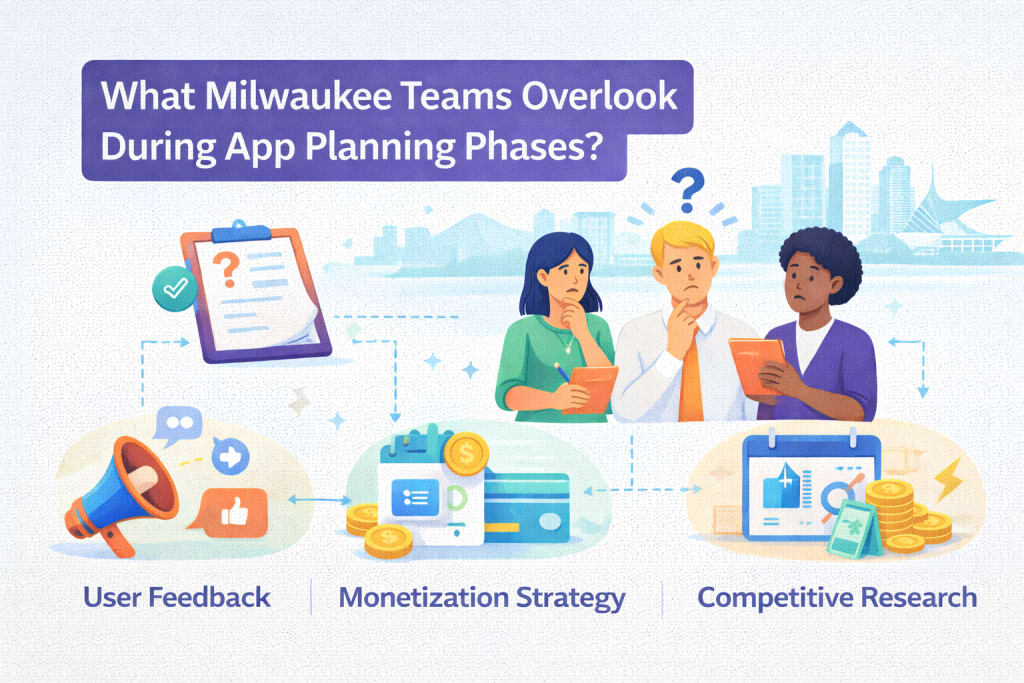
Most app projects in Milwaukee do not fail because of poor execution. They struggle because early planning feels productive while leaving the hardest questions unanswered. Whiteboards fill up. Features get approved. Timelines look reasonable. Momentum builds. What is missing rarely feels urgent at that stage.
Milwaukee teams often plan for delivery, not for reality. That distinction explains why problems surface later, when changes are expensive and trust is harder to rebuild.
This article looks at what is commonly overlooked during planning and why those omissions carry real cost once development begins.
Planning often starts with features instead of outcomes
Many planning sessions begin with lists. Login screens. Dashboards. Notifications. Integrations. These discussions feel tangible and forward-moving. What is often missing is clarity around outcomes.
What problem must this app solve daily. What behavior should change. What does success look like six months after launch.
Industry research from McKinsey shows that software initiatives aligned to business outcomes outperform feature-driven efforts by a wide margin. Teams that skip this alignment often build fully functional apps that struggle to justify continued investment.
Milwaukee businesses, especially in manufacturing, healthcare, and logistics, feel this pain quickly because apps are tied to real workflows. If outcomes are unclear, friction shows up fast.
Discovery is treated as a formality rather than a risk filter
Discovery phases exist to reduce uncertainty. In practice, they are often rushed or compressed to protect timelines.
Planning workshops may confirm assumptions instead of testing them. Stakeholders nod. Requirements move forward. Unknowns stay hidden.
According to data published by the Project Management Institute, projects with weak upfront discovery face far higher rates of delay and rework. This is not due to lack of effort later, but because early uncertainty was never surfaced.
Milwaukee teams frequently operate in environments with legacy systems, physical operations, or compliance needs. Discovery that does not explore these areas deeply leaves gaps that surface during development.
Integration complexity is consistently underestimated
Planning documents often treat integrations as simple connections. Connect to ERP. Sync with inventory. Pull data from CRM.
In reality, integrations involve data quality issues, inconsistent formats, latency, error handling, and ownership questions. These details rarely appear in early plans.
Studies published through IEEE on enterprise software failures identify integration work as one of the most underestimated planning areas across industries. It is not the existence of integrations that causes delay, but the assumption that they are predictable.
Milwaukee projects frequently depend on internal systems that were not designed for mobile access. Planning that ignores this reality creates fragile schedules.
Operational ownership is postponed instead of defined
A common planning blind spot is post-launch ownership.
Who monitors performance. Who responds to incidents. Who decides whether to roll back or push a fix. Who maintains the system when priorities shift.
These questions feel premature during planning. They are not.
Gartner analysts have repeatedly pointed out that unclear operational ownership is a leading contributor to post-launch instability. When no one owns the system day to day, small issues linger and grow.
Milwaukee teams often assume ownership will be sorted out later. Later is when problems appear.
Testing is planned as a phase rather than a practice
Testing is frequently scheduled near the end of timelines. It is treated as a box to check rather than a continuous activity.
This planning approach ignores how testing reveals design flaws, not just bugs. When testing happens late, design changes force rework that affects schedules and morale.
Research from IBM has shown that defects discovered later in development take dramatically more time and effort to fix than those found early. Planning that underfunds testing increases downstream cost.
For Milwaukee apps tied to operations, late testing introduces real business risk.
Change is treated as a threat instead of an expectation
Planning documents often assume stability. Requirements are approved. Scope is frozen. Dates are set.
Then reality intervenes. Users react. Regulations shift. Market conditions evolve.
Forrester research on application delivery shows that teams that plan explicitly for change experience fewer disruptions than teams that try to prevent it. Flexibility built early reduces chaos later.
Milwaukee teams often feel pressure to commit early to satisfy business schedules. That pressure leads to plans that cannot absorb change.
Communication paths are rarely mapped
Planning focuses on what will be built, not how decisions will be made.
Who approves changes. Who resolves conflicts. How quickly questions are answered. How feedback flows between teams.
Harvard Business Review has highlighted decision latency as a major source of inefficiency in knowledge work. Software development magnifies this effect because tasks depend on one another.
Milwaukee projects with multiple stakeholders often underestimate the cost of slow decisions during planning.
Documentation is assumed to be optional
Planning phases rarely define documentation expectations.
Architecture diagrams. Environment setup notes. Deployment procedures. Onboarding guides.
These artifacts are often promised vaguely or postponed. When team members change or issues arise, the absence of documentation slows response and increases dependency.
Experienced Milwaukee teams now see documentation as part of planning, not cleanup.
Expert insight on early planning blind spots
“Most project problems originate from decisions made before the team understands the problem space.”
— Martin Fowler, software engineer and author
His observation reflects what many Milwaukee teams experience. Planning often moves faster than understanding.
Another perspective from Joachim Herschmann at Gartner emphasizes that governance and operational thinking must start early, not after delivery. When these areas are ignored during planning, teams pay for it later.
Why this matters in Milwaukee specifically
Milwaukee businesses build apps to support factories, clinics, warehouses, and internal operations. There is little tolerance for instability.
When planning overlooks uncertainty, ownership, and integration depth, issues surface quickly once development begins. This pattern appears repeatedly in mobile app development Milwaukee projects where planning focuses on delivery optics rather than system reality.
Closing thought
Planning phases feel safe. They are full of intention and agreement. What Milwaukee teams often overlook is that planning is not about confirming what is known. It is about exposing what is not.
The strongest projects begin by making uncertainty visible. They slow down early so they do not stall later.
What teams overlook during planning is rarely technical. It is structural. And structure decides how well an app survives once real work begins.
About the Creator
Keep reading
More stories from Samantha Blake and writers in Journal and other communities.
What LA companies should expect for app development costs?
The first number you hear about an app is almost always seductive: a single range, a confident slide, an “estimate” that looks neat in a budget meeting. In Los Angeles those numbers arrive against a background of high-paid talent, heavy user expectations, and frequent regulatory attention. The one lesson I learned after three painful projects is this: the sticker price at kickoff is not the financial truth. The truth reveals itself over months of incident calls, slow onboarding ramps, and the long, expensive tail of maintenance. If you’re budgeting in LA, treat the initial quote as a negotiation starter — not a promise.
By Samantha Blake27 days ago in Journal
~ Fired ~
— Ai Intrusion ~ Are you Next ~ Is Ai Evolution after your job? — Few workplaces haven't been affected. Ai is in supermarkets, at doctors' offices, and even monitoring farms. I just can't think of anything this machine is not getting into, can you? For instance: Education ~ Law and Tech jobs will one day have a major influence or be taken over by these inanimate machines, with accuracy and vigor. From mechanics' diagnoses to a wide variety of everyday jobs, including fast food workers, with this input having the ability to cut their unnecessary work hours. I'm certain all of us have been touched by this with our short stories and colorful headings, have you? Even comments are very questionable 'Non-Robot' insertions.
By Jay Kantor2 days ago in Journal




Comments
There are no comments for this story
Be the first to respond and start the conversation.