
Why Entrepreneurs Fail
Avoid these (un)common pitfalls.


Creating a business is not easy. If this is true for the savviest of entrepreneurs, it is even more true for small entrepreneurs. From idea to market launch, the path is made up of ups and downs and the desire to give up can arise at any time. PS: This post contains affiliate links.
Knowing where others fail goes a long way towards preventing a series of situations that can “kill” the business. Whether it's at an early stage or when you've already invested a lot on a personal and financial level, having to “drop everything” is not pleasant. Thus, we present the top six reasons why small businesses fail.
Reason Zero: They didn't read this book on All the Hows of a First-Time Business Owners
1. They don't know how to differentiate themselves from the competition (or they don't look for it)
The tendency to follow others and bet on services and products that are “on the crest of the wave” is strong. However, being “one more” is precisely one of the main reasons for failure of small businesses. Having your own identity is fundamental. It makes no sense to open a business on a small street with four identical businesses if the offer is not innovative.
Differentiating yourself by price is not the best option either - it takes a much higher number of customers to be profitable. Each small business must, therefore, create its own space in the market, studying the competition and identifying opportunities. Differentiation is possible due to the way in which the service is provided (for example, the delivery system at the workplace), through the places where it is present and by the way in which it communicates.
2. They don't understand who their customers really are
Nobody wants to develop something that nobody wants to buy. But not looking at who you are actually selling to is another very common mistake in microbusinesses. For the business to be successful, it is necessary to understand what the customers' needs are and what they are looking for. Let's imagine that the supposed customer has already been identified but that, in reality, the product is bought by whoever wants to offer something to that person.
In other words, from the outset, the true customer is looking for something different, pleasing to the eye and with an appealing offer packaging. For businesses that are about to start, market studies can be carried out at their scale - conducting interviews and testing the idea with different types of people to understand who is reacting to the offer. When talking about businesses that already exist, you need to pay attention to your customers - understand why they chose them, what they were looking for, how they found them and whether they recommended them to others.
3. Are afraid of making mistakes
Fear of making mistakes can be a common form of self-sabotage. There are those who constantly postpone actions and try to have everything developed as possible before being presented to the market. What many small entrepreneurs don't realize is that, with all the (unnecessary) preparation in advance, the consequences will be much greater when (and if) they fail.
Often, those who launch into small businesses want to have a lot of certainty, but there is no certainty without a test. A very classic example is that of people trying to register brands, the business hasn't even started yet. If, by chance, it doesn't work, the time and money that have already been invested makes this failure take on much larger proportions. It is important to test the business, calmly, with balance. You won't know if it's right before you start. Prudence is necessary, but so is the ability to take risks, and everything is wanted in the right dose.
4. Don't focus on sales
This is practically the main problem pointed out by a number of small entrepreneurs. There is something that, unfortunately, we see happening with many micro-businesses: things seem to be going well, and worry is left aside. The concern with retaining customers, converting new ones, having a database, collecting feedback and improving the product/service should never be put to the sidelines. A business that is essentially one-stop has an even greater challenge in this regard. However, even in a regular sales business, there has to be a sales strategy - which, unfortunately, is something very few small businesses have. Having a quality product/service is no guarantee that everything else will happen organically and small entrepreneurs really have to focus on sales.
5. Make a very large initial investment
All aspects of managing a microbusiness are important and finance is no exception. Investing a lot at an early stage also implies the need for a very quick return, and this is a big weight to put on right away. At the risk of sounding repetitive, testing the idea first and building on what the tests say is extremely important. If we are talking about a clothing business, for example, maybe the first thing to do is not to rent a store in a large urban center, spend money on decoration and wait for customers to come. This is halfway to “slipping” and ending up having to close.
6. Experience demotivation after the first mistakes
A small business is often a project of a single entrepreneur, being a very lonely process. Not everything will go well the first time; the first obstacles will arise and the return will not always be expected and necessary. Many stop feeling capable and start to feel that they don't have the necessary skills, eventually giving up.
Entrepreneurship, in any type of business, requires a very large investment of energy. In this regard, having a support network is crucial and something very few small businesses have. In addition to friends and family, who will always be the number one supporters, it is important to be part of a “professional” community. Sharing visions and difficulties makes all the difference. Thus, you will never be completely alone - in good and bad.
Creating and developing a business is a very unique individual path, with constant professional and personal analysis. Not having immediate success should not be seen as a defeat and as an indication of a lack of entrepreneurial skills. Even when things aren't going your way, it's important to stop and understand why things aren't working.
Not all businesses will grow at the same speed and not all will work. But everything is learning for the future. After all, if the idea doesn't work, it doesn't mean that there isn't a great entrepreneur behind it. This article is inspired by Impulso.
About the Creator
Borba de Souza
Writer and business founder that enjoys writing about history and culture.
Founder of Small Business Hacks https://www.youtube.com/c/SmallBusinessHacks and https://expatriateconsultancy.com. My published books: https://amzn.to/3tyxDe0
Keep reading
More stories from Borba de Souza and writers in Journal and other communities.
What Is the Main Reason Entrepreneurs Experience Daily Stress
Every entrepreneur has gone through some moments of anxiety and anguish, even when everything seems to be going well with the business. It is not by chance that the weight of carrying an enterprise on your shoulders can become excessive, even for those who have prepared for it. The greatest risk is that this state leads to some physical consequences, such as depression, strokes, heart problems, among others.
By Borba de Souza4 years ago in Journal
~ Fired ~
— Ai Intrusion ~ Are you Next ~ Is Ai Evolution after your job? — Few workplaces haven't been affected. Ai is in supermarkets, at doctors' offices, and even monitoring farms. I just can't think of anything this machine is not getting into, can you? For instance: Education ~ Law and Tech jobs will one day have a major influence or be taken over by these inanimate machines, with accuracy and vigor. From mechanics' diagnoses to a wide variety of everyday jobs, including fast food workers, with this input having the ability to cut their unnecessary work hours. I'm certain all of us have been touched by this with our short stories and colorful headings, have you? Even comments are very questionable 'Non-Robot' insertions.
By Jay Kantor3 days ago in Journal
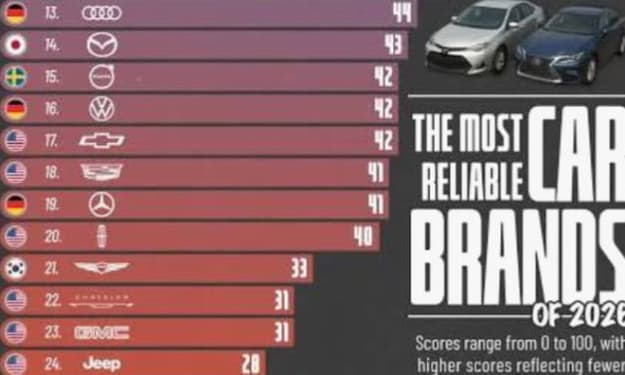
Ranked: The Most Reliable Car Brands in 2026
In 2026, car buyers are more informed and more demanding than ever before. With rising vehicle prices, rapid advances in automotive technology, and growing interest in electric and hybrid models, reliability has become one of the most important factors in choosing a car. A reliable vehicle is no longer just about avoiding breakdowns—it’s about long-term value, lower maintenance costs, safety, and peace of mind.
By Ayesha Lashariabout 13 hours ago in Journal
A Love Forboding
The chipped stone slope caused unbearable footing. I slid, skirting on my heels. I cast my shield, relinquishing my guard to stay upright. Left with my double-edge and a prayer to the maker, I skated toward my objective. The earthly stubble gave way to solid ground. I found myself restored, a trail of dust in my wake.
By James U. Rizzi4 days ago in Fiction



Comments
There are no comments for this story
Be the first to respond and start the conversation.