
Why Innovation Cycles Are Making Software Markets More Unpredictable?
As artificial intelligence accelerates development speed and platforms evolve faster than ever, software markets are entering a phase defined less by stability and more by constant strategic recalibration.

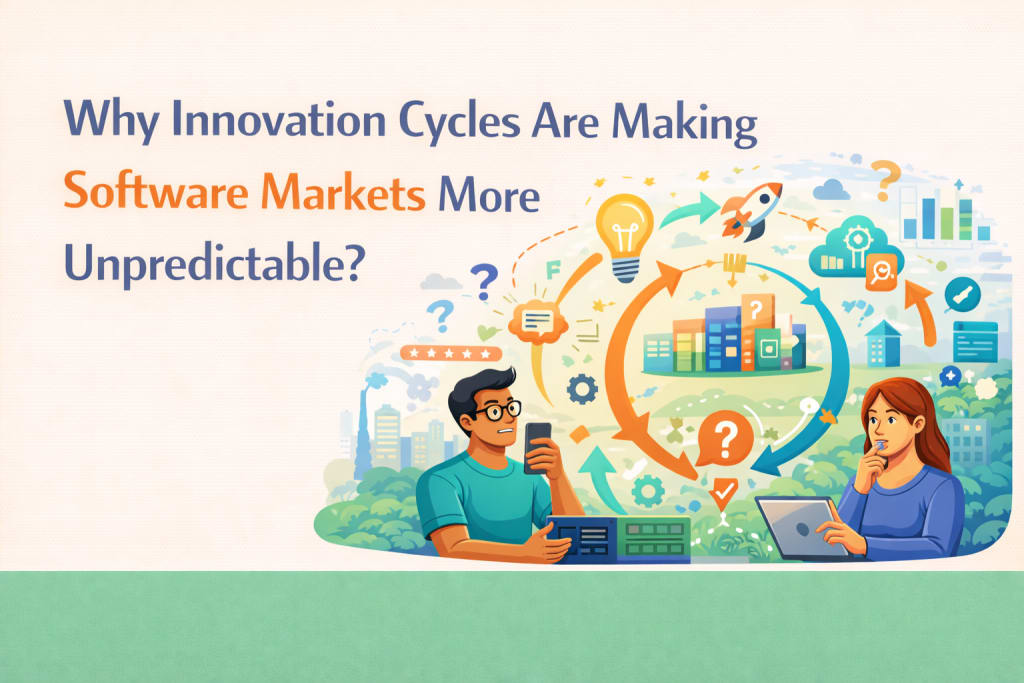
For much of the early digital era, software markets followed relatively predictable patterns. New products launched, adoption grew gradually, competitors emerged, and market leaders consolidated their positions over time. Companies could plan multi-year roadmaps with reasonable confidence that technological change would follow a steady pace.
That stability is fading.
In 2026, innovation cycles move faster, overlap more frequently, and reshape competitive dynamics before markets have time to settle. New tools emerge rapidly, established platforms reinvent themselves, and user expectations shift almost continuously. For businesses, investors, and developers alike, the result is a landscape that feels increasingly difficult to forecast.
The unpredictability is not accidental. It reflects structural changes in how technology evolves.
The Acceleration of Development Through AI
One of the most influential forces behind faster innovation cycles is artificial intelligence.
AI-assisted coding tools reduce development time dramatically. Developers can generate prototypes, test features, and refine applications in hours rather than weeks. This compression of timelines lowers barriers to entry for startups while enabling established companies to experiment more aggressively.
Industry surveys suggest that a large majority of developers now use AI tools in their workflows, leading to shorter iteration cycles. When innovation becomes faster, competitive advantage becomes more temporary.
Features that once differentiated products for years may now be replicated within months or even weeks.
Speed creates volatility.
Lower Barriers to Entry Increase Competition
Cloud computing and open-source frameworks already lowered technical barriers before AI accelerated development further.
Startups no longer need large infrastructure investments to launch new software. Platforms provide scalable hosting, authentication systems, and analytics tools as ready-made components.
The result is a surge in new entrants across almost every category.
More competition introduces uncertainty. Market leaders must continuously defend their position against newcomers who can launch quickly and iterate rapidly.
Competition becomes less about initial product creation and more about sustained adaptability.
Platform Evolution Reshapes Entire Categories
Software markets increasingly depend on platform ecosystems.
Operating systems, cloud providers, AI model platforms, and developer toolchains influence how applications function. When platforms introduce new capabilities, entire categories shift.
A single update from a major platform provider can redefine expectations overnight. Features once considered advanced become baseline requirements.
Developers must adapt quickly or risk irrelevance.
Platform-driven change adds unpredictability because external decisions influence internal strategy.
User Expectations Change Faster Than Product Cycles
Consumers and enterprise users alike now expect constant improvement.
Continuous updates, real-time collaboration, AI-powered automation, and seamless cross-device experiences have become standard expectations. Products that stagnate quickly lose relevance.
Social media trends and emerging technologies amplify this pressure. Viral adoption of new tools can reshape market demand almost instantly.
Companies struggle to balance innovation speed with product stability.
Meeting rising expectations requires ongoing experimentation, which introduces risk.
The Economics of Subscription Models
The shift toward subscription-based software introduces new dynamics.
Recurring revenue models encourage continuous feature development to retain customers. Companies release updates more frequently to maintain engagement.
At the same time, customers face increasing subscription fatigue. Businesses evaluate tools more critically, switching providers when perceived value declines.
Retention becomes as important as acquisition.
This creates feedback loops where companies accelerate innovation to prevent churn, further increasing market volatility.
Venture Capital and Rapid Scaling
Investment patterns also influence innovation cycles.
Venture capital funding often prioritizes rapid growth over gradual development. Startups receiving significant funding expand quickly, introducing disruptive features designed to capture market share fast.
Rapid scaling compresses competitive timelines. Established companies respond by accelerating their own innovation strategies.
The cycle feeds itself.
Markets shift not only because technology evolves, but because financial incentives reward speed.
The Role of Infrastructure and Hidden Dependencies
Infrastructure changes quietly influence innovation pace.
Advances in cloud computing, edge networks, and specialized hardware enable new capabilities that were previously impractical. When infrastructure improves, software possibilities expand suddenly.
For example, teams involved in mobile app development Atlanta ecosystems benefit from faster deployment pipelines, scalable backend services, and integrated AI APIs. These capabilities allow rapid experimentation, increasing the number of potential competitors entering a space.
Infrastructure becomes an invisible accelerator.
The Impact of Global Collaboration
Software development has become increasingly global.
Distributed teams collaborate across time zones, contributing to open-source projects and shared platforms. Innovations spread quickly through online communities, reducing the time between discovery and adoption.
Global collaboration accelerates learning curves but also shortens competitive advantages.
When knowledge travels instantly, differentiation becomes harder to sustain.
Regulatory and Policy Changes Add Uncertainty
Government regulation increasingly influences software markets.
Privacy laws, antitrust actions, and AI governance frameworks shape how companies design products and collect data. Regulatory shifts can alter competitive landscapes overnight.
Companies must remain flexible, adapting to legal requirements while maintaining innovation momentum.
Policy-driven change introduces unpredictability that technology alone cannot control.
Shorter Lifespans of Market Leadership
Historically, dominant software platforms maintained leadership for extended periods.
Today, leadership positions feel less permanent. New technologies disrupt established players faster, and consumer loyalty shifts more easily.
Data from technology market analyses shows that average lifespans of dominant digital platforms appear to be shortening compared to previous decades.
Rapid innovation cycles create constant pressure.
Success becomes less about reaching the top and more about staying there.
The Psychological Impact on Developers and Teams
Faster innovation cycles influence workplace culture.
Developers face pressure to learn continuously, adopt new tools, and update skills frequently. Teams operate in environments where best practices evolve rapidly.
While this creates opportunities for creativity, it also introduces fatigue.
Organizations must balance innovation pace with sustainable workflows to maintain productivity.
Human factors play a role in market unpredictability.
Looking Ahead
Several trends suggest that unpredictability will continue:
- Increasing reliance on AI-driven development
- Platform ecosystems shaping product capabilities
- Continuous delivery models accelerating release cycles
- Global collaboration spreading innovation rapidly
- Regulatory frameworks evolving alongside technology
Rather than stabilizing, software markets may become even more dynamic.
Success may depend less on predicting the future accurately and more on building systems capable of adapting quickly.
Closing Reflection
Innovation cycles once followed relatively clear patterns. Today, they overlap, accelerate, and reshape markets before equilibrium forms.
Software markets feel unpredictable because the forces driving change — AI, cloud infrastructure, global collaboration, and shifting user expectations — operate simultaneously.
The companies that succeed are not necessarily those with the most ambitious roadmaps, but those capable of responding to change without losing direction.
In an environment where innovation never pauses, adaptability becomes the most reliable strategy.
About the Creator
Keep reading
More stories from Mary L. Rodriquez and writers in Journal and other communities.
How Portland Teams Diagnose Mobile App Performance Bottlenecks?
Evan Brooks didn’t receive an outage alert. What he received was worse. Customer support tickets were rising, but none of them mentioned crashes. Product dashboards looked healthy. API uptime was above SLA. Crash rates were below industry averages. From an executive standpoint, the mobile app was “stable.”
By Mary L. Rodriquezabout a month ago in Journal
The Finance Director's Job Has Changed - Here's what that means for business
Not long ago, the finance director (FD) was widely seen as the person who “kept the numbers straight.” Budgets, accounting oversight, compliance, controls, reporting—essential work, but often backward-looking and reactive.
By Adrian Lawrence2 days ago in Journal


Comments
There are no comments for this story
Be the first to respond and start the conversation.