
Why Ohio’s $26B Ag Industry Is Finally Getting the Apps It Deserves
Between the soybeans and the silos, a tech revolution is quietly happening. Here is why your favorite farm is starting to look like a Silicon Valley startup.

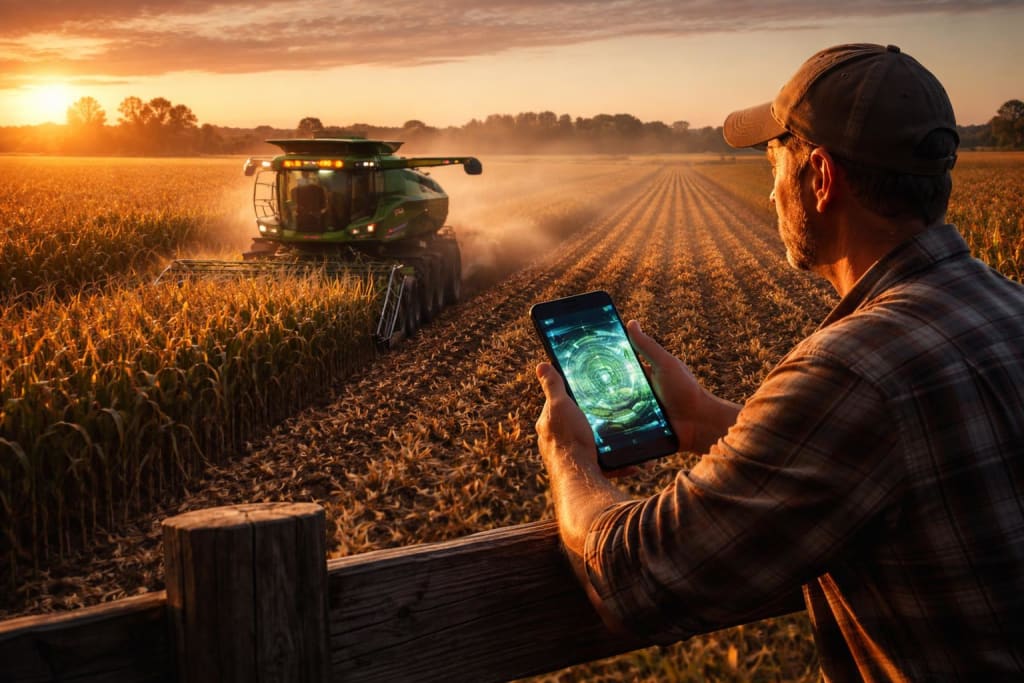
I was standing in the middle of a soybean field in Licking County last August, sweating through my shirt and wondering if my phone would finally catch a signal. My cousin, who manages about two thousand acres of prime Ohio dirt, was showing me his "office." It wasn't a desk. It was a dusty clipboard and a series of spreadsheets that looked like they hadn't been updated since the mid-nineties. I reckon it’s a miracle we even have food on our plates when the tech stack in the rural heartland is sometimes older than the tractors.
The thing is, we’re fixin' to see a massive shift. People love to talk about AI in San Francisco or London, but nobody is talking about how building mobile apps for Ohio's $26B agriculture industry is actually where the real money is hiding. We are talking about a sector that feeds millions, yet for a long time, the software available to these farmers was hella dodgy. It was clunky, it didn't work offline, and it certainly didn't understand the nuance of a Buckeye autumn.
I’ve seen a lot of "ag-tech" come and go, but 2026 feels different. The gear is finally catching up to the grit. Farmers aren't just looking for a weather app anymore. They want full-scale integration. They want to see their drone data, their soil sensors, and their market prices in one spot while they’re sitting in the cab of a combine. If you aren't paying attention to this space, you’re proper missing out on the biggest tech gold mine in the Midwest.
The Massive Economic Engine No One Tweets About
Ohio agriculture isn't just a few red barns and some cute cows. It is a $124 billion total economic contributor to the state, with the core production value sitting comfortably at that $26 billion mark. According to recent data from the Ohio Department of Agriculture, nearly one in eight Ohioans are employed in something related to the food and agriculture chain. That is a lot of people who are currently using outdated tools to do very complicated jobs.
When you think about the scale, it’s gnarly. We are talking about 75,000 farms across the state. Most of these are family-owned, but don't let the "family" label fool you. These are multi-million dollar enterprises that require precision timing. One bad week of rain or a missed window for nitrogen application can wipe out a year’s profit. Real talk: the margin for error is razor-thin, which is why the demand for localized, high-performance mobile software is skyrocketing.
Why Generic Software Fails the Buckeye Farmer
I’ve talked to devs who think they can just reskin a project management app and sell it to a grain elevator. That is all hat and no cattle. A farmer in Mercer County doesn't need "agile workflows." They need a tool that works when the 5G drops out and can handle the massive data loads coming off a John Deere sensor array. Speaking of which, teams working in this space, like those at an app development company Ohio, are starting to realize that "rural tech" is its own specialized beast.
The software has to be rugged. Not the phone, but the code itself. It has to handle edge computing because the cloud is often a distant dream when you’re three miles deep into a cornfield. We’re seeing a shift toward "Offline-First" architecture that syncs the moment the truck hits a paved road with a tower nearby. It’s brilliant, really, and long overdue for a state that leads the nation in soybean production.
"The integration of real-time data analytics into mobile platforms is no longer a luxury for Ohio producers. It is the baseline for survival in a global market where precision is the only competitive advantage left." — Dr. Scott Shearer, Professor and Chair, Food, Agricultural and Biological Engineering, The Ohio State University
The Three Pillars of Modern Ohio Ag-Tech
If you’re looking at what’s actually being built right now, it falls into three buckets. First, you have the "Eyes in the Sky." Drone integration is huge. Farmers are using apps to map out "stressed" areas of a field that need more water or fertilizer. Instead of spraying the whole hundred acres, they just target the five that need it. It saves money, and it’s better for the local water table. Fair dinkum, it’s just smarter farming.
The second pillar is the "Internet of Dirt." We’re talking about IoT sensors buried six inches deep that tell you exactly what the nitrogen levels are. This data used to take weeks to get back from a lab. Now, it’s a push notification on your phone. It’s hella efficient and cuts down on the "guesswork" that has defined farming for a century. No more "I reckon it’s time to fertilize." Now it’s "The app says we do it at 10 AM."
💡 Marcus Leonard (@AgTechOhio): "Most people think drones are for cool photos. For us, they are the difference between a 10% profit and a 5% loss. The app is the brain of the whole operation." — X/Twitter Context
Supply Chain Transparency and the "Local" Push
The third pillar is where the consumer comes in. There is a huge push for "Farm to Table" transparency. People in Columbus or Cleveland want to know that their steak came from a farm that doesn't treat the land like a trash heap. Blockchain-backed mobile apps are allowing farmers to track a product from the moment it leaves the gate to the moment it hits the grocery store shelf. It’s proper accountability that actually builds brand loyalty for local producers.
This isn't just some hipster trend. It’s a multi-billion dollar shift in how we buy food. If a farmer can prove their sustainable practices through a verified digital ledger, they can charge a premium. The app isn't just a tool for the farmer. It’s a marketing department in their pocket. It’s sorted, start to finish.
What the Experts Are Saying in 2026
The consensus among the folks who actually know their way around a grain silo is that we are in the "Golden Age" of regional tech. We’ve stopped trying to make everything a global platform and started making things that work for specific regions. An app designed for a vineyard in Napa is useless for a pig farm in Darke County. The specificity is the feature, not the bug.
"We are seeing a 25% increase in operational efficiency for farms that adopt integrated mobile management systems. This isn't just about saving time. It's about data-driven decision making that protects the family legacy for the next generation." — Elizabeth Harsh, Executive Director, Ohio Cattlemen’s Association
💡 Sarah Bennett, Ag-Economist: "The biggest barrier to entry used to be the 'tech fear.' But when the younger generation takes over the farm, they don't want a clipboard. They want an interface that looks like the rest of their life." — Industry Insights 2026
The Future of the Buckeye Field
Looking ahead to late 2026 and 2027, the big trend is going to be "Autonomous Orchestration." We already have tractors that can drive themselves via GPS, but the next step is having one person manage a fleet of three or four machines from a single mobile interface. It sounds like science fiction, but I’ve seen the beta tests. It’s gnarly how quiet and efficient a field becomes when the machines are talking to each other through a low-latency 5G mesh network.
We’re also fixin' to see more "AI Agronomists." Imagine taking a photo of a weird-looking leaf on a corn stalk and having an AI instantly identify the specific fungus and suggest the exact chemical treatment needed. No waiting for an expert to drive out to the farm. Just snap, analyze, and act. This kind of tech is going to be the standard by 2028, and the foundations are being laid right now in dev shops across Ohio.
At the end of the day, I reckon we should all be a bit more stoked about this. Agriculture is the backbone of the state, and seeing it finally get the digital upgrade it needs is brilliant. It makes the food supply more secure, the farms more profitable, and maybe, just maybe, it’ll mean my cousin can finally throw that dusty clipboard in the trash where it belongs.
I’m curious though—do y’all think we’re leaning too hard on the tech? Is there a risk that we lose the "soul" of farming when everything is managed by an algorithm, or is this just the natural evolution of the oldest job in the world? Let me know in the comments, because I’m proper torn on this one.
About the Creator
Keep reading
More stories from Sherry Walker and writers in Journal and other communities.
UI for AI Agents: What’s Working in 2026
You reckon designing for AI agents is just slapping a chat window on your app? Mate, we're way past that now. 2026 hit different. The whole UI game flipped when AI agents stopped being glorified chatbots and became actual autonomous teammates. I've spent the past few months neck-deep in agentic design work, and let me tell you, the old playbooks? Completely useless.
By Sherry Walker27 days ago in Journal




Comments
There are no comments for this story
Be the first to respond and start the conversation.