
The Truth About "The Anarchist Cookbook"
It's Not The Badass Book You Think It Is

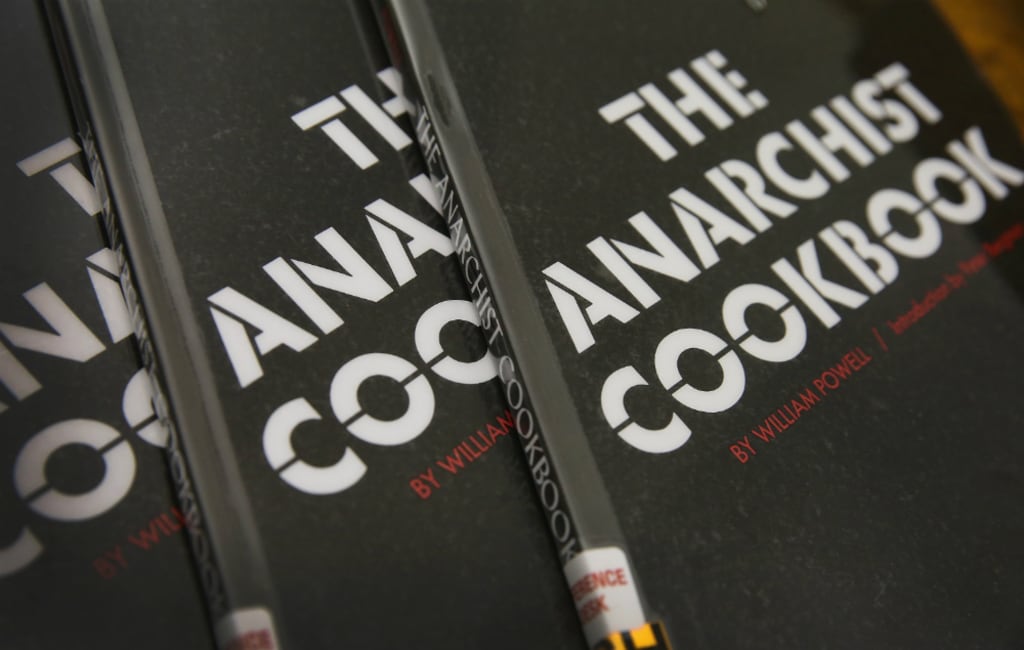
The Anarchist Cookbook is, at least according to street legends and the chatroom rumor mill, the holy grail of do-it-yourself mayhem. The book supposedly gives you the knowledge to brew your own at-home drugs, teaches you how to build bombs, and shows you how to make zip guns.
And though it doesn't say so outright, the implication is that if you study the book, you'll become something akin to an 80s action hero.
As the years have gone by, and further editions of the book have been released, the rumors of its contents have grown to include things like secret techniques for becoming an unbeatable street fighter, and building your own Taser from scrap parts you can find in your junk drawer. The irony is that, like any urban legend, once you actually start shining a light around and introducing some hard facts it's plain to see The Anarchist Cookbook is just one more over-inflated myth.
For more deep dives into the strange parts of history, such as the Vikings that bodyguarded the Eastern empire's Caesar, or perhaps the true story of the Pirate Code, take a moment to stop by my full Vocal archive!
Written By An Angry 19-Year-Old?
What if I told you that the legendary guide to homegrown anarchy was written by a 19-year-old during the period of American history where we were involved in military actions in Vietnam? Not some chemistry genius with an ax to grind, or a brilliant revolutionary, but just an angry teenager who did exactly the amount of research you would expect an angry teenager to do?
Would you think it was smart to follow the recipes in that book?
Well, a lot of people have, despite the fact that according to Wired, The Anarchist Cookbook was originally written by William Powell when he was a teenager in the late 1960s. Powell was angry at the idea that he could be drafted into Vietnam (though he was eventually deemed not fit for service), and all of the energy that only a really motivated 19-year-old can possess made him seek out dangerous information. Powell wanted to know how to make bombs, how to sabotage a communication network, to learn hand-to-hand combat tactics that would let him win fights, and how to make drugs in his own basement. Not only that, but he wanted to take that knowledge and give it to other people who were just as young and just as angry with the state of the world as he was.
Fortunately for Powell the facts he was looking for were right at his fingertips, hiding in plain sight within chemistry books and dusty army manuals that sat neglected on library shelves.
Powell took all of the information he could find, internalized it, and spewed it into a book full of dangerous how-to articles that ranged from making poisons to cobbling together homemade explosives. He didn't, of course, fact-check everything he put in the book or test it out himself to be sure that the information he had worked the way he thought it did. As a result, The Anarchist Cookbook is typically more dangerous for its readers than for any of their potential victims.
Putting It In Print
Powell's writing style was catchy and down to Earth, which made the book seem authoritative even when it was dangerously incomplete. Like any proud author who hasn't quite understood the monster he'd made, Powell bound the manuscript up, and sent it to a publisher.
The publisher gladly accepted Powell's book, but as Vice points out, rather than letting the author maintain the rights to the book, the company acquired them as part of the contract. Powell signed the rights away without much thought at the time, but would later come to regret it.
In addition to keeping the rights, the publishing company didn't fact check or alter the text in any way to make the guide safer or more accurate. All of the dangers were left in place, turning the book into a modern-day Crowley's Homunculus (short history lesson: the famed occultist Aleister Crowley supposedly left behind a grimoire when he died, but according to legend he left out information deliberately so that anyone following the book would immolate themselves because of the missing components in the rituals). Powell eventually realized what he'd done, and has asked several times for the owners of the publishing rights (they've changed hands a few times since the 1970s) to stop publishing the book. Unfortunately, urban legend has made The Anarchist Cookbook so popular that no company that wants to keep making money would even consider not printing it.
Anarchy in The Age of The Internet
Even though The Anarchist Cookbook was written before the computer boom and hacker culture of the late 1980s and 1990s, its influence was still keenly felt when it was reborn online. In additional to the initial book being distributed digitally, numerous other manuscripts used the same title even though they were really guides created whole cloth by those in the hacker counter-culture (a particularly infamous version was written by Jolly Roger). These guides, along with parts and pieces of the original book, were disseminated and re-distributed on message boards, and found their way into the hands of an entirely new, but equally angry and disaffected generation.
You can still find many of these alternative versions today, if you really want to. Beneath the easy prose and calls to casual destruction, though, are just more sets of dubious instructions that give useless (if not outright harmful) recipes for achieving often illegal ends, followed by assurances from the posters that the how-to guides really work. However, to borrow a term of wisdom from today's Internet, "Pics, or it didn't happen."
Does Any of It Work?
When you get down to it, the mythical status of The Anarchist Cookbook is all about one thing; having secret knowledge. This idea also accounts for the success of other texts, like The Poor Man's James Bond. Secret knowledge has always prompted curiosity, and reading a book can't actually do you any harm. However, attempting to follow instructions that were improperly copied and pasted by a 19-year-old first-time author with no oversight based on the notes he made on procedures in a U.S. Army manual from the 1960s might pose quite a risk to life, limb, and even your freedom if you get caught afterwards.
Just something to keep in mind, for those who haven't learned to regard what you hear on the Internet with skepticism.
About the Creator
Neal Litherland
Neal Litherland is an author, freelance blogger, and RPG designer. A regular on the Chicago convention circuit, he works in a variety of genres.
Blog: Improved Initiative and The Literary Mercenary
Keep reading
More stories from Neal Litherland and writers in Lifehack and other communities.
How to Make an Apple Cider Vinegar Fly Trap
Nothing makes your house feel more unclean than bugs. Whether it's ants walking across your kitchen floor, or midges holding meetings in your sink, you can't help but feel that every room needs to be scrubbed down until the insectoid interlopers get the hint they aren't wanted. You may even be tempted to go for the nuclear option; fumigating your home with bug bombs or aerosol cans. The thing is, though, you're going to be breathing the same air and absorbing the same chemicals as your enemy in those cases. That's why you need to take a step back to deploy something that will be deadly to them, but which couldn't hurt you even if you drank it.
By Neal Litherland6 years ago in Lifehack



Comments
There are no comments for this story
Be the first to respond and start the conversation.