
You are what you eat
There is no shortcut to own a healthier body. Eating well and with moderation.

Different authors are related to this quote, also interpreted as “tell me what you eat, and I will tell you who you are.” And it is not for coincidence. Food is, without any doubt, the most impactful aspect of our life.
Our simple presence in this physical plane and all the systems that come together and make us possible to live demands energy, which is understood as a certain number of calories.
They are replenished by the food consumed – assuming the most common way of nutrition that is the enteral one.
That number of calories can start in the lower 1000s up to the 1500s. And this is without taking into account any activity so far. Depending on the gender, the type of lifestyle, anthropometrics, age, and depending on the personal plan: maintaining, gaining, or losing weight, it can be established a nutrition plan with an accurate range of daily calories. It is known that the number required can be a very variable figure. Therefore, the recommendation for knowing the calories your body needs is to get help from experts to get a starting point.
If you get this step done, then you can move further with any nutrition plan.
Let’s say that the plan does not have to be related to achieving extreme limits with the eating patterns or condemning foods you love and enjoy. The key here is moderation. When there is equilibrium, the nutrition is accountable and enjoyable.
Consequently, once the plan is known, the calories can be targeted now. For instance, my current nutrition plan is a normocaloric and normoproteic plan of 2800 calories – it means that I eat “regular” food focused on good sources of protein, healthy fats, and moderation in carbs.
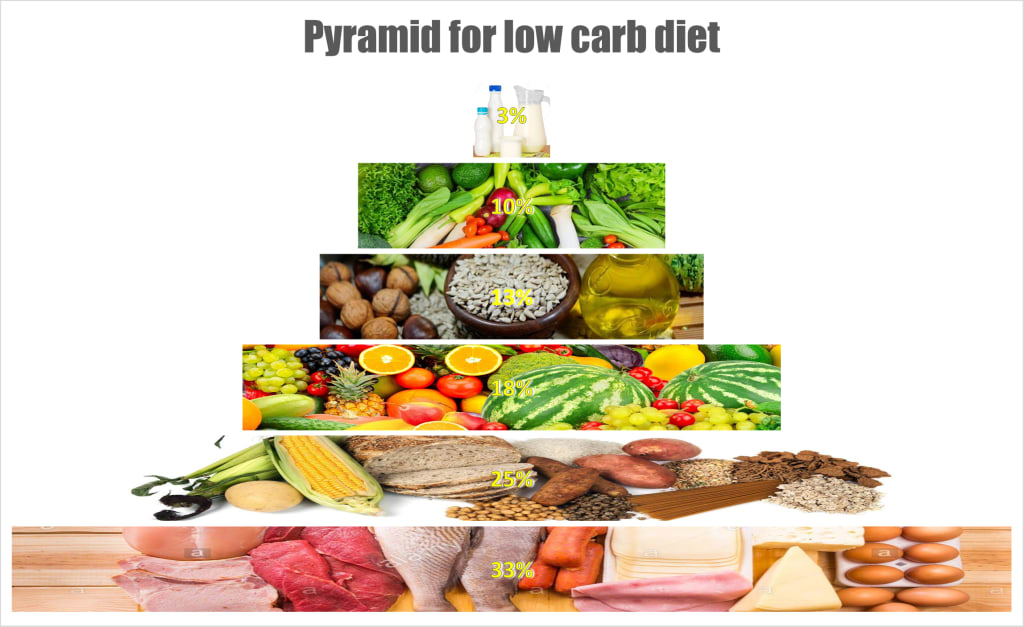
To achieve the daily goal of calories, I combine foods from 6 different nutritional groups that together compound a 6-story pyramid. At the bottom of the pyramid is the group of main Proteins: all types of animal meats – fish, ground, avian – and derivates - eggs, white cheese, sausages. In this group, protein powder/shakes are also included. To get an idea of the amounts, a portion of food coming from this group is equivalent to 1 oz (30 grams) of meat or cheese, one egg, or 10 grams of protein powder (or its equivalence to 8 grams of pure protein). One portion delivers around 55 – 75 calories, 7 – 8 grams of protein, and 3 – 5 grams of fat. As I just mentioned, this nutritional group is the larger and more representative when looking for a low-carb diet.
Keep in mind the number of calories delivered, because that is going to summarize the grand total by the end of the day.
Climbing the pyramid, the group of Carbohydrates, composed of all types of tubers, cereals – beans, oatmeal, quinoa, rice, corn, wheat -, and its derivate products as flours, bread, pasta, and cookies. A portion of food from this group corresponds to a half cup of cooked cereal, 2 – 3 cookies, 1 slide of bread, and each portion delivers around 80 calories, 3 grams of proteins, 15 grams of carbohydrates, and traces of fat. These numbers can vary depending on the type of product it has been selected. The desirable products should be the ones with a low glycemic index, like beans, quinoa, or whole rice. A side note is that, although this group is the toughest one to control or avoid, consuming with moderation will bring faster and more visible results.
The next group is the Fruits, composed of all types of fruits – of course – and their juices. As the Carbohydrate group, the desirable portions shall come from fruits with a low glycemic index, like the berries, mandarins, peaches, apples, oranges, passion fruits. Each portion is proportional to 2 oranges or 2 mandarins, 1 peach or 1 apple or 1 pear, 1 cup of any of the berries, or a half of a cup of juice. In terms of nutrition facts, 60 calories and 15 grams of carbohydrates.
The fourth group is the Fats: all types of oils and seeds. In numbers, one portion from this group stands for 45 – 55 calories, 5 grams of fat, and is equivalent to one scoop of oil, mayo or fat cheese, 6 almonds or 20 pistachios.
The Vegetables are the fifth group; again, the ones with low glycemic index – like green leaves, broccoli, cucumber, celery - are more preferred than the ones with higher index – like pumpkin, onion, green beans. 1 cup of vegetables is equivalent to 20 – 30 calories, 2 grams of proteins, and 5 grams of carbohydrates.
At the top of the pyramid, the group of Milk and Dairy. 8 oz of milk or yogurt represents 170 – 180 calories, 8 grams of proteins, 10 grams of fat, and 12 grams of carbs.
In general, this is a brief description of the pyramid. Once we get professional aid from nutritionists or other specialists, the objective is to get stick to the plan and eat moderately according to the portions.
Once we add the habit of eating with moderation, we will have a feeling of commitment with ourselves in fulfilling the goals we have in our sights, by improving our metabolism or having a healthier body or that shape we have desired for a long time.
About the Creator
Keep reading
More stories from Miguel Gonzalez Quero and writers in Lifehack and other communities.
Moving from Boston to Seattle: What to Expect When Crossing the Country
Moving from Boston to Seattle is more than a change of address—it’s a full cross-country transition that reshapes daily routines, habits, and expectations. While both cities are known for their strong identities, history, and vibrant communities, the experience of relocating between them requires careful preparation and an understanding of how different life can feel on the other side of the country.
By House Doctor5 days ago in Lifehack
Moving in Edmonds, WA: What Residents Should Know Before Relocating
Moving to a new home often marks an important life transition, but the process itself can feel overwhelming without the right preparation. In Edmonds, Washington, the moving experience comes with unique considerations shaped by the city’s geography, residential layout, and local regulations. Understanding these factors ahead of time can make a noticeable difference in how smoothly a relocation unfolds.
By House Doctor3 days ago in Lifehack



Comments
There are no comments for this story
Be the first to respond and start the conversation.