
Iran's Stray Dogs
and the Policy Loop That Keeps Producing Them

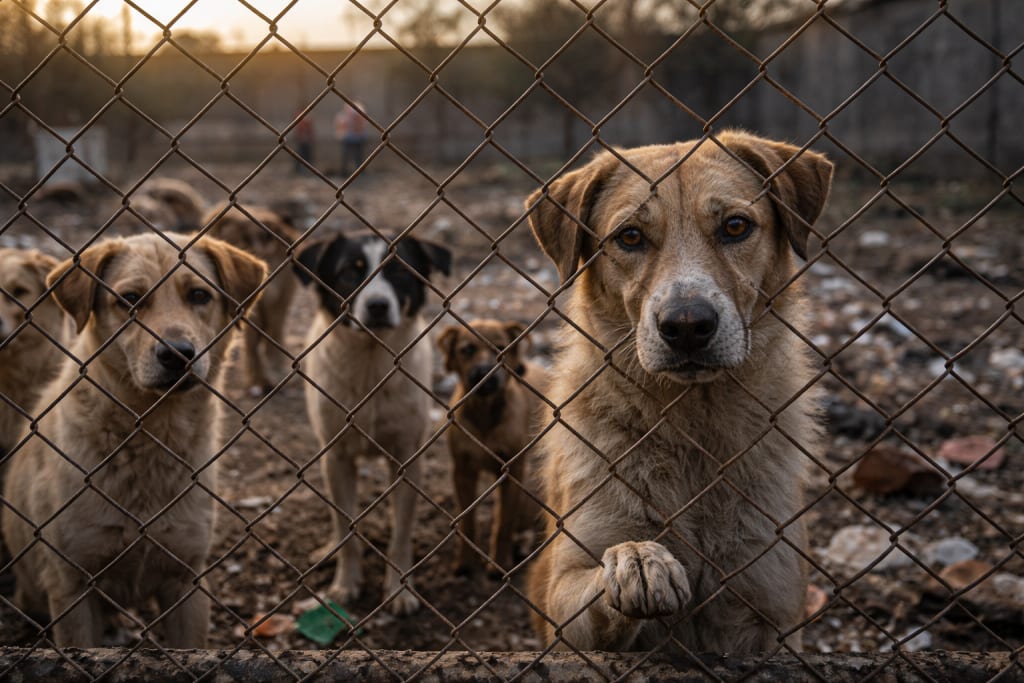
Stray dogs on the edge of a city are the visible part of a hidden system. You can usually trace that system with boring inputs: food access, abandonment pressure, veterinary reach, and the incentives created by enforcement. When those inputs are misaligned, dogs become the output. People then argue about the dogs instead of the machinery that keeps generating them.
The VIDEO on Twitter (X) that inspired me to write this article lands because it holds 2 truths at once.
(1) Many free-roaming dogs in Iran are socially tolerant and calm around people, even after hard lives.
(2) At the same time, reporting and activism have described municipal responses that range from punitive to overtly cruel.
Both can be true.
Social animals can still be treated as disposable. A government can still claim public safety while using methods that do not reduce the population over time.
I have worked enough cruelty cases since high school to recognize the pattern when a system relies on intimidation and disposal instead of prevention. The suffering is real. The failure mode is also real. That is what matters if the goal is measurable change and accountability that survives pushback.
The policy paradox
A street-dog problem is not just about dogs. It is about whether a society makes responsible ownership easier than abandonment. When ownership becomes legally risky or socially punishable, people adapt in predictable ways. They hide dogs, skip routine vet care, avoid licensing, avoid leashing, and reduce visibility in public spaces. Shadow ownership raises disease risk and lowers sterilization rates. It also increases abandonment under pressure from housing, neighbors, or enforcement. Those abandoned animals become tomorrow's "strays."
In June 2025, reporting described expanded restrictions on dog walking across multiple Iranian cities and renewed enforcement pressure framed as public health and public order. The key outcome is not the argument officials use. The key outcome is behavioral. If visible compliance makes you a target, compliance drops. That is how a state can punish ownership while the street population continues unchecked.
Why disposal keeps failing
Mass capture and killing looks decisive because it produces immediate optics. It is also the classic strategy that keeps failing in dog population control because it does not change the inputs. If food sources remain stable and abandonment continues, removal creates vacancy. Vacancies are filled by reproduction, migration, and dumping. The net result is churn, not resolution.
From a behavioral science angle, churn matters. When dogs are constantly displaced, hunted, or mishandled, you do not get a calmer street environment. You get instability. Fearful animals move differently, form different group patterns, and are harder to reach for vaccination. A program that depends on force often destroys the cooperation it needs to succeed.
Public health is not a talking point
Bites and rabies exposure are real public burdens. A national registry-based study in Iran covering March 2021 to March 2022 reported 260,470 registered animal-bite cases and analyzed factors linked to delayed post-exposure prophylaxis. That is the kind of dataset that should drive policy because it is about measurable risk, not ideology.
Rabies is the hard edge of this issue. Globally, dog bites and scratches account for the overwhelming majority of human rabies cases, and prevention hinges on vaccination and access to post-exposure care. If the state wants public safety, the path is not terrorizing owners and killing street dogs in cycles. The path is vaccination coverage paired with population management that reduces births.
What works in the real world
(1) Catch–Neuter–Vaccinate–Return (CNVR) is not sentimental. It is a population lever paired with a public-health lever. Sterilization reduces births over time. Vaccination reduces transmission risk. Return to territory reduces the vacancy effect by keeping stable, vaccinated dogs in place so new unvaccinated dogs do not rapidly replace them.
This is also where claims should stay disciplined. CNVR is not "one campaign and done." It is a sustained municipal program with targets, monitoring, and quality control. A large CNVR program in Greater Bangkok sterilized and vaccinated hundreds of thousands of dogs over multiple years, and published data show dose-dependent improvements in resident-reported outcomes in areas with higher intervention intensity. The details vary by city and baseline ecology, but the causal logic is consistent: reduce births, increase immunity, reduce churn.
(2) Managed shelters belong in this system, but not as the whole solution. Shelters without standards become warehouses, which become outbreaks, which become excuses for disposal. A credible shelter node has veterinary triage, isolation capacity, vaccination protocols, humane handling, and transparent outcomes. Outcomes mean adoption, reunification when possible, managed return after CNVR, and humane euthanasia only for severe untreatable suffering. Not volume control. Not convenience.
(3) The other lever people avoid naming is waste management. Dog population size follows food. Open dumping, unsecured trash, and slaughter waste create carrying capacity. If those conditions persist, killing dogs will never outpace replacement. If a municipality wants fewer dogs, it has to treat waste control as part of dog control.
Accountability that holds up
If the demand is "hold them responsible," the strongest version is standards plus documentation plus metrics. Standards let you audit. Documentation lets you prove. Metrics let you expose failure without relying on outrage.
International guidance on dog population management already exists and is designed for exactly this problem: reduce risk to humans, reduce suffering, and replace ad hoc killing with structured programs. That guidance also makes a simple point that policy actors often dodge: dog population management is part of rabies control, not a separate moral debate.
Documentation has to be strategic. The goal is not viral content. The goal is verifiable records that can survive scrutiny: dates, locations, agencies or contractors involved, methods used, chain-of-custody habits for media, and corroboration where possible. If a practice cannot withstand daylight, it does not belong in public administration.
Action steps for local and international readers
For readers inside Iran, the most durable help is structured and safety-aware. Support vetted local rescuers with funds earmarked for vaccination, sterilization, and transport. Where CNVR access exists, push effort into repeatable rounds by neighborhood rather than one-off rescues that leave the population dynamics untouched. When documentation is safe, record events with the basics that make evidence usable later: time, place, responsible unit if identifiable, and redundant backups that protect the people involved.
For diaspora and international readers, fund capacity, not chaos. Sponsor CNVR throughput, vaccine drives, and veterinary supply chains. Support translation and documentation teams so local evidence can be published in formats international outlets and monitors can use without exposing vulnerable individuals. Pressure public institutions with measurable asks: published bite data, rabies prophylaxis access metrics, vaccination coverage, sterilization coverage, and shelter outcomes. If a municipality cannot publish trend lines, it is not managing the problem. It is reacting to it.
For professionals with leverage, insist on program design that is auditable. That means written humane handling protocols, contractor oversight, training standards, and public reporting. It also means a policy environment that rewards compliance. If responsible ownership is punished, abandonment rises. That is not a moral statement. That is behavioral economics applied to public administration.
This topic does not need louder opinions. It needs a system that makes responsible ownership easier than abandonment, and humane street management easier than spectacle. That is how you reduce bites, reduce rabies risk, reduce suffering, and build an accountability record that holds.
Sources That Don't Suck
Agence France-Presse. (2025, June 8). Iran extends ban on dog-walking for "public order, safety and health". The Guardian.
Carroll, R. (2025, June 9). Despite outrage, Iran expands dog-walking ban across multiple provinces. Al-Monitor.
Hiby, E., Rungpatana, T., Boonmasawai, S., et al. (2025). The impact of catch-neuter-vaccinate-return (CNVR) on Greater Bangkok residents' attitudes and behaviours towards free-roaming dogs. Animals, 15(9).
International Companion Animal Management Coalition. (2019). Humane dog population management guidance.
Khazaei, S., Shirzadi, M. R., Amiri, B., Pourmozafari, J., & Ayubi, E. (2023). Epidemiologic aspects of animal bite, rabies, and predictors of delay in post-exposure prophylaxis: A national registry-based study in Iran. Journal of Research in Health Sciences, 23(2).
Morters, M. K., Restif, O., Hampson, K., Cleaveland, S., Wood, J. L. N., & Conlan, A. J. K. (2013). Evidence-based control of canine rabies: A critical review of population density reduction. Journal of Animal Ecology, 82(1), 6–14.
World Health Organization. (2024, June 5). Rabies. WHO Fact Sheets.
World Organisation for Animal Health. (2024). Dog population management (Terrestrial Animal Health Code, Chapter 7.7).
About the Creator
Dr. Mozelle Martin
Behavioral analyst and investigative writer examining how people, institutions, and narratives behave under pressure—and what remains when systems fail.
Keep reading
More stories from Dr. Mozelle Martin and writers in Petlife and other communities.
Why Pet Collars Matter More Than We Think
Domestic animals read the world through continuity. A collar or ID tag may look trivial to a human, but to a dog or a cat it can operate as an identity object. I have seen this pattern across enough households, shelters, and animal-welfare cases to know it is not coincidence. When an animal becomes distressed after its collar is removed, the reaction is almost always tied to safety, belonging, and recognition.
By Dr. Mozelle Martin21 days ago in Petlife
The Summer I Was Chosen by a Northern Mockingbird
During the long, suspended days of the pandemic, a wild mockingbird began visiting my driveway and chose me, again and again. What started as a strange encounter became a brief, meaningful connection that I still carry with me.
By Erica Roberts 26 days ago in Petlife
When True Love Never Questions Your Soul
“And she’s going to learn that this life will hit you, hard, in the face, wait for you to get back up, just so it can kick you in the stomach but getting the wind knocked out of you is the only way to remind your lungs how much they like the taste of air.” — Sarah Kay’s Poem — If I Should Have a Daughter
By Chantal Christie Weiss7 days ago in Humans



Comments