
We are England
A photographic walk around the London district of South Norwood

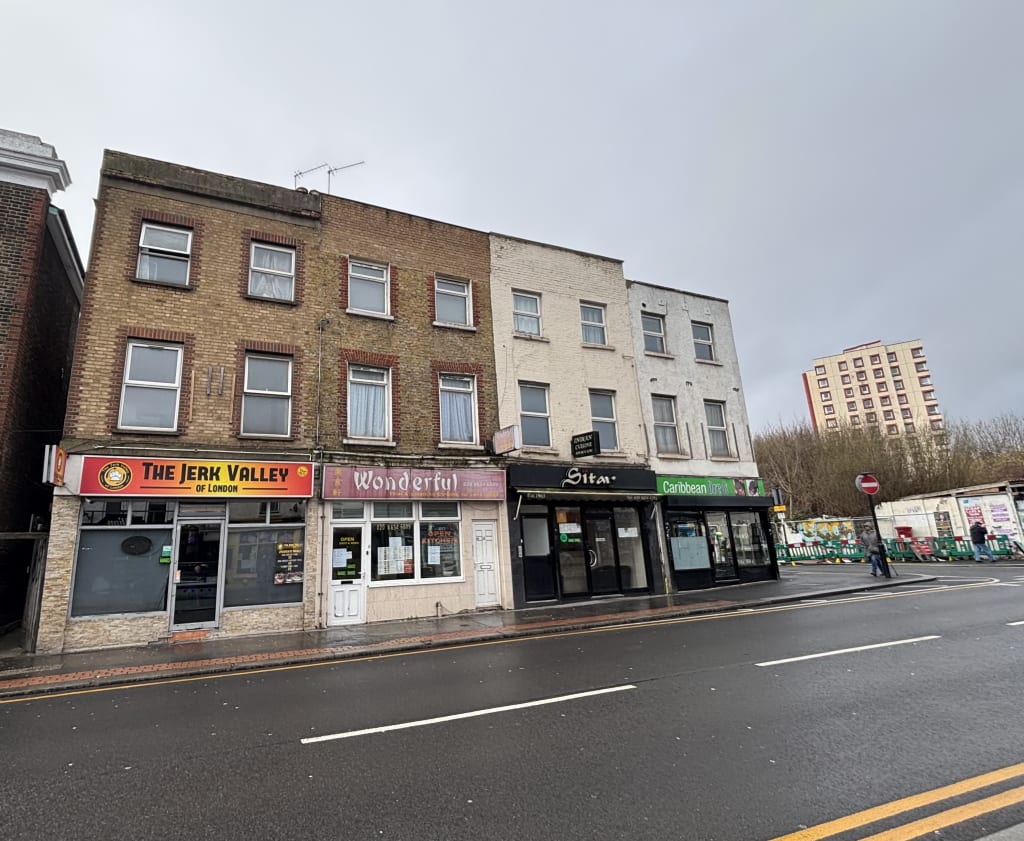
Met a dear friend for a coffee the other day, walking to the appointment through familiar territory. I twice lived in South Norwood in the 1970s, a district of South London (SE25) so named for the great North Wood that covered the land 500 years ago. Some tiny remnants of this once expansive forest remain, as does considerable industrial archaeology and broader social and economic history.
My morning walk not only recalled my time living here in the late 1970s, it also seemed to me to represent a snapshot of urban England in the 2020s. Not the image of England presented to the world, it seems, by movies like Downton Abbey or the just-released Wuthering Heights. I like to think, a more authentic tapestry.
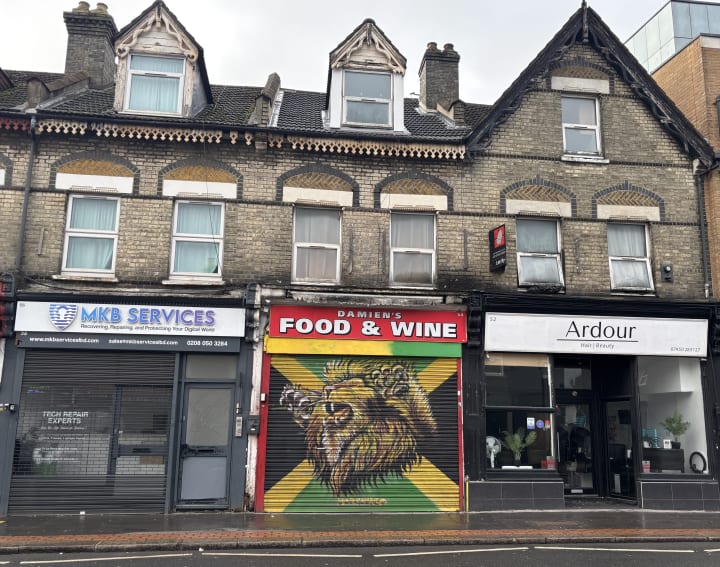
The proprietor of this premesis clearly wanted to celebrate his Jamaican roots, as well he should. I too have Jamaican roots, though you would be forgiven for not noticing, given my very light complexion, blue eyes and once blond hair. Jamaican roots, if the stories my mother told are to be believed. My mother’s maternal grandfather, to be specific, was described by Mum as Spanish-Jamaican.
The population of Jamaica is considered ‘highly blended,’ hence the national motto "Out of many, one people". Estimates of ethnic breakdown vary, but perhaps 75-85% African, with Chinese, British and other European heritage, and of course an incalculable mix of pre-colonial First Nation peoples.
Of the many people with Caribbean heritage living in London, Jamaicans are the biggest group. Of whom Damien is, without doubt, a proud ambassador.
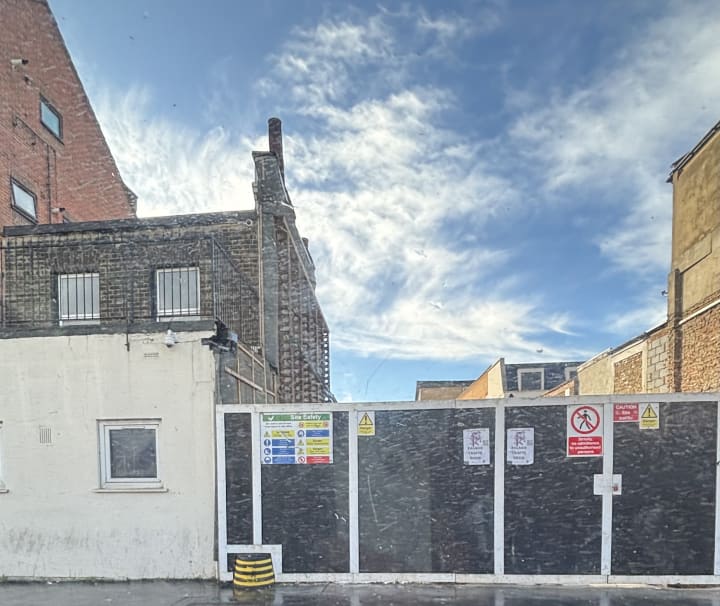
This next image shows a building site a short distance from chez Damien. If memory serves, this site once included a pub I visited as a 19 year old. UK law generally allows drinking in bars at age 18. It was a quiet, weekday evening and the only other customers, in the pub in question, were a group of elderly Afro-Caribbean men playing dominoes, in a way that was as loud as it was friendly. Had I been a little less shy (as a youth) I might have asked to join in.
This recollection is one of the enduring memories I have of my time living in London SE25.
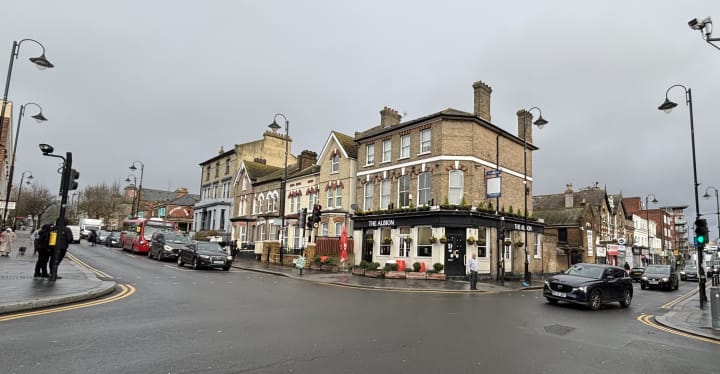
Given the thematic approach to this photo journey is Englishness, I think the next two digital images are historically important. They show two pubs at diagonally opposite corners of a crossroads. The first is of the pub known as The Albion. A name often used, poetically, to describe the island of Great Britain. Long before the Romans attempted to invade Britain, visitors to these islands would use the Greek name Albion (white), for the imposing white cliffs that were the first glimpse of land, crossing the sea from the land that is now known as France.
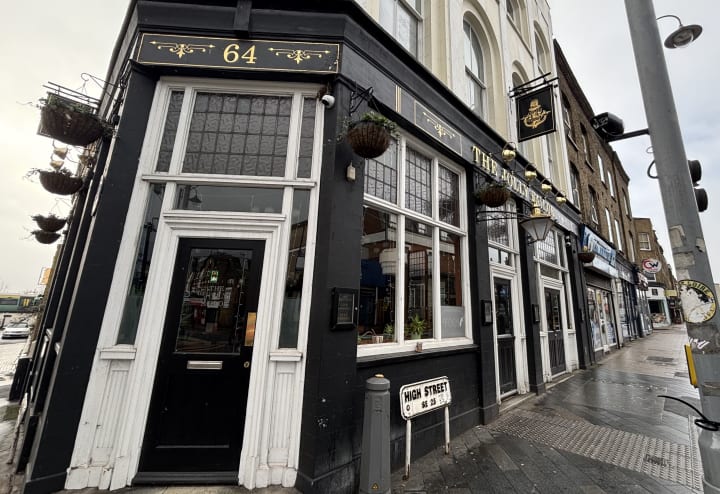
Diagonally opposite The Albion, lies the Jolly Sailor. And what could be more English than the myth of Jolly Jack Tar? With his braided long hair and hempen trousers made waterproof, like his long hair, with tar.
Driving around the Kent suburbs of London I have, in recent years, been confronted by hastily and badly-mounted Union flags and the red cross of Saint George, officially the flag of England, among other things, places and peoples. These are both flags I have been proud to serve under, in my time as a prison officer for His Majesty's Prison and Probation Service.
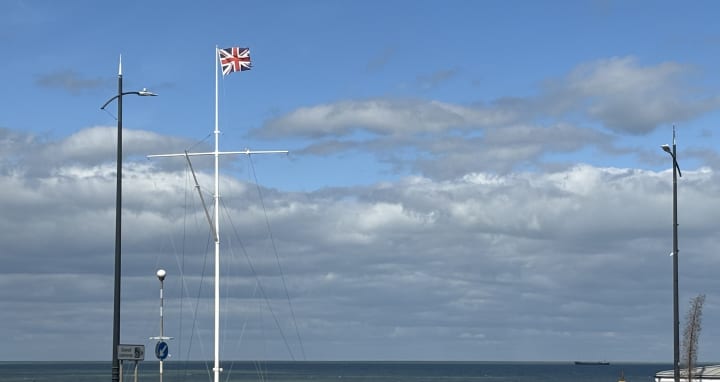
How the flag should be flown. Proudly flying in the breeze atop a properly mounted flagpole, welcoming friends, warning enemies.
The appearance of our flags (England and the United Kingdom) as droopy lamp post decoration has less to do with celebration of nationality, I suspect, than an intention to threaten and intimidate those who stand apart from the myth of racially white Englishness. Worse still to see the Red Cross painted on a pavement for dogs to piss on.
To those who revel in the sight of the Union Flag, or the Red Cross of Saint George, as symbols of some kind of racially pure England or Britain, I say only this. England has never been one nation, one race. The land of Albion has always been a land of many peoples, from the length and breadth of Europe, greater Asia and Africa. Be in no doubt that these peoples fought each other, at times, for the right to call Albion, the land of the white cliffs across the sea, their own. You are not one of them.
We are England
We are all England, that deem this sceptred isle our home.
Thanks for reading my photographic history of England in its London SE25 microcosm.
About the Creator
Raymond G. Taylor
Author living in Kent, England. Writer of short stories and poems in a wide range of genres, forms and styles. A non-fiction writer for 40+ years. Subjects include art, history, science, business, law, and the human condition.
Keep reading
More stories from Raymond G. Taylor and writers in Photography and other communities.
What Are the Best Action Cameras in 2026?
In a world where moments disappear in seconds, capturing them perfectly has never been more important. Whether you're hiking through misty mountains, diving into crystal-clear waters, documenting your travels, vlogging your daily life, or racing down rugged trails, an action camera gives you the power to relive every thrilling second.
By Labiba6 days ago in Photography
How an AI Photo Enhancer Helped Me Rescue My Childhood Memories
You know that feeling when you stumble upon something you forgot existed? That happened to me last weekend. I was digging through an old drawer when I found a stack of childhood photos — you know, the ones you haven’t looked at in decades. Most were a disaster: faded, scratched, some even curling at the edges. And there, in the middle, was a photo of my old dog, Buster. My heart sank.
By Verity Gray2 days ago in Photography
If You Write A Book, Don’t Tell Anyone
There are days when I’m grateful Amazon doesn’t tell me specifically who has bought my book and who hasn’t. If they did, I would be heartbroken when I read the list and noticed all the important names in my life were not on my list of customers.
By Ellen Frances7 days ago in Writers



Comments (4)
Nice photographs, makes me nostalgic for having a cloudy beer and a meat pie the few times I've visited London. And nice message, go back a generation or two, and we all have ancestors who were "outsiders" back then. basically go back a bit and no one is really a local. and what about the normal conquest!
Oooo, the Jolly Sailor looks nice! I think you didn't intend to have the word "have" before 18 in this sentence: "UK law generally allows drinking in bars at age have18."
I’ve learned a lot and enjoyed your photos, Raymond!
What a great article and pictures of your England. Loved it and so glad that I have British, Welsh, Scots blood in me from both my mom and dad's side.