
Alive in Form, Absent in Feeling
When the heart stops believing, survival becomes a quiet performance

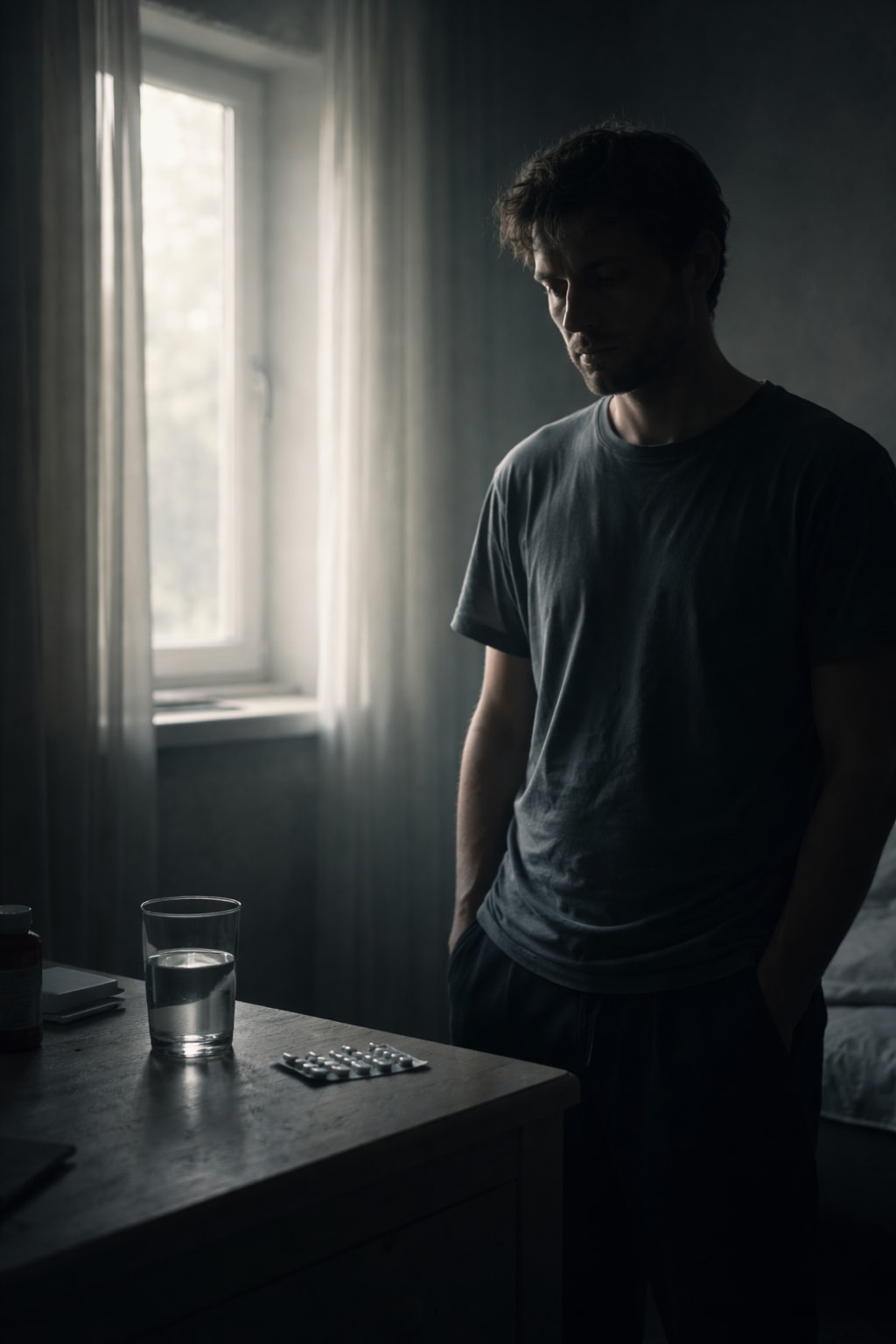
He had mastered the art of answering, “I’m fine.”
It was the most efficient lie ever invented. No follow-up questions. No uncomfortable silences. No one asking what was really happening behind his eyes.
“Are you okay?” they would ask.
“Yes,” he would reply.
And the world would continue spinning, unaware that something inside him had already stopped.
He often felt like a paradox — breathing, walking, working, speaking — yet internally vacant. The heart, as poets describe it, had once been a furnace of warmth. Now it felt like cold ash. Not shattered. Not bleeding. Just extinguished.
He wasn’t dramatic about it. He still showed up to work. He still met deadlines. He laughed at the appropriate moments. But the laughter sounded rehearsed, like lines delivered in a play he never auditioned for.
Sometimes he would stand before a mirror and search for evidence of collapse. Dark circles? Yes. Tiredness? Certainly. But nothing that screamed, This man is drowning. Pain, he learned, does not always announce itself loudly. Often, it becomes polite.
Inside, he whispered words he would never say aloud:
The heart has already died, yet here I am — alive.
The world has a strange relationship with suffering. It tolerates visible wounds — bandages, casts, hospital rooms. But invisible fractures make people uneasy. There is no X-ray for emotional erosion. No prescription slip for exhaustion of the soul.
He sometimes wished there were.
“A bitter medicine,” he once thought. “Something harsh enough to burn this numbness out of me.”
Not a cure — just something strong enough to make him feel again.
The problem with numbness is not the absence of pain. It’s the absence of everything. Joy flattens. Anger dulls. Love echoes but doesn’t land. You exist, but lightly — as if the world could blow through you.
He remembered when feeling deeply was effortless. When heartbreak cut sharp and love healed warm. When hope was not a strategy but a reflex.
Now hope required effort.
People still asked him, “You’re good, right?”
He nodded. Always.
He didn’t resent them. Most were sincere. But sincerity without depth often becomes routine. They wanted reassurance, not truth. Truth would complicate things. Truth would require time.
So he gave them what they needed.
“Yes, I’m good.”
But in the privacy of his thoughts, another sentence lingered:
I wish you would pray for me.
Not because he was religious in the ritualistic sense, but because prayer implied care beyond conversation. It meant someone acknowledging that maybe things were not visible but still real. That maybe strength was a performance, not a fact.
He didn’t need advice. He didn’t need solutions. He needed quiet solidarity.
There is a particular loneliness in being the strong one.
When you are reliable, people assume resilience is permanent. When you solve problems, they assume you don’t create any of your own. When you carry weight well, they forget it is heavy.
He had become that person — the dependable one.
But reliability does not eliminate vulnerability. It only hides it better.
Late at night, when the world retreated into silence, he allowed himself to feel the truth. The exhaustion. The silent grief of expectations unmet. The ache of dreams delayed. The quiet resentment toward his own endurance.
He wasn’t broken by one dramatic tragedy. It was subtler than that. A series of disappointments. Small betrayals. Unspoken sacrifices. Compromises that slowly carved away at certainty.
Death of the heart, he realized, is rarely violent.
It is erosion.
One evening, after another long day of pretending, he sat alone and asked himself a dangerous question:
“When did I stop believing things would get better?”
He couldn’t identify a specific date. No grand collapse. Just gradual dimming. Like a room losing light at dusk — so slowly you don’t notice until it’s dark.
He thought about the version of himself from years ago. That younger man had dreams large enough to scare him. Ambitions that felt electric. Love that felt infinite.
What happened to him?
Life happened.
Responsibility happened.
Reality happened.
And somewhere between survival and expectation, that bright internal fire softened into a manageable glow — then into embers.
But something shifted that night.
For the first time, instead of asking for a cure, he allowed himself to ask for help — not publicly, not dramatically — but honestly.
“I don’t need to be strong today,” he whispered into the quiet room.
It was a small sentence. Yet it felt revolutionary.
Strength had become his identity. But identities can become prisons when they leave no room for weakness.
He realized that perhaps the heart was not dead — only exhausted.
There is a difference.
Dead things do not ache. Exhausted things do.
And he was still aching.
The next day, when someone asked, “You’re good, right?” he paused a fraction longer than usual.
Then he answered differently.
“I’m trying.”
It wasn’t dramatic. It wasn’t a breakdown. But it was honest.
Trying is a powerful word. It acknowledges struggle without surrender. It invites understanding without demanding rescue.
Some conversations grew slightly deeper after that. Not all. But a few. And sometimes, a few are enough.
He began to accept that healing is not a lightning strike. It is a slow negotiation between despair and persistence. It does not arrive in grand gestures. It arrives in small decisions — like choosing honesty over habit.
He stopped searching for a “poisonous medicine” to shock him back to life. Instead, he experimented with gentler remedies:
Walking without headphones.
Writing thoughts he never shared.
Saying no without apology.
Allowing silence without guilt.
None of these revived him instantly. But they reminded him he was still capable of choice.
And choice is proof of life.
He began to see something else: maybe the heart doesn’t die. Maybe it protects itself.
When overwhelmed, it numbs. When hurt, it withdraws. When disappointed, it quiets.
Perhaps what he called death was simply defense.
Understanding that softened his anger toward himself. He had blamed himself for becoming indifferent. For losing intensity. For not feeling as deeply as before.
But maybe depth requires safety.
And safety sometimes requires rebuilding.
Months later, he still wasn’t the same person he once was.
But he was different in a healthier way.
He no longer performed perfection so convincingly. He allowed cracks to exist. He accepted that being alive is not the same as being vibrant — and that vibrancy can return slowly, without announcement.
When people asked, “Are you okay?” he no longer rushed to close the conversation.
Sometimes he said, “Not entirely.”
Sometimes he said, “I’m working on it.”
And sometimes, he simply said, “Pray for me.”
Not as a plea. As an acknowledgment that survival is communal. That even the strongest among us require unseen support.
The heart had not died.
It had endured.
And endurance, though quiet, is not empty.
It is the first stage of return.
Because as long as there is breath — as long as there is ache — as long as there is even the smallest desire for healing —
There is life.
And life, even when dim, can learn to glow again.
About the Creator
LUNA EDITH
Writer, storyteller, and lifelong learner. I share thoughts on life, creativity, and everything in between. Here to connect, inspire, and grow — one story at a time.
Keep reading
More stories from LUNA EDITH and writers in Poets and other communities.
The Pride Flag and the Diversion
For nearly a decade, the LGBTQIA Pride Flag rippled in the wind at Christopher Park, a kaleidoscope of color staked into the soil of America’s first national monument to LGBTQIA+ liberation. That flag came down this week. Federal officials, citing new guidance from the Trump Administration, silently lowered the rainbow flag from its pole across the street from the Stonewall Inn. The birthplace of the modern gay rights movement now flies only the United States flag.
By Tim Carmichael6 days ago in Pride


Comments
There are no comments for this story
Be the first to respond and start the conversation.