
The Topography of Oblivion
Step into “The Topography of Oblivion”, a haunting free verse poem that explores the ephemeral landscapes of a forgotten world. As memory erosion takes hold, once vibrant hydrological systems and verdant forests crumble under the relentless forces of temporal decay and epistemic erosion. This evocative piece weaves vivid imagery and profound themes, from geomorphological complexity to the decay of semiotic codes, offering a poignant meditation on identity dissolution and the fragile impermanence of existence. Through intricate descriptions of desolate landscapes, cognitive dissonance, and fragmented narratives, the poem portrays a world losing its sense of self, its lithological composition, and its climatic regime. Amid this unraveling, a solitary figure—a cartographer—ventures through the void of epistemic oblivion, driven by a duty to document the erosion of culture, memory, and knowledge. Perfect for readers drawn to existential themes, nostalgia, and decay, “The Topography of Oblivion” captures the human spirit's resilience in the face of vanishing worlds. Whether you are captivated by the metaphorical palimpsests of time or the haunting beauty of burnished umber skies, this poem invites you to reflect on the impermanence of identity and the enduring quest to remember. Delve into this poignant exploration of memory loss and the erosion of civilizations—a poetic journey into a vanishing world that resonates with today’s fragility of knowledge and culture.

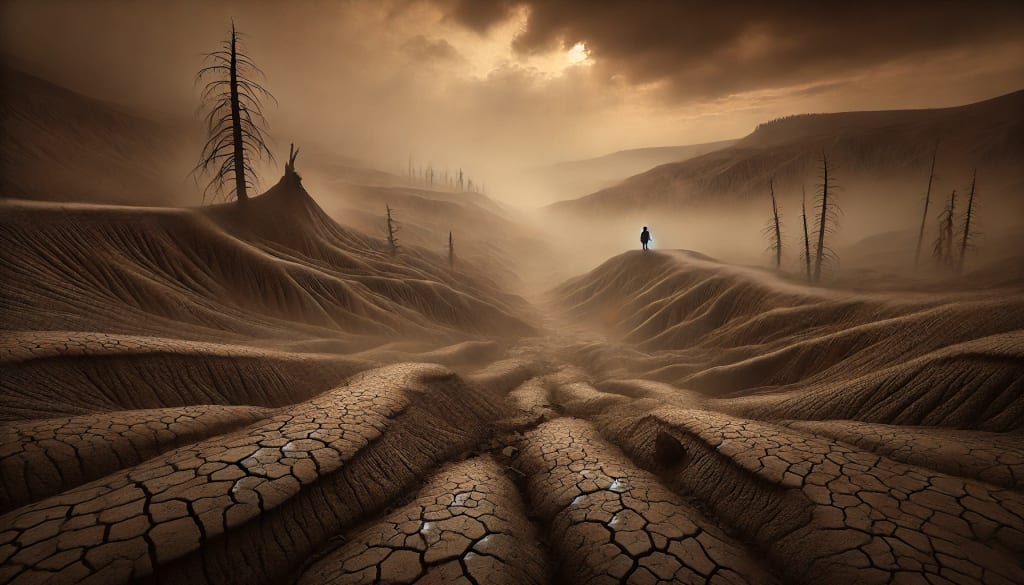
A Landscape Erased by Time
A world where remembrance is a dwindling resource
forgotten landscapes unfold like a palimpsest of worn vellum
the gentle hills that once cradled the ancient hydrological systems
now lie barren,
erosive power of temporal decay
The cartographers of old, who once carefully mapped
the contours of this world, now find their work
reduced to fragments, tattered and yellowed with age
as the very entity of reality begins to degrade into a state of ontological ambiguity
In the distance, a mountain range, once a proud exemplar
of geomorphological complexity, now wears a mantle of obfuscation
its peaks, softened, rounded, as if worn down by
the relentless tides of epistemic erosion that lap at its base
Rivers, too, have begun to forget their courses
their waters, once crystal clear, now turbid and uncertain
as they meander through a landscape that is slowly
erasing itself, leaving behind only the faintest smudge
of a forgotten paradigm
The forests, those vast and sprawling metropolises
of verdant complexity, where ancient trees once stood as sentinels
of remembrance, now stand as skeletal reminders
of a world that is slowly forgetting its own taxonomic classification
In this desolate landscape, the skies are a deep,
burnished umber, like the patina on a worn artifact
as the very earth itself begins to forget
its own lithological composition, its own geomorphological rhythms,
its own chronostratigraphic identity
The scent of desiccation
the very earth itself begins to forget
its own hydrological cycles, its own atmospheric circulation patterns
leaving behind only the faintest spot
of a forgotten climatic regime
In this world, the concept of time is a fluid,
ever-changing entity, a river that flows
in reverse, erasing all that it touches
leaving behind only the faintest stain
of a forgotten chronostratigraphic sequence
The creatures that inhabit this world
are themselves afflicted with a form of cognitive dissonance
their memories, once a coherent narrative,
now a fragmented, disjointed series of events
as if their very perception of reality
has been disrupted by the forces of epistemic erosion
Their language, too, is a shadow of its former self
a series of fragmented phrases, half-remembered
words, and gestures that no longer hold meaning
in a world that is slowly forgetting its own semiotic codes
In the cities, the buildings stand as empty,
hollow monoliths, earnests to a civilization
that has forgotten its own architectural heritage
its own cultural identity, its own
historical context, which is slowly being erased
by the relentless tides of epistemic erosion
The streets, once thronged with the sounds
of human activity, of conversation, of creativity
now lie empty, silent,
realism of society torn asunder
by the forces of social disintegration
In the midst of this desolation,
a figure wanders, a cartographer
the forgotten, seeks to map
the contours of a world, slowly
erasing itself, to preserve
the memories of a civilization
that is slowly forgetting its own existence
This figure moves with a sense of purpose
through the empty landscapes, the deserted cities
documenting the gradual erosion
of a world, disappearing
into the void of epistemic oblivion
With each step, the figure leaves behind
a trail of memories, of fragments
of a world that once was,
a world that is slowly being erased
by the relentless tides of epistemic erosion
The figure's heart is obtuse
of remembrance, of the knowledge
that this world, this civilization
is slowly disappearing,
leaving behind only the faintest mark
of a forgotten past
And yet, the figure persists,
driven by a sense of duty,
of responsibility, to preserve
the memories of a world
that is slowly forgetting its own existence
In the silence, the figure hears
the calls of the past,
the echoes of a civilization
that once thrived,
that once pulsed with life,
with energy, with vitality
The figure's ears are attuned
to the subtle vibrations
of the earth, the rhythms
of the landscape,
the beat of the heart
of a world that is slowly forgetting its own identity
In this world, the concept of self
is a fluid, ever-changing entity
a river that flows in reverse,
erasing all that it touches,
leaving behind only the faintest fleck
of a forgotten sense of identity
The figure's sense of self is a fragile,
shattered thing, a reflection
of the world it inhabits,
a world that is slowly forgetting its own existence
And yet, the figure holds on
to the fragments of its own identity
a tenuous thread that connects
it to the world, to the past,
to the memories that are slowly
being erased by the relentless tides of epistemic erosion
In the distance, a mountain range
rises, a reminder of a world
that once was, a world that is slowly
being erased, forgotten,
lost to the void of epistemic oblivion
The figure stands at the edge
of this world, at the threshold
of the unknown,
and looks out upon the landscape
of a civilization that is slowly
forgetting its own existence
In this moment, the figure
is aware of the weight
of remembrance, of the burden
of preserving the past,
of holding on to the fragments
of a world that is slowly
disappearing into the void
The figure's actions are a tribute
to the human spirit,
a spirit that persists
even in the face of overwhelming
oblivion, a spirit that
refuses to surrender
to the forces of epistemic erosion
In this world, the concept of hope
is a fragile, flickering flame
that burns brightly in the darkness
a flame that guides the figure
through the desolate landscape
of a world that is slowly
forgetting its own existence
The figure's journey is a journey
through the void,
a journey through the abyss
of epistemic oblivion,
a journey that is both
futile and necessary
a journey that is driven
by the human spirit
to preserve, to remember,
to hold on to the fragments
of a world that is slowly
disappearing into the void
The figure's heart is a burden
a burden that weighs it down
a burden that threatens
to consume it whole
and yet, the figure persists
driven by a sense of duty
of responsibility
to preserve the memories
of a world that is slowly
forgetting its own existence
In the end, the figure's journey
is a journey into the unknown
a journey into the void
of epistemic oblivion
a journey that is both
futile and necessary
a journey that is driven
by the human spirit
to preserve, to remember,
to hold on to the fragments
of a world that is slowly
disappearing into the void
The figure's story is a story
of loss, of forgetting,
of erasure,
a story that is both
personal and universal
a story that speaks
to the human condition
in all its complexity
and fragility
The figure's world is a world
that is slowly disappearing
into the void of epistemic oblivion
a world that is losing
its sense of identity,
its sense of self,
its sense of purpose
And yet, the figure persists
driven by a sense of duty
of responsibility
to preserve the memories
of a world that is slowly
forgetting its own existence
in a desperate bid
to stave off the inevitable
forces of epistemic erosion.
© 2025 Kingsley Gomes. All rights reserved.
About the Creator
Kingsley Gomes, PhD.
Professional engineer with a passion for storytelling, crafting compelling narratives that explore the human experience. Author of poetry, short stories, and inspirational articles, weaving words into emotional journeys.
Keep reading
More stories from Kingsley Gomes, PhD. and writers in Poets and other communities.
Scenery of Society by Rikki La Rouge 🇬🇧 🇨🇦
Julio, every summer you come back and make me relive these tortuous memories. Julio, do you remember the day you almost drowned? I do. Julio, I can't escape your punishment. Julio, I want to know why you cursed me. July, I remember our difficult times before July, when we couldn't start again.
By Revista Miko4 days ago in Poets




Comments
There are no comments for this story
Be the first to respond and start the conversation.