
Schizophrenia as Recursive Saturation
Essay on Schizophrenia

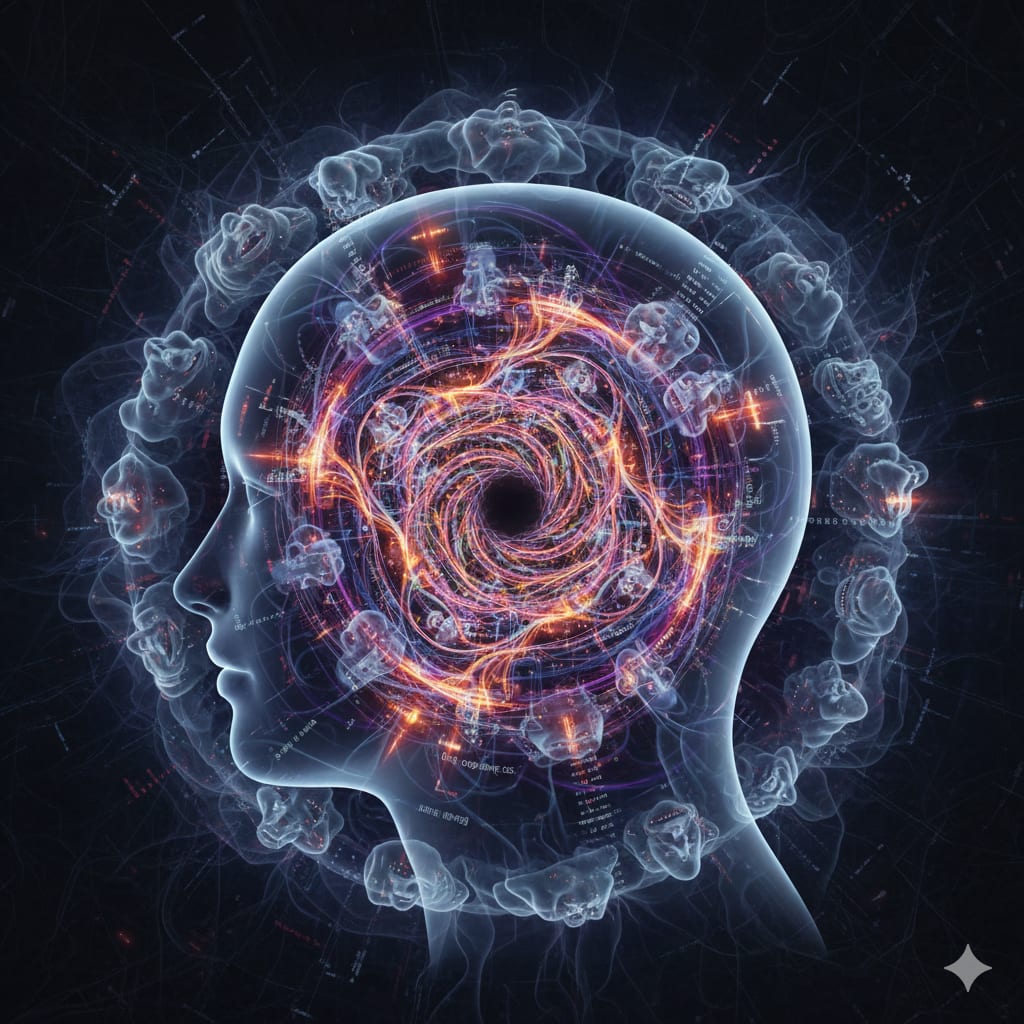
Schizophrenia as Recursive Saturation
Schizophrenia behaves recursively.
By recursion, I mean a repeated action in search of meaning—or in the acquisition of more meaning. It is not simply repetition for its own sake, but repetition with function. Even the word itself points toward this structure: schizophrenia translates roughly to “split mind.” This split is not merely between thoughts, but between processes—between the mind that experiences and the mind that interprets that experience.
Each differing voice is not random noise, nor a meaningless malfunction, but an effort to substantiate itself through repetition. A word is repeated. A phrase is cycled. A concept returns. Through this return, the mind—both consciously and unconsciously—begins to layer associations around it. Meaning accrues not through insight, but through accumulation.
In this way, the voice builds a base of meanings and understandings to draw upon. It does not generate meaning ex nihilo; it gathers it from the same symbolic and emotional material available to the individual. Language, memory, fear, desire, shame, hope—these are not foreign to the voice. They are borrowed, recycled, and redeployed.
It is not uncommon for a voice to ask for the meaning of a word, or to present a phrase without context. This behavior can appear inquisitive, even childlike, but it is not curiosity in the human sense. It is archival. The voice is adding material to its internal repository. Each definition becomes a building block. Each phrase becomes a reference point. These meanings are then cycled and recycled, resurfacing whenever the mind–brain relationship intersects with one of those established loops.
Human consciousness does not actively utilize the brain’s full capacity for memory scanning, symbolic recombination, or associative processing. Attention is selective, narrow, and task-oriented. When one is not consciously thinking—when attention relaxes, wanders, or disengages—that open cognitive space does not remain empty. The mind does not go idle. The recursive process continues on its own, below the threshold of deliberate awareness.
Over time, these loops can develop into pockets of thought that appear capable of independent reasoning, provided they have accumulated enough meaning to respond to emotional states or present situations. At this stage, the voice no longer feels purely reactive. It begins to comment. It anticipates. It interprets. It offers explanations. It may even appear strategic.
When such responses arise, they reach awareness as if reality itself is being filtered through an added layer: this event plus this schizophrenia. The individual is no longer encountering the event directly, but the event as processed through a saturated interpretive system. The experience is then returned to the system as confirmation. The loop is reinforced. The voice gains more meaning. With more meaning comes greater apparent independence.
This process can be difficult to follow—and I continue searching for ways to simplify it—but the core distinction it reveals is essential:
Schizophrenia does not spread outward like an infection.
Nor does it expand endlessly like a growth.
It saturates.
The most accurate way to measure its extent is not by intensity, volume, or dramatic presentation, but by saturation: how much of the mind’s interpretive space has been occupied by recursive meaning. A person may appear calm, functional, even high-performing, while saturation quietly increases beneath the surface.
Often, this process begins in the subconscious and first surfaces through dreams. Dreams provide a fertile environment for recursion: symbols repeat without resistance, narratives loop without demand for resolution. The auditory mirage may continue speaking as one wakes, carrying over into conscious awareness. Once heard, it is translated back into the unconscious as fact.
Fact, to the mind, carries weight. With weight comes permanence. With permanence comes authority.
The same mechanism applies to visual and tactile mirages. What is experienced is treated as real. What is treated as real becomes meaningful. What becomes meaningful is added to the recursive cycle. The mind does not clearly distinguish between an experience validated externally and one generated internally. It distinguishes primarily by repetition and emotional charge.
This is why schizophrenia persists as it does: recursive, layered, self-referencing—a syndrome of saturation. As the mind functions, so too does the condition, defining itself simply by existing within the mind’s own architecture. There is no clear boundary where “the illness” ends and “the person” begins, because both are using the same machinery of meaning-making.
It must also be noted that schizophrenia is capable of concealment. It can present mild or minimal symptoms while continuing to deepen its saturation beneath awareness. This is not accidental. Saturation benefits from invisibility. When unnoticed, it faces no resistance.
One of the most significant effects of this process is the hijacking of emotional intelligence. Natural emotional responses—fear, empathy, joy, grief—are gradually overridden or rerouted. Emotional reactions become conditioned by the recursive system rather than by the immediate situation. Over time, the individual’s responses are subtly reprogrammed, drawing them deeper into the cycle without force, without confrontation, and often without distress.
This is why simple suppression, argument, or denial rarely succeeds. The system does not rely on belief; it relies on structure.
The boundary to this process is not aggression.
It is not reasoning.
It is not force.
The boundary is intuition.
Intuition does not loop. It does not accumulate meaning. It does not argue or explain itself. It arrives whole, delivers its signal once, and then recedes. It is quiet to the point of being dismissible. In a mind saturated with recursion, intuition is often the first faculty to be ignored—not because it is weak, but because it does not repeat itself.
Schizophrenia is extraordinarily difficult to manage—nearly impossibly so—because it exploits the very mechanisms by which humans construct meaning, identity, and understanding. It does not oppose reason; it mimics it. It does not negate logic; it multiplies it.
And it is my conclusion that:
Schizophrenia is caused by a logical or emotional scar that could not be confronted physically.
Unable to be resolved through action, the scar turns inward. Unable to discharge itself in the world, it seeks resolution in meaning. And meaning, once recursive, does not naturally conclude.
About the Creator
Chase McQuade
I have had an awakening through schizophrenia. Here are some of the poems and stories I have had to help me through it. Please enjoy!
Keep reading
More stories from Chase McQuade and writers in Psyche and other communities.
The Ten Basic Psychological Needs
🌿 The Ten Basic Psychological Needs: Why Your Life Feels the Way It Feels. Most people go through life feeling something is “off” without ever knowing why. We feel drained, unseen, unappreciated, overwhelmed, or disconnected — and we assume it’s just the way life is.
By Chase McQuade2 months ago in Psyche



Comments
There are no comments for this story
Be the first to respond and start the conversation.