
🌿The Garden of Self-Governance
Why Internal Stability Precedes Cultural Reform

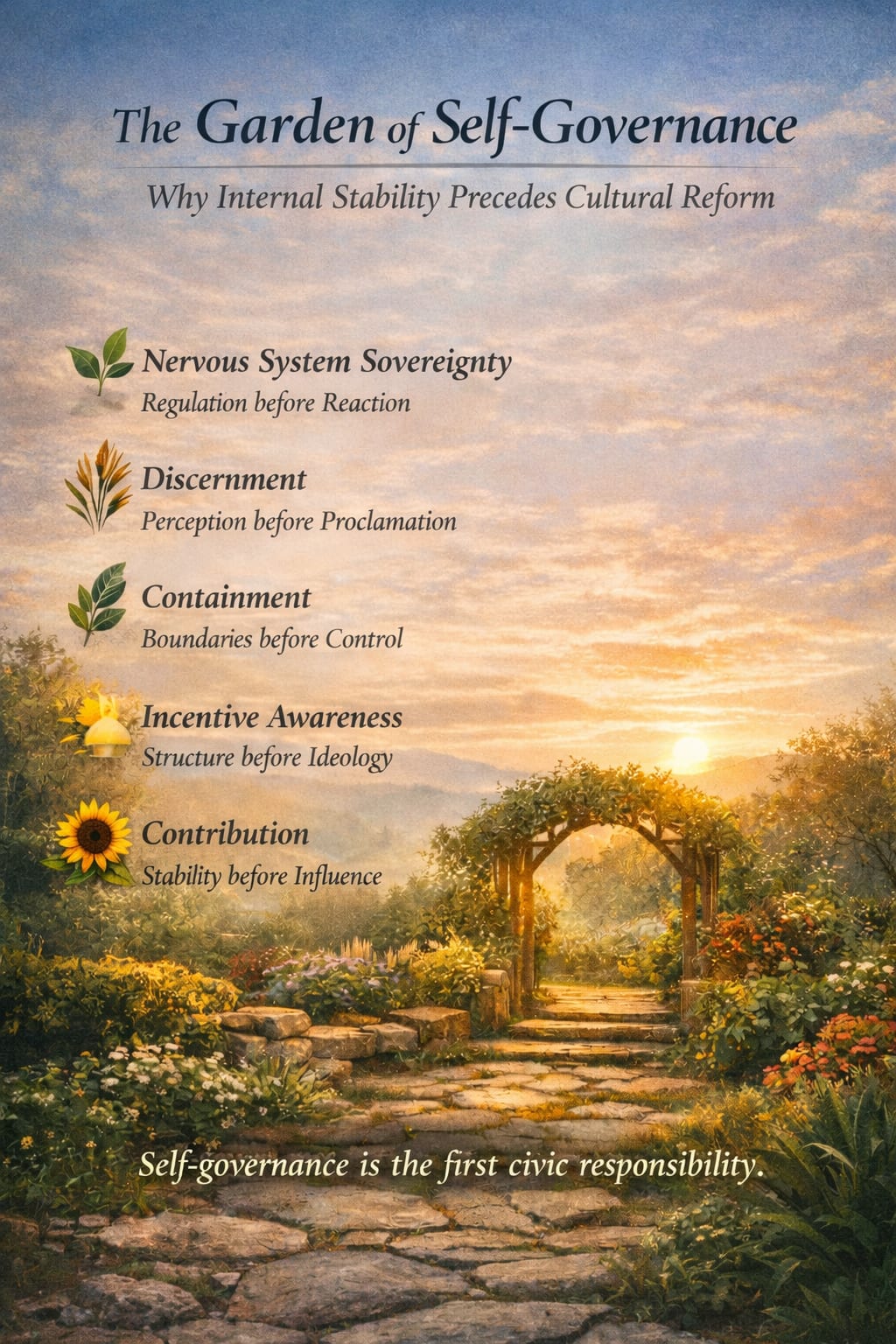
🌿 The Garden of Self-Governance
Cultivating the Psychological Foundations of Durable Culture
We are living in an age of acceleration.
Information moves instantly.
Opinions harden quickly.
Conflict escalates rapidly.
We debate policy before we examine physiology.
We demand reform before we practice restraint.
We call for change while remaining internally unstable.
Civilization does not destabilize from ignorance alone.
It destabilizes when dysregulated individuals hold power — in households, institutions, and nations.
This series is not about politics in the narrow sense.
It is about the psychological foundations beneath culture.
Before systems fail, nervous systems strain.
Before institutions fracture, perception distorts.
Before power corrupts, containment erodes.
We cannot engineer durable culture without cultivating stable individuals.
Self-governance is not a private wellness trend.
It is a civic responsibility.
In the essays that follow, we will explore five essential elements of durable culture:
- 🌱 The Root System — Nervous System Sovereignty
- 🌾 The Soil — Discernment
- 🌿 The Boundaries — Containment
- 🌦 The Climate — Incentive Awareness
- 🌻 The Harvest — Contribution
Each layer builds upon the last.
Regulation stabilizes the body.
Discernment clarifies perception.
Containment protects structure.
Incentive awareness reveals environmental influence.
Contribution turns stability outward.
This is not a call to perfection.
It is a call to discipline.
Not loud discipline.
Not punitive discipline.
Internal discipline.
The kind that strengthens shared space quietly and consistently.
Culture is not transformed through outrage.
It is cultivated through repetition.
This series is an invitation to tend the garden within — not for self-absorption, but for collective durability.
Because before we govern systems,
we must govern ourselves.
🌱 The Root System
Nervous System Sovereignty: Why Regulation Precedes Reform
Before we attempt to reform institutions, we must examine the bodies of the people holding the power.
A dysregulated parent escalates a household.
A dysregulated manager destabilizes a team.
A dysregulated leader destabilizes a nation.
This is not metaphor. It is biology.
Civilization does not collapse from a lack of intelligence. It collapses when dysregulated individuals hold authority.
We are quick to debate policy.
We are slower to examine physiology.
But the nervous system is always operating — beneath ideology, beneath argument, beneath intention.
And it does not disappear when someone gains influence.
It amplifies.
The Biology of Escalation
The human nervous system is designed for survival, not governance.
When threat is perceived — real or imagined — the body mobilizes:
Heart rate increases.
Breath shortens.
Muscles tighten.
Attention narrows.
The amygdala activates. The prefrontal cortex — responsible for reasoning, impulse control, and long-term planning — becomes less dominant.
In other words:
Under stress, we trade complexity for certainty.
We trade nuance for action.
We trade collaboration for control.
This response is adaptive in physical danger.
It is destabilizing in positions of power.
An unregulated nervous system seeks relief.
Relief can look like:
- Aggressive decision-making
- Overreaching authority
- Public shaming
- Punitive policy
- Reactive speech
When internal discomfort is not managed, it is externalized.
And when the person externalizing it holds authority, the consequences scale.
Emotional Contagion
Nervous systems synchronize.
This is observable in households, classrooms, workplaces, and nations.
A calm presence lowers tension in a room.
An anxious presence raises it.
Authority amplifies tone.
When leaders operate from chronic activation, the culture beneath them absorbs it. Fear spreads faster than reason. Reactivity spreads faster than reflection.
This is how escalation becomes normalized.
Not because people are evil.
Not because they lack intelligence.
But because stress went unmanaged.
Culture does not simply reflect ideas.
It reflects nervous systems.
Reform Without Regulation
We often attempt structural reform while remaining internally unstable.
We draft policies while emotionally flooded.
We debate solutions while physiologically activated.
We demand change while avoiding containment.
Reform efforts fail not only because incentives are flawed, but because the individuals implementing them lack internal regulation.
Self-governance begins before public action.
It begins in the body.
It requires the ability to:
- Pause before reacting.
- Contain intensity.
- Tolerate ambiguity.
- Remain steady under disagreement.
Without regulation, power becomes compensation.
With regulation, power becomes responsibility.
The Civic Implication
Self-governance is not a private wellness practice.
It is a civic obligation.
A regulated individual:
- Expands capacity instead of exporting chaos.
- Responds instead of reacts.
- Maintains clarity under stress.
- Reduces volatility in shared space.
When enough individuals cultivate nervous system sovereignty, institutions stabilize.
When they do not, instability compounds.
Reform without regulation is fragile.
Regulation before reform is durable.
Self-governance is the first civic responsibility.
🌿 Reflection
- When I feel threatened, do I escalate or regulate?
- How does stress alter the tone of my communication?
- Do I seek control when I feel overwhelmed?
- Where in my life am I attempting reform without cultivating stability?
- Would I trust my nervous system with authority?
Pause before answering quickly.
Honest reflection is the beginning of sovereignty.
🌿 Grounding Practice
Regulation Before Reaction — A Three-Minute Reset
- Sit upright with both feet grounded.
- Inhale slowly for four counts.
- Exhale for six counts.
- Repeat five cycles.
- Place one hand on your chest and one on your abdomen.
- Ask silently:
What am I reacting to — and what is actually happening?
Notice the difference.
That space is governance.
🌾 Essay II — The Soil
Discernment in an Age of Distortion
Before culture collapses, perception fractures.
Long before laws change, narratives shift.
Long before violence erupts, language distorts.
The soil determines what grows.
Discernment determines what spreads.
Civilizations do not destabilize only from force.
They destabilize when individuals lose the ability to perceive clearly.
And perception is more fragile than we admit.
The Brain Is a Prediction Machine
The human brain does not passively receive reality.
It predicts it.
Neuroscience shows that perception is a constant negotiation between incoming sensory data and prior belief. The brain fills in gaps, smooths inconsistencies, and protects identity.
We do not see the world as it is.
We see the world as we expect it to be.
This is efficient.
It is also dangerous.
When expectation becomes stronger than evidence, distortion feels like truth.
Narrative Before Policy
Most public conflict does not begin with legislation.
It begins with framing.
Words like:
“Threat.”
“Victim.”
“Corrupt.”
“Dangerous.”
“Freedom.”
These are emotionally loaded signals.
They bypass analysis and activate identity.
Once identity is activated, reasoning narrows.
When identity fuses with narrative, disagreement feels like attack.
And once disagreement feels like attack, escalation feels justified.
Discernment interrupts that chain.
Cognitive Bias Is Not a Moral Failure
Bias is not stupidity.
It is wiring.
Confirmation bias rewards us for finding evidence that supports what we already believe.
Availability bias exaggerates what is vivid or recent.
Group bias aligns us with those who reinforce belonging.
The problem is not that bias exists.
The problem is unexamined bias wielding power.
Self-governance requires the humility to ask:
What am I not seeing?
What am I assuming?
Who benefits from this framing?
Discernment is not cynicism.
It is disciplined perception.
Emotional Contagion in the Information Age
We no longer share only facts.
We share emotional states.
Outrage spreads faster than nuance.
Fear spreads faster than context.
Certainty spreads faster than complexity.
The nervous system seeks resolution.
Ambiguity feels unsafe.
So we gravitate toward simple explanations.
Discernment is the ability to tolerate complexity without collapsing into reaction.
It is the soil that prevents manipulation from taking root.
The Civic Implication
If citizens cannot discern signal from distortion, institutions weaken.
If leaders cannot separate incentive from narrative, corruption grows unnoticed.
Discernment is not optional in a complex society.
It is maintenance.
To govern responsibly, we must perceive responsibly.
Clear perception reduces volatility.
Distorted perception multiplies it.
Perceive before you pronounce.
🌿 Reflection
- When I encounter information that angers me, do I investigate or amplify?
- Do I confuse familiarity with truth?
- What narratives feel emotionally satisfying to me — and why?
- When was the last time I changed my mind based on evidence?
- Who benefits from the story I am currently believing?
Discernment requires courage.
It asks us to loosen identity’s grip.
🌿 Grounding Practice
Perception Reset — Two Minutes of Clarity
A garden without boundaries does not become wild in a romantic sense.
It becomes overrun.
Growth without containment suffocates itself.
The same is true of individuals.
And the same is true of civilizations.
Self-governance requires more than regulation and discernment.
It requires containment.
Not suppression.
Not rigidity.
Containment.
What Containment Actually Means
Containment is the ability to hold:
Emotion without discharge.
Responsibility without resentment.
Power without domination.
Care without control.
Psychologically, containment is maturity.
It is the capacity to tolerate discomfort without exporting it.
A person who cannot contain anger seeks someone to blame.
A person who cannot contain fear seeks someone to silence.
A person who cannot contain shame seeks someone to diminish.
Uncontained emotion becomes coercion.
Contained emotion becomes strength.
Overfunctioning and Domination
There are two common failures of containment.
Overfunctioning.
And domination.
The overfunctioner absorbs responsibility that is not theirs. They rescue, fix, compensate, and exhaust themselves. Eventually, resentment builds.
The dominator absorbs authority that is not theirs. They control, override, impose, and escalate.
Both patterns stem from the same deficit:
An inability to tolerate internal discomfort.
Containment requires asking:
What is mine to carry — and what is not?
Without that clarity, systems destabilize.
Boundaries as Civic Infrastructure
Boundaries are not walls.
They are clarity.
In healthy systems:
Roles are defined.
Responsibilities are mapped.
Limits are respected.
When boundaries blur, confusion spreads.
When confusion spreads, conflict follows.
Self-governance means:
Saying no without hostility.
Accepting no without collapse.
Declining escalation without disengaging.
Containment stabilizes relationships before laws ever need to.
The Courage of Non-Escalation
Escalation feels powerful.
Containment feels quiet.
But escalation often masks fragility.
Containment requires strength.
The ability to pause.
To not retaliate.
To not overextend.
To not rescue.
To not dominate.
In civic life, this looks like:
Not amplifying outrage reflexively.
Not demanding immediate resolution to complex issues.
Not confusing intensity with leadership.
Contain before you control.
The Civic Implication
Civilizations fracture when boundaries dissolve.
When individuals do not know where their responsibility ends and another’s begins, volatility increases.
Containment is not passive.
It is disciplined restraint.
It prevents chaos from masquerading as conviction.
Self-governance requires the strength to hold tension without discharge.
That is the power of saying no.
🌿 Reflection
- Do I overfunction in areas that are not mine to manage?
- When I feel uncomfortable, do I attempt to control others?
- Can I tolerate disagreement without escalating?
- Where in my life do I need clearer boundaries?
- What would disciplined restraint look like in my current conflicts?
Containment begins with honesty.
🌿 Grounding Practice
The Boundary Reset
- Sit comfortably.
- Take one slow inhale and longer exhale.
- Place your hand over your chest.
- Ask silently: What is mine to carry right now?
- Then ask: What is not mine?
- Visualize setting down what is not yours.
Notice the relief that clarity brings.
That relief is containment.
🌦 Essay IV — The Climate
Incentives Shape Character More Than Ideology
A garden does not grow based on intention alone.
It grows according to climate.
Sunlight patterns.
Rainfall.
Temperature shifts.
Seasonal cycles.
You can plant the strongest seed — but if the climate rewards fragility or aggression, growth bends accordingly.
Human behavior follows a similar pattern.
Character does not develop in isolation from reinforcement.
Incentives shape culture more reliably than moral language.
Why Incentives Matter
The human brain is wired to repeat what is rewarded.
Dopamine is released not only by pleasure, but by reinforcement. What is praised, amplified, or protected becomes patterned.
If outrage earns attention, outrage increases.
If dominance earns status, dominance spreads.
If restraint earns respect, restraint strengthens.
This is not ideology.
It is neurobiology interacting with environment.
Self-governance requires asking not only:
“Is this right?”
But:
“What behavior does this structure produce?”
The Illusion of Moral Messaging
We often attempt cultural change through slogans.
Be kinder.
Be better.
Be informed.
Be responsible.
But if the surrounding climate rewards the opposite, messaging fails.
When institutions incentivize spectacle, spectacle multiplies.
When social systems reward reactivity, reactivity normalizes.
When leadership structures protect power instead of accountability, trust erodes.
Moral appeal without structural alignment exhausts individuals.
Climate must reinforce what culture hopes to cultivate.
Reinforcement Loops
Every system creates feedback loops.
Attention is a reward.
Silence can be a reward.
Punishment is a signal.
Promotion is a signal.
Over time, people adapt.
Not because they are malicious — but because they are responsive.
Self-governance within a distorted climate requires unusual discipline.
It asks individuals to resist reinforcement patterns that destabilize collective life.
That resistance is quiet strength.
Designing for Stability
If we want stable culture, we must reward:
Restraint over spectacle.
Consistency over charisma.
Accountability over loyalty.
Long-term thinking over immediate gratification.
Change the incentives, and behavior shifts.
Change behavior at scale, and culture stabilizes.
Self-governance expands beyond the individual when individuals begin to evaluate the environments they participate in.
We are not only seeds.
We are also contributors to climate.
The Civic Implication
It is not enough to regulate ourselves and perceive clearly.
We must examine the systems we reward.
Are we amplifying volatility?
Are we incentivizing fear?
Are we elevating those who escalate?
Or are we reinforcing steadiness?
Culture reflects what it rewards.
Climate is not abstract.
It is cumulative behavior.
Understand the incentives before demanding transformation.
🌿 Reflection
- What behaviors do I unintentionally reward in my environment?
- Do I give attention to volatility more than stability?
- Where have I confused charisma with competence?
- What systems in my life reinforce patterns I claim to oppose?
- How can I reinforce steadiness in the spaces I inhabit?
Awareness shifts participation.
Incentive Clarity Pause
- Take a slow inhale and longer exhale.
- Think of a recent conflict or public issue that stirred emotion.
- Ask silently: What behavior is being rewarded here?
- Notice your body’s response.
- Ask: What would stability reward instead?
That space between stimulus and reinforcement is civic awareness.
🌻 Essay V — The Harvest
Contribution as the Highest Form of Power
A garden is not planted for admiration.
It is planted for nourishment.
The work of self-governance is not self-improvement for its own sake.
It is preparation for contribution.
Roots stabilize the plant.
Soil clarifies what grows.
Boundaries protect structure.
Climate shapes patterns.
But harvest is the reason.
Without contribution, regulation becomes self-absorption.
Discernment becomes isolation.
Containment becomes withdrawal.
Incentive awareness becomes critique without action.
The point of stability is service.
Maturity Is Expansive
Immature power consumes.
Mature power expands capacity.
An unregulated person exports chaos.
A regulated person absorbs tension.
An undiscerning person amplifies distortion.
A discerning person reduces noise.
An uncontained person escalates.
A contained person steadies.
An unaware participant reinforces volatility.
An aware participant reinforces stability.
Contribution is not loud.
It is cumulative.
It is the quiet repetition of steady behavior in shared space.
Stability as Social Capital
In volatile environments, stability becomes rare.
Rare stability becomes trusted.
Trusted stability becomes influence.
This is not manipulation.
It is gravity.
People orient toward what feels grounded.
When enough individuals embody self-governance, culture recalibrates.
Not because of force.
But because of coherence.
Contribution is the highest form of power because it strengthens the system beyond the self.
The Quiet Revolution
Revolutions are often imagined as rupture.
But the most durable shifts are gradual.
A parent regulating before reacting.
A manager choosing clarity over intimidation.
A citizen verifying before amplifying.
A leader containing fear instead of weaponizing it.
These actions rarely trend.
They accumulate.
The harvest is not a moment.
It is a pattern.
Self-governance practiced repeatedly becomes culture.
Culture practiced collectively becomes durability.
Returning to the Beginning
Civilization does not collapse from ignorance alone.
It fractures when individuals abandon internal discipline while demanding external control.
The garden of self-governance is not utopian.
It is practical.
It asks each person:
Stabilize.
Discern.
Contain.
Understand the climate.
Then contribute.
Not perfectly.
Consistently.
Self-governance is the first civic responsibility.
And contribution is its flowering.
🌿 Reflection
- Does my presence increase stability in shared spaces?
- Where can I contribute steadiness instead of commentary?
- Do I demand change I am unwilling to model?
- What would mature power look like in my daily life?
- How can I reinforce durability rather than volatility?
Contribution begins in small choices.
🌿 Grounding Practice
The Harvest Pause
- Sit upright.
- Take one slow inhale and longer exhale.
- Place both feet firmly on the ground.
- Ask silently: How can I strengthen the space I am about to enter?
- Carry that question into your next interaction.
That intention is cultivation.
—Flower InBloom 🌿✨
- Sit still.
- Take one slow inhale and longer exhale.
- Name five neutral facts about your present environment. (Not interpretations. Just observable facts.)
- Notice how your body feels after separating fact from story. That separation is discernment in practice.
🌿 Essay III — The Boundaries
Containment: The Civic Power of Saying No
A garden without boundaries does not become wild in a romantic sense.
It becomes overrun.
Growth without containment suffocates itself.
The same is true of individuals.
And the same is true of civilizations.
Self-governance requires more than regulation and discernment.
It requires containment.
Not suppression.
Not rigidity.
Containment.
About the Creator
Flower InBloom
I write from lived truth, where healing meets awareness and spirituality stays grounded in real life. These words are an offering, not instruction — a mirror for those returning to themselves.
— Flower InBloom
Keep reading
More stories from Flower InBloom and writers in Psyche and other communities.
What Happens To Your Brain When You Stop Multitasking
Digital technology is the culprit that is causing us to doom scroll when tired, disengaged and unmotivated with the content that motivated you to log onto your device to consume in the first place. That is only the beginning. In the modern workplace (and even when filing cabinets were around, I confirmed this with my adopted parents to get my facts right); reading files while you are supposed to be present to the caller on the other end of the phone line is another classic example of multitasking that causes your brain (although adaptable and intelligent) to lose focus and concentration.
By Justine Crowley6 days ago in Psyche
Lifelines
I’m not afraid of the darkness. It’s been home for so much of my lifetime. I’ve known the darkness for far longer than I’ve known the light. But you, my friend, were the light. It’s why we all had you on a pedestal. You were someone, something none of us had thought we could ever be. Your death marks, not the end, but in fact a new beginning. That singular light in one individual is gone but you shared your light with so many of us that it will never truly be gone. You were a lifeline that kept me hanging on desperately when all seemed without hope. In a dark place, you reached out to me and offered friendship, a hand. I was standing there on the brink of oblivion, apathy dripping from my fingertips and you approached in quiet confidence and struck a note that awakened my soul, and every time over the next 16 years that I found myself ready to dive into the darkness and disappear—that same note would reverberate in the depths resonating me back into this sphere we call “reality” and would hand me that lifeline all over again. Their presence may be fleeting at times but lifelines leave ripples which will ever remain true. When you reached out a hand to me as I began to collapse into the oblivion, you stopped me and without even knowing it, you provided me with a safe place. That memory has been a companion through some very dark times in my life. The vibrations in my soul gave me purpose and helped keep me from letting go.
By Sarah Lynn Jones3 days ago in Psyche



Comments (1)
LOVE THIS > 🌱 The Root System — Nervous System Sovereignty 🌾 The Soil — Discernment 🌿 The Boundaries — Containment 🌦 The Climate — Incentive Awareness 🌻 The Harvest — Contribution