
Bitcoin Holders Capitulation: What It Means and Why It Matters
Understanding fear-driven selling and its impact on Bitcoin market cycles

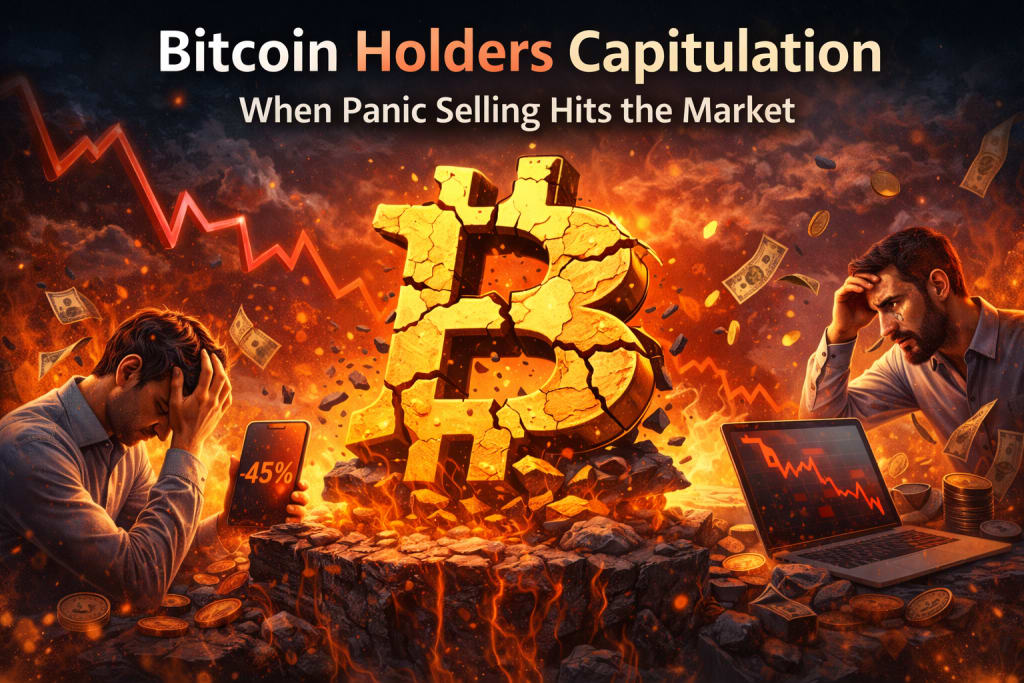
Bitcoin holders capitulation is a term often used during sharp market downturns. It describes a phase where investors, overwhelmed by fear, sell their Bitcoin at a loss just to exit the market. This moment is emotionally driven, not strategic, and it usually happens after long periods of declining prices.
Capitulation is painful, but it is also important. Many experienced traders view it as a signal that selling pressure may be close to exhaustion. Understanding this concept helps investors avoid emotional mistakes and better interpret market cycles.
In this article, we will break down what Bitcoin holders capitulation really means, how it happens, how to identify it, and why it often plays a key role in long-term market recoveries.
What Is Bitcoin Holders Capitulation?
Bitcoin holders capitulation occurs when a large number of investors decide to sell their holdings after sustained losses. These holders often bought at higher prices and held through the decline, hoping for a recovery. When prices continue falling, fear replaces patience.
At this stage:
Confidence drops sharply
Selling volume spikes
Losses become realized, not just on paper
Capitulation is not about logic. It is about emotion. Investors sell because they feel the pain is unbearable or believe prices will keep falling forever.
Why Capitulation Happens in Bitcoin Markets
Bitcoin is highly volatile. Sharp price swings can test even experienced investors. Capitulation usually happens due to a combination of factors:
Extended bear markets that drain optimism
Negative news cycles such as regulation fears or exchange failures
Leverage liquidations that accelerate price drops
Psychological fatigue from holding losses too long
Retail investors are usually the most affected. Institutional investors often prepare for these phases, while newer holders react emotionally.
Signs of Bitcoin Holders Capitulation
While capitulation can only be confirmed in hindsight, several indicators often appear during this phase:
1. High Selling Volume
Large spikes in sell volume suggest panic-driven exits.
2. On-Chain Loss Realization
More coins move at prices lower than their purchase price, showing holders are locking in losses.
3. Extreme Fear Sentiment
Market sentiment tools often show “extreme fear” readings during capitulation.
4. Sharp Price Drops in Short Timeframes
Sudden declines without strong recovery attempts are common.
These signals together suggest that weaker hands are leaving the market.
Short-Term vs Long-Term Holders During Capitulation
Not all Bitcoin holders react the same way.
Short-Term Holders
More likely to capitulate
Often entered near market tops
Sell quickly to stop losses
Long-Term Holders
Historically less reactive
Often accumulate during capitulation
View price drops as opportunities
Data from past cycles shows that long-term holders often absorb supply sold by capitulating investors.
Is Capitulation a Bottom Signal?
Capitulation does not guarantee an immediate market bottom. However, it often marks the late stages of a bear market.
Why?
Most emotional sellers have already exited
Selling pressure weakens
Price stabilizes over time
Historically, Bitcoin’s strongest recoveries began after major capitulation events, not before them.
Historical Examples of Bitcoin Capitulation
Bitcoin has experienced several clear capitulation phases:
2014–2015 bear market after early exchange failures
2018 crash following the ICO bubble burst
March 2020 crash driven by global market panic
2022 downturn after major industry collapses
In each case, capitulation preceded long consolidation periods and eventual recoveries.
Common Mistakes Investors Make During Capitulation
Many investors regret decisions made during capitulation. Common mistakes include:
Selling at maximum fear
Ignoring long-term fundamentals
Following social media panic
Overusing leverage during volatility
Capitulation punishes emotional decision-making more than bad analysis.
How Smart Investors Respond to Capitulation
Experienced investors usually do not try to predict exact bottoms. Instead, they focus on:
Risk management
Gradual accumulation strategies
Long-term conviction
Emotional discipline
They understand that capitulation is part of every market cycle, not a failure of Bitcoin itself.
What Bitcoin Holders Capitulation Teaches Us
Capitulation highlights an important truth:
Markets move on psychology as much as fundamentals.
It reminds investors that:
Volatility is normal in Bitcoin
Emotional selling creates opportunity for patient capital
Long-term success depends on discipline, not panic
Understanding capitulation helps investors act calmly when others cannot.
Conclusion
Bitcoin holders capitulation is one of the most emotionally intense phases of a market cycle. It represents fear, exhaustion, and loss—but also transition. While painful for those who sell, it often clears the path for healthier price action and future growth.
For investors who understand market psychology, capitulation is not just something to fear. It is something to study, respect, and prepare for. The ability to stay rational during these moments often separates long-term winners from short-term regret.
In Bitcoin markets, survival is not about avoiding downturns. It is about understanding them.
FAQs
1. What does Bitcoin capitulation mean?
It means investors sell Bitcoin at a loss due to fear during market downturns.
2. Is capitulation bad for Bitcoin?
Short-term it hurts sentiment, but long-term it often resets the market.
3. Can capitulation predict a market bottom?
Not exactly, but it often occurs near late bear market stages.
4. Who usually capitulates first?
Short-term and highly leveraged holders tend to capitulate first.
5. Should investors sell during capitulation?
That depends on risk tolerance, but emotional selling often leads to regret.
About the Creator
saif ullah
Content writer on different niches, specially on finance.
Keep reading
More stories from saif ullah and writers in The Chain and other communities.
Crypto Wallets: The Complete Guide to Securely Storing Digital Assets
Introduction: Why Crypto Wallets Matter More Than Ever Crypto wallets are the backbone of the digital asset economy. Whether you trade daily, invest long-term, or simply hold Bitcoin and altcoins, your crypto wallet determines how safely and efficiently you control your funds. Unlike traditional banks, crypto puts you in charge. That freedom also comes with responsibility.
By saif ullah21 days ago in The Chain
How Cross-Chain NFT Marketplace Development Solves Scalability and High Gas Fee Issues
Single-chain NFT marketplaces, where users buy and sell NFTs on a single blockchain, may deal with problems such as network congestion, high transaction fees, and limited scalability. This is because single-chain NFT marketplaces are limited by the number of transactions that the blockchain can process. Cross-chain NFT marketplaces allow transactions and interactions between multiple blockchains, which can address limitations such as scalability, cost, and liquidity. Possible solutions to the challenges of existing NFT marketplaces include cross-chain technology such as cross-chain atomic swaps. Cross-chain NFT marketplace solutions ease NFT platform scalability across NFT markets, enabling creators and collectors around the world to access its services.
By Henry james5 days ago in The Chain




Comments
There are no comments for this story
Be the first to respond and start the conversation.