
IDO Launch Trends to Watch in 2026 — What's Changing and Why It Matters
These IDO fundraising trends are reshaping decentralized token launches in 2026
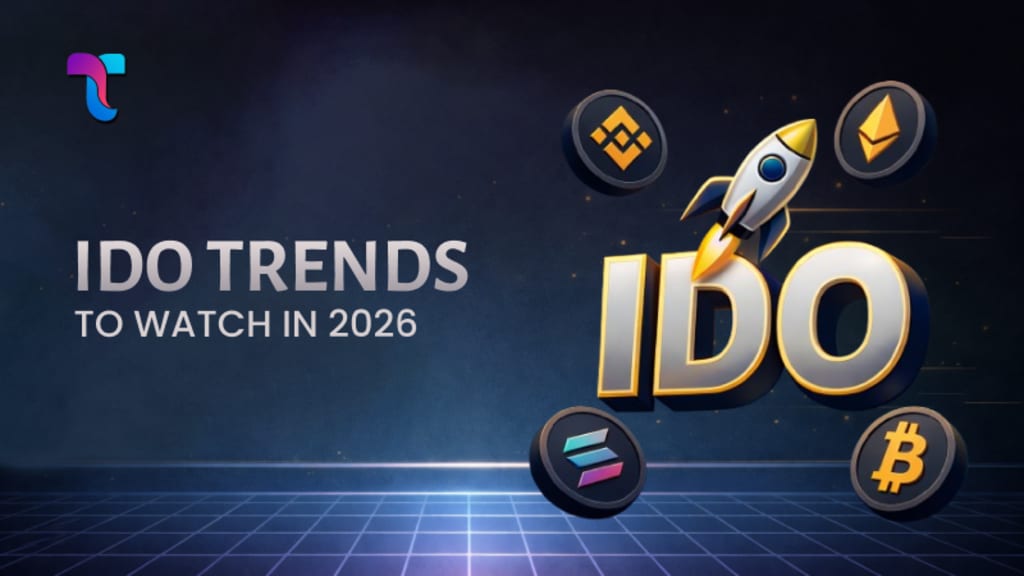
Nobody predicted 2025 would slow down the IDO space the way it did. And yet — here we are.
Projects got quieter. Investors got harder to convince. And launchpads that used to list almost anything started asking uncomfortable questions. Honestly? That was probably overdue.
But slowing down isn't the same as dying. If anything, the IDO model heading into 2026 looks more interesting than it has in years — just for completely different reasons than before. The get-rich-quick energy is mostly gone. What's replacing it is something more deliberate, and in a lot of ways, more valuable.
Here's what's actually shifting on the ground right now.
The 7 Biggest IDO Trends Reshaping Decentralized Fundraising in 2026
Not predictions. Not wishful thinking. These are patterns already showing up across launchpads, DeFi ecosystems, and blockchain communities — and they're only going to get louder through the rest of the year.
1. Single-Chain Launches Are Quietly Dying
Pick any major IDO from three years ago. Chances are it launched on Ethereum, maybe BNB Chain, and that was considered totally fine.
That assumption doesn't hold anymore.
Investors today are spread across a dozen ecosystems. Some live on Solana. Others swear by Polygon or Avalanche. A growing number are building on TON. Asking all of them to bridge assets just to participate in your token sale is — bluntly — asking some of them to leave.
Multi-chain IDOs aren't a luxury feature anymore. They're becoming the baseline expectation. Projects launching on five or six networks simultaneously are seeing broader participation, deeper liquidity, and frankly just more attention from the kind of investors who know what they're doing.
The catch is that doing this well is genuinely complicated. Cross-chain smart contracts, coordinated liquidity across networks, and security audits on each chain—it adds up fast. This is one area where having a team behind you that's already navigated this kind of complexity is important. That’s why teams with proven experience in IDO development often play a critical role in ensuring a smooth launch.
2. The Community-First Model Is Winning — Finally
This one feels personal to a lot of people in the space, and rightfully so.
For a while, the standard IDO playbook looked something like this: give VCs early allocation at a steep discount, throw retail investors a small public round at a much higher price, watch insiders dump on launch day, repeat. It wasn't sustainable and the community knew it.
What's replacing that in 2026 is genuinely refreshing. Launchpads built around community participation — where holding platform tokens, contributing to governance, or being an active ecosystem member actually gets you meaningful access — are pulling ahead. Not just ethically, but performance-wise. Community-backed projects simply hold better post-launch because the people holding the tokens actually believe in what they're holding.
If you're building an IDO this year, community isn't your marketing plan. It's your foundation. Start building it before you write a single line of smart contract code.
3. Compliance Isn't the Enemy Anymore
A couple of years ago, the word "regulation" in an IDO conversation felt like a buzzkill. Now it's just... part of the conversation.
MiCA in Europe is already reshaping how projects structure token offerings for European investors. Other regions are moving in similar directions with their own KYC and AML requirements. And here's the thing — the projects fighting this the hardest are often the ones with the most to hide.
Smart teams in 2026 are building compliance directly into their launch infrastructure. On-chain identity verification, permissioned whitelisting, jurisdiction-aware access controls — all of this is becoming standard smart contract functionality rather than an afterthought bolted on at the last minute.
If you're still fuzzy on where IDOs stand relative to more regulated models, the breakdown on IDO vs ICO explained is worth reading before you start thinking about compliance architecture. Gets into the structural differences in a way that actually helps.
4. AI Is Starting to Kill Off Weak Projects at the Gate
The IDO space has always had a noise problem. Slick decks, vague roadmaps, anonymous teams with impressive-sounding advisors — the formula for a mediocre project getting listed was well-understood and widely used.
That's getting harder.
Launchpad platforms are integrating AI-driven vetting tools that scan whitepapers, audit smart contract code before humans even look at it, evaluate tokenomics logic, check team backgrounds, and monitor social channels for early red flags. By the time a project reaches a human reviewer, a lot of the obvious problems have already been flagged.
For projects doing real work — this is great news. For projects that have been leaning on presentation over substance, 2026 is going to be a difficult year to get listed anywhere that matters.
5. Real-World Assets Are Finding Their Way Into IDOs
This trend is moving slower than some of the others, but it might end up being the most significant one in the long run.
Tokenized real-world assets — property, commodities, infrastructure, private credit — are starting to use IDO-style mechanics for fundraising. Instead of purely speculative token plays, investors can participate in offerings backed by something tangible that generates real yield.
This pulls a completely different type of investor into DeFi. Not the trader looking for a 10x in two weeks, but someone evaluating yield, asset quality, and long-term stability. As institutional interest in tokenization keeps building, this segment of the IDO market could look very different by the end of 2026 than it does today.
6. Fixed Price Sales Are Getting Replaced by Smarter Models
Here's an honest problem with fixed-price IDOs: they work great for early buyers who can flip immediately at listing. They're less great for everyone who bought in expecting the token to hold its value.
The whale dump cycle — buy early, sell the moment trading opens, leave retail holding the bag — is one of the most complained-about patterns in IDO history. And it's largely a pricing mechanism problem.
In 2026, more projects are moving toward Dutch auctions, tiered pricing structures, and dynamic bonding curve models where the price responds to actual demand rather than being locked in ahead of time. It's better price discovery, fairer distribution, and typically more sustainable post-launch performance.
These models are also significantly more complex to implement correctly. Which is why projects working with experienced IDO development services — teams that have already built and stress-tested these mechanisms — have a real head start over those trying to figure it out from scratch.
7. What Happens After Launch Matters Just As Much Now
This might be the quietest shift on this list, but it's one that serious investors are paying close attention to.
The post-launch track record of IDO projects has historically been... uneven. Roadmaps get quietly revised. Token vesting schedules get adjusted without much explanation. Community communication drops off after the raise is done. People notice. They talk about it. And in crypto, that reputation sticks.
In 2026, investors are evaluating what a project's post-launch plan looks like before they commit — not after. Regular updates, transparent milestone tracking, active liquidity management, and genuine community engagement are no longer nice-to-haves. They're being built into the decision of whether to participate at all.
Projects treating their IDO as the finish line are the ones struggling most right now. The ones treating it as the starting point are quietly building the kind of credibility that compounds over time.
What This All Means If You're Building Right Now
The honest summary is this — IDOs in 2026 are more demanding on every front. Technical complexity is up. Investor expectations are higher. Regulatory awareness is non-negotiable. Community standards have risen.
But the opportunity is also more real than it's been in a while. Because when the noise clears, what's left is actually worth paying attention to.
2026 Belongs to Projects That Are Genuinely Ready
The IDO space has had its failures — everyone knows this. Tokens that dumped within hours. Projects that vanished after raising. Communities left holding nothing but a whitepaper and broken promises.
But those failures built something. A smarter investor base. Launchpads with actual standards. Communities that hold founders accountable in real time. The ecosystem learned — slowly, sometimes painfully — and 2026 is where that learning starts to show up in outcomes.
Multi-chain infrastructure, compliance layers, dynamic pricing, community-first models, AI-driven vetting — none of this is complexity for its own sake. It's the IDO market finally growing into something that can last.
For anyone building a project right now, the window for cutting corners has pretty much closed. But for teams doing the work properly — getting the tokenomics right, thinking through the compliance angle, building community before the launch, planning what comes after — this is genuinely one of the better environments the space has offered.
About the Creator
Technoloader
Technoloader is a complete blockchain development company in India that provides end-to-end solutions in this field. We offer blockchain development, defi development, cryptocurrency wallet & exchange development and mlm development.
Keep reading
More stories from Technoloader and writers in The Chain and other communities.
Token Development on Ethereum vs. Binance Smart Chain: Which is Better?
The world of blockchain is booming, and token development is at the heart of it. Whether you're launching a new cryptocurrency, an NFT collection, or a DeFi project, choosing the right blockchain is crucial.
By Technoloader10 months ago in The Chain
BlackRock Signals $257 Million Bitcoin and Ethereum Sell-Off Ahead of Partial U.S. Government Shutdown
facing turbulence as BlackRock, the world’s largest asset manager, moves a massive amount of digital assets onto exchanges. Roughly $257 million worth of Bitcoin and Ethereum has been transferred in what analysts believe could be a signal of an upcoming sell-off.
By Sajida Sikandar3 days ago in The Chain
The Cave Part 6
If you have ever heard a tale about yourself that you cannot remember and doubtless think is made up, you will know how I felt when Tharkin related all that the eagle had seen of me before my memories were scattered. Of far distances and traveling companions that I did not recall, camping out under the stars and making our way to the mountains with deliberate purpose. The great bird had lost contact with my party once we entered the forests, and the seven other members were not seen again by him or his brethren since.
By Jamye Sharp3 days ago in Chapters




Comments
There are no comments for this story
Be the first to respond and start the conversation.