
Utility Token Development: How to Add Staking, Governance, Rewards, and Access to Your Token?
Utility gives a token purpose by embedding it into the everyday functioning of an ecosystem. Utility acts as the anchor that keeps an ecosystem stable when external attention shifts elsewhere.

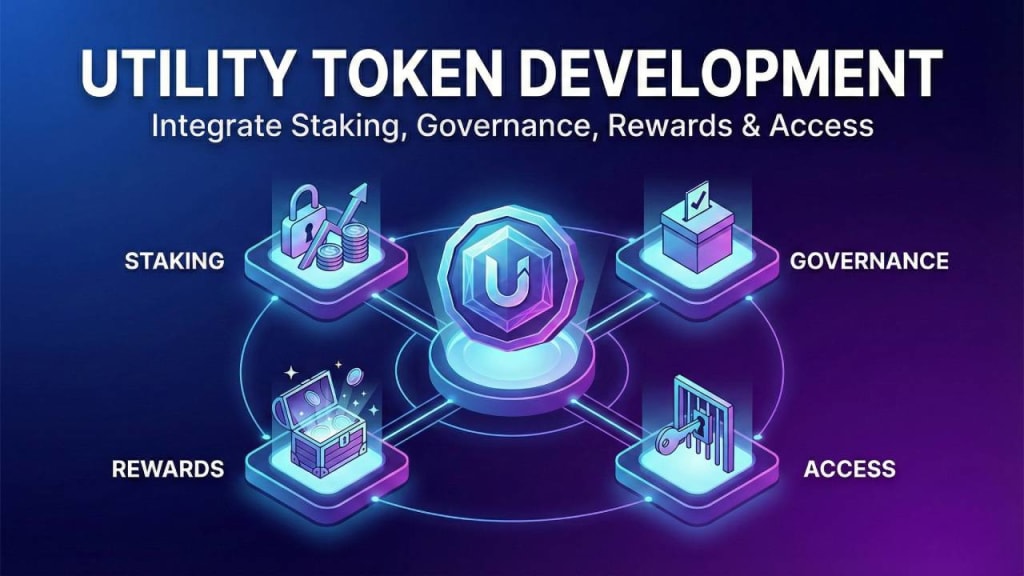
A token without utility rarely maintains relevance beyond early interest. When users hold a token but cannot actively use it, motivation fades and trust weakens. Utility gives a token purpose by embedding it into the everyday functioning of an ecosystem. Instead of being just another asset to trade, the token becomes something users depend on for participation, benefits, and influence.
Why hype alone is never enough
Projects driven mainly by hype often follow a predictable path. Attention rises quickly, price movement attracts traders, and then engagement drops once excitement cools down. Without real utility, users have no reason to stay. Utility acts as the anchor that keeps an ecosystem stable when external attention shifts elsewhere.
From speculation to participation-driven ecosystems
User expectations have matured. Holding a token is no longer just about waiting for value appreciation. People want involvement and recognition. Participation-driven ecosystems allow users to engage through staking, voting, earning rewards, and accessing exclusive features. This participation builds loyalty and creates a stronger bond between users and the project.
What this guide helps you achieve
This guide explains how to design meaningful token utility using staking, governance, rewards, and access. The focus is on creating practical value that users understand and trust, helping you build an ecosystem designed for steady growth rather than short-lived momentum.
Utility token development focuses on building tokens with real functionality like staking, governance, rewards, and platform access. It helps businesses turn their blockchain projects into working ecosystems, not just tradable assets.
What token utility means for real users?
From a user's perspective, token utility is simple. It answers the question of what owning the token allows them to do. Whether it enables voting, earning, or unlocking features, utility should be clear and immediately recognizable. When users understand the value, they are more likely to hold and engage with the token.
Utility versus incentives explained clearly
Incentives are often temporary tools used to attract attention, while utility delivers ongoing value. A short-term reward may encourage users to try a platform, but utility gives them a reason to stay. Tokens with real utility become part of a user's routine rather than a short-term opportunity.
How utility encourages active participation
When tokens unlock actions instead of passive rewards, user behavior changes. Holding turns into participation. Users begin staking tokens, contributing to decisions, and engaging with the platform more consistently. This shift strengthens the ecosystem and creates a sense of shared ownership.
Principles behind effective token utility design
Strong utility is easy to understand, directly connected to the product, and scalable over time. It avoids unnecessary complexity and focuses on benefits that users can feel and use. When utility aligns with these principles, adoption becomes natural rather than forced.
Staking Utility: Locking Tokens to Create Long-Term Value
Why staking is a powerful utility mechanism
Staking allows users to commit their tokens while earning benefits in return. By locking tokens, users demonstrate confidence in the project, and the ecosystem benefits from reduced circulating supply. This creates a healthier balance that supports long-term planning and growth.
How staking supports holding behavior
Staking encourages users to think beyond short-term gains. Since staked tokens are not immediately tradable, users are more likely to focus on long-term value. This behavior reduces constant selling pressure and promotes stability across the ecosystem.
Common staking models and their purpose
Fixed-duration staking offers predictable rewards in exchange for locking tokens for a defined period. Flexible staking provides freedom for users who prefer liquidity. Tiered staking rewards deeper commitment with greater benefits, creating a clear path for increased involvement. Each model serves a different audience and project goal.
Designing staking rewards that last
Sustainable staking rewards focus on balance rather than extremes. Overly generous rewards may attract attention but often damage long-term token value. A well-designed staking system ensures rewards remain appealing while supporting the overall health of the ecosystem.
Connecting staking with governance and access
Staking becomes more meaningful when it unlocks additional privileges. Many projects link staking to voting rights or special access, giving users more influence and exclusive benefits. This makes staking feel purposeful and valuable beyond earning rewards alone.
Mistakes to avoid in staking implementation
Poorly designed staking systems can confuse users or harm token economics. Complex rules, unclear benefits, and unrealistic reward promises often lead to disappointment. Successful staking utility remains simple, transparent, and aligned with long-term goals.
Governance Utility: Empowering Token Holders to Shape the Project
Why governance builds trust and decentralization
Governance gives token holders a seat at the table. Instead of decisions happening behind closed doors, governance opens the process and invites the community to participate. When users can influence how a project evolves, trust grows naturally. Decentralization is no longer just a promise; it becomes something users experience through real decision-making power.
How token-based governance systems work
Token-based governance allows holders to vote on proposals using their tokens as voting power. The more tokens a user holds or stakes, the greater their influence. Proposals are typically submitted, discussed, and then voted on within a defined period. Once approved, decisions are executed either automatically through smart contracts or manually by the core team, depending on the setup.
What token holders can actually govern
Governance is most effective when it focuses on meaningful decisions. Token holders often participate in shaping protocol upgrades and technical changes that impact performance or security. They may also vote on how treasury funds are allocated, deciding which initiatives deserve financial support. In many ecosystems, governance extends to ecosystem growth, including partnerships, integrations, and expansion strategies that define the project's direction.
Balancing openness with execution speed
Open governance is powerful, but too much friction can slow progress. Successful projects strike a balance by defining which decisions require community input and which remain operational. Clear voting rules, proposal thresholds, and timelines help maintain momentum without sacrificing transparency.
Protecting governance from manipulation
Governance systems must be designed with safeguards. Without protections, voting power can be abused by a small group of large holders. Techniques such as quorum requirements, vote weighting, and time-locked execution help reduce manipulation while keeping governance fair and credible.
Making governance easy and rewarding
Participation should feel simple, not intimidating. Clear interfaces, short explanations, and visible outcomes encourage more users to vote. Many projects also reward governance participation, turning voting into an engaging activity rather than a chore.
Reward Utility: Incentivizing Participation and Contribution
Why rewards should support real engagement
Rewards work best when they reinforce actions that strengthen the ecosystem. Handing out tokens without purpose attracts short-term behavior. Well-designed reward systems encourage users to stake, participate, contribute, and stay active in ways that create long-term value.
Different types of reward-based utility
Staking rewards compensate users for locking their tokens and supporting stability. Usage and engagement rewards recognize users who actively interact with the platform, whether through transactions, content, or services. Contribution and community rewards acknowledge efforts such as development, moderation, or advocacy that help the ecosystem grow.
Preventing inflation and reward abuse
Reward systems must be carefully structured to avoid uncontrolled token supply growth. Gradual emissions, capped rewards, and performance-based distribution help maintain balance. When rewards are earned rather than farmed, the ecosystem remains healthy and sustainable.
Aligning rewards with long-term goals
Rewards should reflect what the project values most. If growth, security, or community participation is a priority, incentives should directly support those outcomes. This alignment ensures that rewards strengthen the ecosystem instead of draining it.
Measuring success and adjusting incentives
Reward effectiveness is not static. Projects need to track participation levels, token circulation, and user behavior. Regular evaluation allows teams to adjust incentives and keep rewards relevant as the ecosystem evolves.
Access Utility: Using Tokens as Keys to Exclusive Value
Why access-based utility feels real to users
Access-based utility is powerful because it delivers tangible benefits. When tokens unlock something users cannot get otherwise, value becomes immediate and clear. Access creates a sense of belonging and exclusivity that goes beyond financial rewards.
Tokens as digital passes or memberships
Tokens can act as digital keys that grant entry to premium experiences. Holding or staking tokens may unlock special features, services, or content within a platform. This model works well because it connects ownership directly to utility.
Types of access that tokens can unlock
Access utility often includes premium features or advanced tools designed for committed users. Early access to product launches or updates rewards loyal holders. Some projects also use tokens to unlock private communities, events, or exclusive content that strengthens user connection.
Designing fair and effective access tiers
Access tiers should feel motivating, not restrictive. Linking access to token ownership or staking levels creates clear progression without excluding new users. Well-designed tiers encourage growth while keeping entry points accessible.
Avoiding pay-to-win dynamics
Access utility must enhance experience without creating unfair advantages. When access becomes too exclusive, it risks alienating users. The goal is to reward commitment while preserving balance and fairness across the ecosystem.
Combining Staking, Governance, Rewards, and Access
Why single-purpose tokens struggle to retain users
Tokens that serve only one function often lose relevance quickly. If a token only exists for trading or a single reward mechanic, users have little reason to stay once that benefit feels exhausted. People want depth. When a token plays multiple roles within an ecosystem, it becomes part of the user's journey rather than a one-time stop. A multi-utility token gives holders reasons to return, engage, and grow alongside the project.
How staking can unlock governance, rewards, and access
Staking works best when it acts as a gateway rather than a standalone feature. When users stake tokens, they can unlock voting power, earn enhanced rewards, or gain access to premium features. This creates a clear value exchange. Users commit tokens, and in return, they receive influence, benefits, and recognition. Staking becomes the engine that powers deeper engagement across the ecosystem.
Designing a layered utility system
A layered utility system feels natural when each feature builds on the previous one. Holding tokens leads to staking. Staking unlocks governance and rewards. Higher commitment opens access to exclusive features or communities. Each layer adds value without overwhelming the user. The key is to design utility like steps on a ladder rather than scattered features with no clear connection.
Creating a clear progression for token holders
Users stay engaged when they can see what comes next. A clear progression path shows how increased participation leads to greater benefits. Entry-level holders get basic utility, active stakers gain influence and rewards, and long-term supporters unlock premium access. This progression keeps users motivated and gives them a sense of growth within the ecosystem.
Keeping the utility system simple and understandable
Complex systems drive users away. Even powerful utility loses value if people struggle to understand how it works. The best token ecosystems explain benefits clearly, use simple language, and avoid unnecessary rules. When users instantly understand what they gain by holding or staking, adoption follows naturally.
Tokenomics Considerations for Utility-Based Tokens
How utility impacts token supply and demand
Utility directly shapes how tokens move through an ecosystem. When users stake tokens, vote with them, or lock them for access, circulating supply decreases. At the same time, demand grows because the token becomes useful rather than optional. This balance between usage and availability is what gives utility-driven tokens long-term strength.
Emissions, inflation, and reward sustainability
Rewards are powerful, but they must be controlled. Excessive token emissions may attract attention early but often weaken value over time. Sustainable reward systems focus on long-term participation rather than short-term excitement. A healthy emission model supports users without flooding the market.
Aligning token distribution with utility adoption
Token distribution should match how utility is used. If most utility comes from staking or governance, tokens should gradually flow toward active participants. This alignment rewards commitment and prevents tokens from sitting idle. When distribution supports usage, ecosystems grow more organically.
Avoiding over-incentivization in early stages
High rewards may seem tempting at launch, but they can create habits that are difficult to maintain. Over-incentivization often leads to users chasing rewards instead of contributing real value. A balanced approach encourages genuine participation while preserving long-term stability.
Updating utility without breaking token economics
As projects evolve, utility often expands. The challenge is adding new features without disrupting supply, demand, or trust. Gradual updates, clear communication, and careful modeling allow utility to grow while keeping token economics intact.
Launching and Scaling Token Utility
Launching token utility is less like flipping a switch and more like opening doors one at a time. If everything is released at once, users can feel overwhelmed, and teams lose valuable feedback. A thoughtful rollout gives your community time to understand each feature, adopt it naturally, and build trust along the way. Scaling then becomes a process of refinement rather than constant damage control.
Rolling out utility features in stages
Releasing utility in stages helps users focus and learn. Start with one core feature, usually staking or access, and make sure it works smoothly before adding more layers. When users clearly understand how one utility benefits them, they're more open to exploring the next. This step-by-step approach also lets your team identify friction points early, fix usability issues, and improve documentation without risking the entire ecosystem.
Encouraging early participation without unsustainable rewards
Early users matter, but overpaying them can hurt the project later. Instead of relying on extreme rewards, focus on value-based incentives. Early participants can receive priority access, stronger governance influence, or long-term benefits that don't inflate supply. When users feel appreciated without seeing reckless emissions, confidence grows and participation feels genuine rather than transactional.
Using analytics to improve utility design
Utility should evolve based on real behavior, not assumptions. Analytics reveal what users actually do, not what they say they'll do. Tracking metrics such as staking duration, governance participation, reward claim frequency, and access usage helps identify what's working and what's being ignored. If users drop off at certain points, that's a signal to simplify, rebalance, or redesign the experience.
Adapting utility as the ecosystem grows
What works for a small community may not work at scale. As the ecosystem expands, utility models should adapt to new user profiles, higher transaction volumes, and changing expectations. Governance may need clearer proposal structures, staking may require better tier definitions, and access models might need expansion to avoid exclusivity fatigue. Flexibility keeps utility relevant as growth accelerates.
Preparing for future expansions and integrations
Strong token utility should never feel boxed in. Planning for future integrations, cross-platform use, and partner ecosystems helps extend value without disrupting existing users. Whether it's integrating with other protocols, adding new access layers, or expanding governance scope, forward-thinking design ensures your token remains useful as the ecosystem evolves. When utility is built with expansion in mind, growth feels like a natural extension rather than a risky overhaul.
Conclusion
In the end, adding real utility to your token is about giving people a reason to care beyond price movement. Staking encourages commitment, governance creates ownership, rewards drive meaningful participation, and access delivers tangible value that users can actually feel. When these elements work together, a token becomes more than a digital asset; it becomes a tool users rely on and return to. Projects that focus on clarity, sustainability, and user experience build ecosystems that grow through trust rather than hype. By designing utility with intention and adapting it as your community evolves, you set the foundation for a token that stays relevant, useful, and valued over the long run.
About the Creator
Keep reading
More stories from Jennifer Atkinson and writers in The Chain and other communities.
MiCA and Stablecoins in 2026: How Europe Is Redefining Peg Stability and Reserves
In 2026, MiCA and Stablecoins remain at the forefront of financial regulatory evolution. The European Union’s Markets in Crypto-Assets Regulation (MiCA) has fundamentally reshaped how electronic money tokens (EMTs) and stable value instruments operate within the Single Market. With mounting institutional adoption and escalating macroeconomic pressures, MiCA’s explicit norms on reserve composition, collateral buffers, and peg reliability are critical for market integrity. This analysis explores MiCA’s architecture, the mechanics governing reserve adequacy, and the implications for innovation and compliance in the European digital asset ecosystem.
By Siddarth D6 days ago in The Chain
How New Licensing Models Are Changing Stablecoin Issuance
The global regulatory stance on digital assets has matured significantly over the past few years. Stablecoins, once treated as experimental financial instruments, are now being positioned as regulated monetary tools. This shift is driven largely by new licensing models that redefine how Stablecoin Issuance is structured, governed, and supervised.
By Siddarth D4 days ago in The Chain



Comments
There are no comments for this story
Be the first to respond and start the conversation.