
Buried for 33 Years: The Dream to Revive One of the Country’s Largest Gold Mines Is Back on the Map
After decades of dormancy, renewed investment, modern technology, and rising gold prices are breathing new life into a once-forgotten mining giant
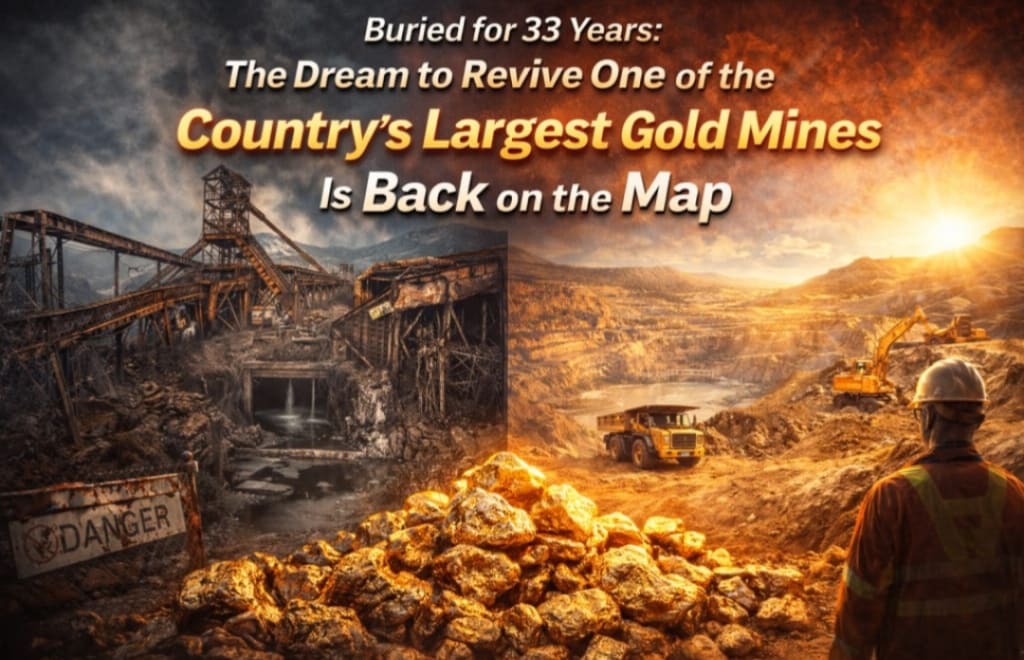
For more than three decades, one of the country’s largest gold mines lay silent—its tunnels sealed, machinery rusting, and ambitions buried beneath layers of dust and political indecision. Once a symbol of industrial promise and national wealth, the mine was shut down 33 years ago amid falling gold prices, operational challenges, and unresolved ownership issues. Today, that long-dormant dream is back on the map. Driven by soaring global demand for gold, advances in mining technology, and renewed investor confidence, plans to revive the historic mine are gathering momentum.
The proposed revival is more than a commercial venture. It represents a broader shift in how countries are reassessing their natural resource potential in an era defined by economic uncertainty, supply-chain stress, and the search for domestic growth engines.
A Mine That Shaped a Generation
When the mine first opened decades ago, it was hailed as a national milestone. At its peak, it employed thousands of workers and supported entire communities through direct jobs, subcontracting, and local businesses. Gold from the mine contributed significantly to exports and foreign exchange reserves, helping stabilize the economy during challenging periods.
However, the boom did not last forever. By the early 1990s, a combination of declining ore grades, outdated extraction methods, and unfavorable global prices made operations increasingly uneconomical. Environmental concerns and regulatory gaps further complicated matters. Eventually, the mine was shuttered, leaving behind not only idle infrastructure but also unresolved social and environmental legacies.
Why the Revival Is Happening Now
The renewed interest in reopening the mine is no coincidence. Gold has reasserted itself as a strategic asset in recent years, serving as a hedge against inflation, currency volatility, and geopolitical risk. Central banks have increased gold purchases, while investors continue to view the metal as a safe haven in uncertain times.
At the same time, mining technology has evolved dramatically. Modern exploration techniques, such as advanced geological modeling and remote sensing, allow companies to reassess old deposits with fresh eyes. What was once considered marginal or inaccessible ore may now be economically viable using contemporary extraction and processing methods.
Rising gold prices have also improved project economics, making large-scale investments more attractive. For policymakers and investors alike, the dormant mine represents untapped value waiting to be unlocked.
Economic Promise and Job Creation
If the revival moves forward as planned, the economic impact could be substantial. Construction and redevelopment alone are expected to generate thousands of jobs, with long-term employment opportunities once production resumes. Local suppliers, transport companies, and service providers would benefit from renewed activity, creating a ripple effect across the regional economy.
From a national perspective, gold exports could help strengthen foreign exchange reserves and reduce dependence on external borrowing. Governments increasingly see resource development as a way to support fiscal stability, provided revenues are managed transparently and responsibly.
Environmental and Social Responsibilities
Reopening a mine that has been dormant for 33 years is not without challenges. Environmental standards have evolved significantly since the original closure, and any revival will face intense scrutiny. Issues such as water management, waste disposal, land rehabilitation, and emissions control must be addressed from the outset.
Equally important is rebuilding trust with local communities. Many residents still remember the mine’s closure and the economic hardship that followed. Meaningful engagement, fair compensation, and investment in community development will be critical to securing social license to operate.
Modern mining projects increasingly integrate sustainability into their core planning. Proponents of the revival argue that with proper oversight and modern practices, the mine can operate responsibly while delivering long-term benefits.
Government and Investor Alignment
The revival effort has gained traction thanks to closer alignment between government authorities and private investors. Regulatory reforms, clearer licensing frameworks, and incentives aimed at attracting responsible mining investment have created a more favorable environment.
Public-private partnerships are being explored to balance risk and ensure national interests are protected. For governments, the challenge lies in encouraging investment without repeating the mistakes of the past, when weak oversight and short-term thinking undermined long-term value.
Strategic Significance Beyond Gold
While gold is the immediate focus, the mine’s revival carries broader strategic implications. It signals a willingness to revisit legacy assets and reassess their potential in light of modern realities. For a country seeking to diversify its economy and strengthen resource security, such projects can play a symbolic and practical role.
The move also sends a message to international investors: that the country is open to business, willing to modernize its extractive sector, and prepared to meet global standards.
A Cautious Optimism
Despite the excitement, experts urge caution. Reviving a mine after three decades is a complex, capital-intensive process. Geological uncertainty, regulatory delays, and market volatility remain real risks. Success will depend on careful planning, robust financing, and sustained political support.
Yet optimism is growing. Feasibility studies are underway, investor interest is rising, and policymakers appear committed to seeing the project through.
Conclusion
Buried for 33 years, the dream of reviving one of the country’s largest gold mines has emerged from dormancy at a pivotal moment. As gold regains prominence in the global economy and technology reshapes what is possible underground, the once-forgotten mine stands poised for a second life. If managed wisely, its revival could become a powerful example of how legacy resources can be transformed into engines of modern, sustainable growth.
About the Creator
Keep reading
More stories from Sadaqat Ali and writers in The Swamp and other communities.
By Dumping Sand Into the Ocean for More Than a Decade, China Has Created Entirely New Islands From Scratch
For more than a decade, China has been quietly but relentlessly transforming stretches of the ocean into solid ground. By dredging sand from the seabed and dumping it onto coral reefs and shallow waters, Beijing has managed to create entirely new islands from scratch. What began as limited land reclamation has evolved into one of the most ambitious maritime engineering efforts in modern history, fundamentally reshaping the geography of the South China Sea and redefining the balance between infrastructure development, geopolitics, and environmental stewardship.
By Sadaqat Ali16 days ago in The Swamp
A Gathering of Evil Bosses
“I’m the queen of chin jutting while I smooth my hair, attacking, insulting, and deflecting to protect my appointer.” “Oh, please, Blondi, my hair is curled, highlighted, and longer than yours. I feature television commercials telling immigrants that we will give them a free plane ride home, and if they voluntarily turn themselves in, they will be allowed to legally apply for re-entry. It runs everywhere, and I look good in it! You can’t compete because of your blond hair. Mine is nicer, and my lips are prettier than yours.”
By Andrea Corwin 7 days ago in The Swamp
5 NATO Allies Agree to Produce Low-Cost Drones
In a move that underscores how warfare and defense strategy are rapidly evolving, five member nations of the North Atlantic Treaty Organization have agreed to jointly develop and produce low-cost military drones. The announcement highlights a growing recognition that future conflicts will rely not only on advanced fighter jets and missile systems but also on scalable, affordable unmanned aerial vehicles that can be produced in large numbers.
By Sajida Sikandar4 days ago in The Swamp
Boundless
A geographical map could take you there. To the places I've been, to the sights I've seen, to the landscapes I've climbed. But no compass could point you in the direction of my memories. To the experiences I've lived, to the happiness I've felt, to the wonder I've held so close to my heart.
By Alyssa Musso3 days ago in Writers


Comments
There are no comments for this story
Be the first to respond and start the conversation.