
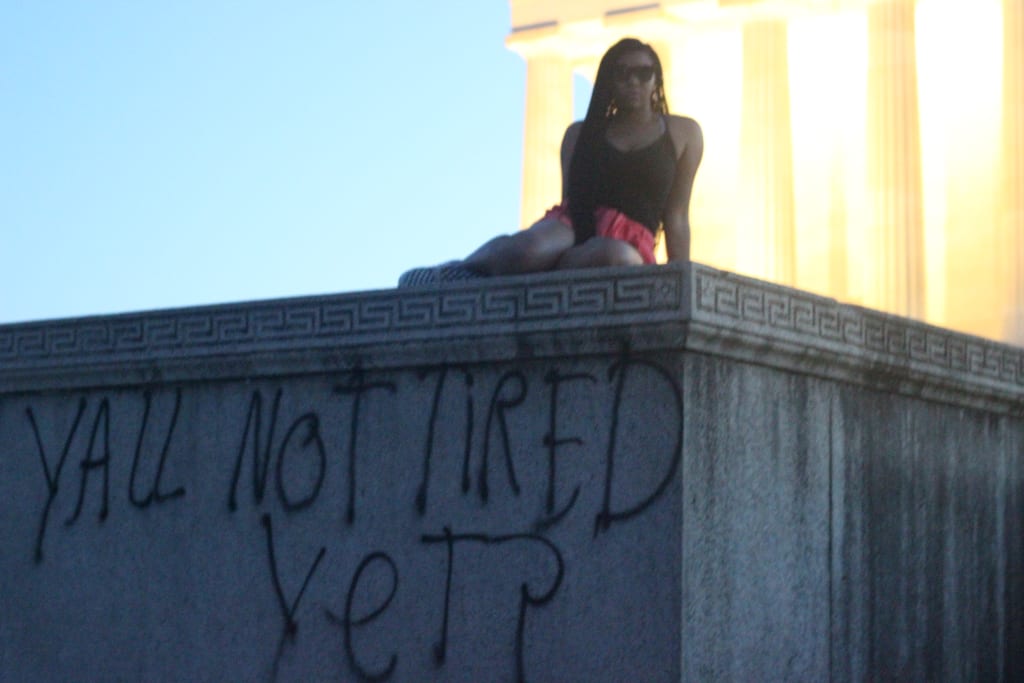
What started out as a peaceful day at the Washington monument picnicking. Ended in turmoil. I almost died. And I wasn’t even protesting. I’m traumatized. I am black in America.
On May 31st at 11pm at night I thought I was never going to make it home. Getting trapped in dc, and witnessing police shoot and bomb people. I was legitimately shocked and disgusted, but moreover in anger. I was thinking to myself, this is it. As I left DC. I don’t know where to begin to express the anger and rage I feel towards police. But if your a white person and you don’t understand your privilege then you are disgustingly apart of the problem. Genuinely I am aware this is a systematic issue but I have to ask is this a fade? I see people posting black lives matter, but what are you actively doing to actually help. Are you actually helping? A simple retweet. But then living as if the world doesn’t affect you is selfish. Does your word even hold weight when you post something but then keep with your silly ideas and live in a fantasy world.
I wish America liked black people as much as they like black culture.
I wish America liked black people as much as they liked fetishizing black men.
I wish America liked black people as much as they liked big butts, big boobs, hips, curves.
I wish America liked black people as much as they like saying the word nigga
This is a systematic issue. This system can no longer work, it isn’t working and will eventually stop working.
Check up on your black/brown and moor friends. No longer live in denial or be silent. And if your of color and you choose to live in denial it’ll be your turn one day when you experience a situation where your race factors in wether you live or die. Then you’ll realize that police are not your friend, they view you as a nigga and you need to arm protect and defend yourself.
I am not promoting violence. I am promoting the fact that you need to wake up, and understand your history. Our world. And that you need to protect yourself. Police where only invented to control “black” people. So why would I ever trust them. This system was only built for white men.
Change the system.
What are you doing to fix the problem?
About the Creator
Keep reading
More stories from writers in The Swamp and other communities.
Why Black History Matters in America?
The United States of America is celebrating their 250th anniversary in 2026. I'm proud to be an American and as someone who was born here, I wouldn't imagine myself living anywhere else. This is a country where opportunities are possible. Where anyone can be successful in anything they desire to do. Equality, community, and togetherness are the backbones of what America is and should be about. However, we have an administration who wants to erase and disregard those who have made positive, meaningful impacts in our country, specifically Black figures, such as Martin Luther King, Jr., Rosa Parks, and Maya Angelou. President Trump and his administration have been constantly complaining and fighting against what they call the "Woke agenda". They use this excuse as a distraction from other issues they refuse to address, such as the high cost of living, climate change, and inflation. That equality is dividing America, when in reality, it's bringing us together. Being woke is not tied to a specific political party. No matter where you stand on the political spectrum, you can still care about other people and their plights. Compassion and empathy for others isn't tied to a political party, either. We were taught as children to treat others the way we want to be treated and not judge others because they're different from us. Caring about others isn't a personal attack on your beliefs. It doesn't make you any less of a person. People who are easily offended over African American figures, past or present, or anything related to it, are grasping at straws. Current and future generations need to know who people like Harriet Tubman and Shirley Chisholm were, especially in the classroom. Black History is part of American History. It should be recognized, not hidden or forgotten. Besides, you can't shield children from everything, just because your feelings are easily hurt.
By Mark Wesley Pritchard 13 days ago in The Swamp
Iran Sentences Nobel Laureate Mohammadi to Seven More Years in Prison
Iran has handed down a new prison sentence of more than seven years to Narges Mohammadi, the Iranian human rights activist and 2023 Nobel Peace Prize laureate, in a move that has drawn sharp international criticism and raised further concerns about the country’s crackdown on dissent. Reuters Supporters and legal representatives say the sentence was issued on February 8, 2026, by a Revolutionary Court in the northeastern city of Mashhad, where Mohammadi has been held since her arrest in December. It comes amid a broader government effort to silence critics and activists at a time of heightened political sensitivity in Iran. A New Sentence and Its Conditions According to Mohammadi’s lawyer, Mostafa Nili, Mohammadi was sentenced to: 6 years in prison on charges of “assembly and collusion against national security” 1.5 years for “propaganda against the government” A two-year ban on travel Two years of internal exile to the city of Khusf in South Khorasan province Reuters The combined sentence amounts to approximately 7½ years of additional imprisonment, on top of a previous sentence that has kept Mohammadi behind bars for extensive periods over the past decade. Iran’s foreign ministry has not publicly acknowledged the new sentencing. Geo News Detention and Hunger Strike Mohammadi, who is now 53, was arrested on December 12, 2025 after speaking out at a memorial ceremony for human rights lawyer Khosrow Alikordi, whose death under unclear circumstances earlier in the year had sparked protests among activists. The authorities accused her of encouraging “norm-breaking slogans” at the event — allegations her supporters describe as politically motivated. Reuters In early February, Mohammadi launched a week-long hunger strike to protest prison conditions and her inability to contact her lawyers and family. Her health deteriorated significantly during the hunger strike, prompting concerns among rights advocates about her safety. Al Jazeera A Life of Activism and Imprisonment Narges Mohammadi has long been a prominent figure in Iran’s human rights movement. She has campaigned tirelessly against the death penalty, for women’s rights, and in opposition to state repression. Mohammadi is deputy director of the Defenders of Human Rights Center (DHRC) and has been detained repeatedly since the late 1990s for her activism. AIPDHE She was awarded the Nobel Peace Prize in 2023 in recognition of her decades-long struggle for human rights under challenging and often dangerous conditions. When the prize was announced, Mohammadi was already in prison, and her children accepted the award on her behalf. Geo News Despite her international recognition, Mohammadi has spent much of the past decade in and out of prison. Even during previous periods of ill health, including after surgeries and hunger strikes, authorities have either returned her to detention or denied requests for extended medical leave. hrw.org Domestic and International Reaction The latest sentence has drawn sharp reactions from rights groups and foreign governments. Human rights organizations describe the ruling as part of a systematic crackdown on dissent in Iran, especially following nationwide protests that began in late December 2025. These demonstrations were fuelled by public anger over political repression and the suspicious death of activists like Alikordi. International figures have called for Mohammadi’s release and urged Iran to respect its obligations under international human rights law, including freedom of expression and fair trial standards. Critics argue that the additional prison term exemplifies how authorities use national security laws to stifle peaceful activism. hrw.org Legal Context in Iran The sentence was issued by a Revolutionary Court, a parallel judicial system in Iran that handles cases involving “national security” and political charges. These courts have been criticised by rights groups for opaque procedures, limited defence rights, and close alignment with security agencies. PBS Revolutionary Courts often try political activists, journalists, and dissidents on charges such as “collusion against national security” and “propaganda against the system,” both of which carry heavy sentences. The new sentence against Mohammadi follows this pattern of legal practice, which critics assert is used to suppress dissenting voices. Geo News Health and Human Rights Concerns Mohammadi’s health has been a subject of ongoing concern. During her imprisonment, she has suffered serious medical issues and has at times been denied adequate treatment, rights groups say. The hunger strike in early February further aggravated those concerns, with supporters warning that continued detention in harsh conditions could be life-threatening. Al Jazeera Human rights advocates have urged that she be granted medical parole or transferred to proper care facilities, arguing that her deteriorating condition underscores the humanitarian dimensions of her case. hrw.org The Broader Climate of Repression Mohammadi’s sentencing comes amid an intensifying pattern of suppression targeting critics and reformists in Iran. Authorities have detained other political figures and activists in recent weeks, tightening restrictions on civil society and political expression while negotiating with the United States over sensitive issues like Iran’s nuclear programme. The sentencing highlights the complex and often conflicting dynamics in Iranian politics: on one hand, Tehran seeks to project strength on the international stage; on the other, it continues a robust internal crackdown against voices calling for greater rights and accountability. As the legal avenues narrow for activists within Iran, international attention and pressure are likely to remain focused on cases like Mohammadi’s, where issues of human rights, national security, and political dissent intersect in a highly contentious environment.
By Fiaz Ahmed 6 days ago in The Swamp



Comments
There are no comments for this story
Be the first to respond and start the conversation.