
China Showcases Humanoid Martial Arts Robots: Should Europe Be Worried?
Beijing’s latest robotics display blends spectacle and strategy — raising fresh questions about tech rivalry, security and industrial competitiveness

When China unveiled a new generation of humanoid robots capable of performing intricate martial arts routines, the global reaction was immediate. Videos of machines executing synchronized kicks, fluid defensive stances and near-human reflexes spread quickly across social media. At first glance, the demonstration looked like a theatrical fusion of kung fu cinema and futuristic engineering.
But beneath the spectacle lies a more serious question: Should Europe be worried?
The answer depends on how one interprets the message behind the machines.
More Than a Tech Demo
China’s robotics exhibition was not merely entertainment. The humanoid systems — agile, balanced, and increasingly autonomous — reflect years of state-backed investment in artificial intelligence, advanced manufacturing and robotics.
While martial arts choreography may appear symbolic, the underlying technology has practical implications. These robots rely on high-performance sensors, machine vision, real-time motion planning and adaptive balance control. Those same capabilities can be applied in logistics, healthcare, defense, disaster response and industrial automation.
In other words, the martial arts routine was likely designed to showcase coordination, agility and precision — not just to impress, but to signal technological maturity.
China has long prioritized robotics as part of its broader industrial strategy, aiming to reduce reliance on foreign technology and dominate next-generation manufacturing. Humanoid robotics sits at the intersection of AI software, semiconductor hardware and advanced mechanical engineering — three sectors central to global competition.
Symbolism Meets Strategy
The martial arts element wasn’t accidental.
Martial arts carry deep cultural symbolism in China — discipline, balance, power and national heritage. By pairing traditional imagery with futuristic robotics, the message is both cultural and strategic: China is blending heritage with innovation.
For domestic audiences, it reinforces national pride and technological progress. For international observers, it signals confidence.
But the real story isn’t the kicks and spins. It’s the speed of advancement.
Only a few years ago, humanoid robots struggled with basic balance and slow movement. Now, demonstrations show fluidity that rivals early prototypes from Western firms. The progress suggests improvements in motor precision, lightweight materials and AI-driven motion learning.
And that’s where Europe enters the conversation.
Europe’s Robotics Position
Europe has a strong legacy in industrial robotics. Companies in Germany, France, and the Nordic countries have long dominated factory automation and precision engineering. European research institutions also remain influential in AI ethics and robotics design.
However, humanoid robotics — particularly dynamic, highly mobile systems — is becoming an arena dominated by a few key players globally, including American and Chinese firms.
China’s advantage lies in scale and state coordination. Massive domestic manufacturing capacity, generous subsidies and vertically integrated supply chains allow rapid prototyping and deployment.
Europe, by contrast, often moves more cautiously. Strong regulatory frameworks ensure safety and ethical oversight, but they can slow commercialization. Funding structures are fragmented across member states. Strategic cohesion sometimes lags behind technological ambition.
Should that cause alarm? Not necessarily — but it should prompt reflection.
Security Implications
Humanoid robots performing martial arts inevitably spark speculation about military applications. While there’s no evidence these specific robots are designed for combat, the dual-use nature of robotics technology is undeniable.
Mobility systems that allow a robot to balance during a spinning kick could also stabilize it in rough terrain. Vision systems used to track movement in a demonstration could aid autonomous navigation in disaster zones — or surveillance environments.
Europe has long championed responsible AI development. The European Union’s regulatory approach emphasizes transparency, human oversight and risk mitigation. That framework may provide moral authority, but it also means Europe must ensure it doesn’t fall behind technologically while setting standards.
If China achieves rapid scaling of advanced humanoid systems — even for civilian use — it could influence global supply chains, pricing and standards in robotics hardware.
Technological leadership often translates into geopolitical leverage.
Industrial Competitiveness
Beyond security, the economic implications are significant.
Humanoid robots have potential applications in aging societies — a particularly relevant issue for Europe. Automated caregiving assistance, warehouse labor support and repetitive task management could ease labor shortages.
If Chinese firms become the primary suppliers of such systems, European industries may become dependent on external technology providers — echoing concerns seen in semiconductor and telecommunications sectors.
Maintaining competitive domestic robotics capabilities is not simply about pride. It’s about economic resilience.
Europe already excels in collaborative robotics (cobots), precision automation and industrial AI. The question is whether policymakers and private investors will expand that leadership into next-generation humanoid systems.
The AI Factor
Humanoid robotics cannot be separated from artificial intelligence.
China’s progress reflects heavy investment in machine learning, real-time processing and AI training models. Robots capable of performing coordinated martial arts routines must interpret spatial data, adjust to minor balance shifts and execute pre-programmed or adaptive responses.
Europe has strong AI research, particularly in explainable and ethical AI. However, commercialization often trails behind the U.S. and China.
If humanoid robotics becomes a defining industrial platform over the next decade, AI integration will determine competitive advantage.
The martial arts performance may have been choreographed — but the learning algorithms behind it are real.
Should Europe Be Worried?
Worry may be the wrong word.
Concern? Awareness? Strategic urgency? Yes.
China’s robotics display is less a threat than a signal. It demonstrates the country’s determination to lead in high-tech sectors. It shows confidence in combining hardware engineering with AI capability.
Europe does not need to react with panic. But it cannot afford complacency.
To remain competitive, Europe may need:
Increased cross-border research collaboration
Streamlined funding for robotics startups
Strategic investment in semiconductor supply chains
Balanced regulation that protects safety without stifling innovation
Public-private partnerships to scale commercialization
Innovation ecosystems thrive when policy aligns with ambition.
A Global Race, Not a Zero-Sum Game
Technological advancement does not have to be framed solely as rivalry. Global collaboration in robotics could accelerate medical care, disaster response and sustainable manufacturing worldwide.
Yet geopolitical reality complicates cooperation.
As the U.S., China and Europe compete for leadership in AI and robotics, each demonstration becomes part of a broader narrative.
China’s humanoid martial arts robots are not merely performing choreography. They are performing strategy.
Final Thoughts
Should Europe be worried?
Only if it ignores the signal.
The robots on display represent progress — in AI coordination, mechanical design and industrial ambition. They highlight how quickly advanced technologies are evolving and how strategic investment can accelerate innovation.
Europe remains a global force in engineering and ethical technology standards. But leadership requires both principle and pace.
China’s showcase was dramatic by design. The deeper question is whether Europe will respond with its own bold vision for the future of robotics — not out of fear, but out of competitive confidence.
In the race for technological leadership, spectacle may grab headlines. Sustained strategy, however, determines who shapes the next industrial era.
About the Creator
A Gathering of Evil Bosses
“I’m the queen of chin jutting while I smooth my hair, attacking, insulting, and deflecting to protect my appointer.” “Oh, please, Blondi, my hair is curled, highlighted, and longer than yours. I feature television commercials telling immigrants that we will give them a free plane ride home, and if they voluntarily turn themselves in, they will be allowed to legally apply for re-entry. It runs everywhere, and I look good in it! You can’t compete because of your blond hair. Mine is nicer, and my lips are prettier than yours.”
By Andrea Corwin 4 days ago in The Swamp
Anti-Drone Warfare: France Grapples with the Challenge of Scaling Up
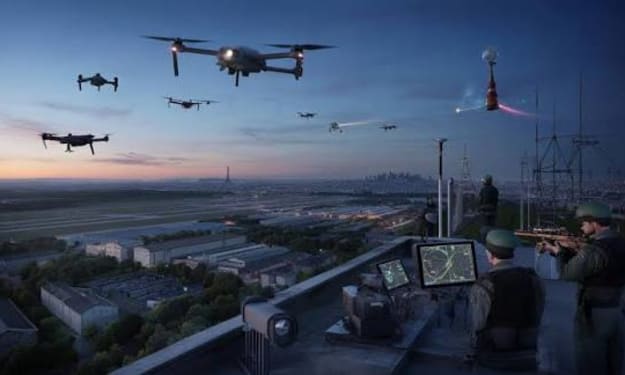
France is facing a growing challenge in countering the increasing threat posed by drones, both in military operations and critical infrastructure protection. The rapid proliferation of unmanned aerial systems (UAS), ranging from small commercial drones to more sophisticated tactical platforms, has prompted the French Armed Forces and government agencies to accelerate efforts to scale up their anti-drone capabilities. Rising Drone Threats Over the past few years, drones have become a prominent feature in modern conflict and security scenarios. From surveillance and reconnaissance to armed attacks, unmanned aerial systems are increasingly used by state and non-state actors alike. The French Ministry of Armed Forces has highlighted multiple incidents in which drones posed risks to military installations, borders, and major public events. “Drones have become more accessible, cheaper, and technologically advanced,” said a defense official. “This represents a significant challenge, as traditional air defense systems are not always optimized to detect and neutralize these smaller, agile platforms.” Military and Industrial Response France has been investing in both technological and operational solutions to strengthen its counter-drone capabilities. French defense contractors, in collaboration with the armed forces, are developing systems that combine radar, electronic warfare, and directed-energy technologies to detect, track, and disable unauthorized drones. One prominent approach involves jamming communications and GPS signals, effectively neutralizing drones without causing collateral damage. Other measures include deploying high-energy laser systems and integrating anti-drone sensors into existing air defense networks. However, scaling up these systems for nationwide coverage is a complex task. According to military analysts, France faces logistical, technological, and regulatory hurdles in deploying anti-drone systems across military bases, urban centers, and critical infrastructure sites. Budgetary and Strategic Considerations The French government has allocated funds for research and development of anti-drone technology, but defense officials acknowledge that additional investments are needed to rapidly expand operational capacity. “We must balance budgetary constraints with the urgency of the threat,” a MoD spokesperson said. “It is not enough to have isolated systems; we need integrated, scalable solutions across all strategic sites.” The challenge is further compounded by the fast pace of drone technology. Modern drones can be small, silent, and highly maneuverable, making detection difficult. Defense experts argue that France must adopt a multi-layered approach, combining sensors, countermeasures, and rapid response teams to maintain operational effectiveness. Civil-Military Cooperation Beyond military applications, anti-drone measures are increasingly relevant to civil authorities, particularly in urban areas and around public events. Airports, stadiums, and government buildings are considered vulnerable to unauthorized drone incursions. France has initiated pilot programs involving both military and law enforcement agencies to develop rapid deployment protocols and emergency response strategies. Legal frameworks are also being updated to regulate drone operations and support counter-drone measures. Enforcement of no-fly zones, certification of commercial drone operators, and penalties for violations are being strengthened to complement technical defenses. Future Outlook French defense officials emphasize that countering the drone threat is a long-term endeavor. The Ministry of Armed Forces is working to integrate anti-drone systems into the broader military modernization plan, including joint exercises and operational training. Coordination with NATO allies is also a priority, ensuring interoperability and shared technological advances. Experts caution that failure to scale up anti-drone capabilities could leave France vulnerable to espionage, sabotage, and asymmetric attacks. Conversely, successfully implementing a robust counter-drone infrastructure could serve as a model for other European nations facing similar challenges. Conclusion The rapid rise of drone technology presents a multidimensional challenge for France, requiring investment, innovation, and strategic foresight. From military bases to urban centers, authorities must develop scalable solutions capable of detecting, neutralizing, and deterring drone threats. While progress is being made, the need for integrated systems, enhanced legislation, and civil-military cooperation remains urgent, underscoring the high stakes of anti-drone warfare in the 21st century.
By Fiaz Ahmed 4 days ago in The Swamp



Comments
There are no comments for this story
Be the first to respond and start the conversation.