
Exclusive: Russian Embassy in Seoul Defies South Korea, Keeps Pro-War Banner
Diplomatic tensions flare as the Russian Embassy in Seoul refuses to remove a controversial pro-war banner, challenging South Korea's diplomatic norms and international relations
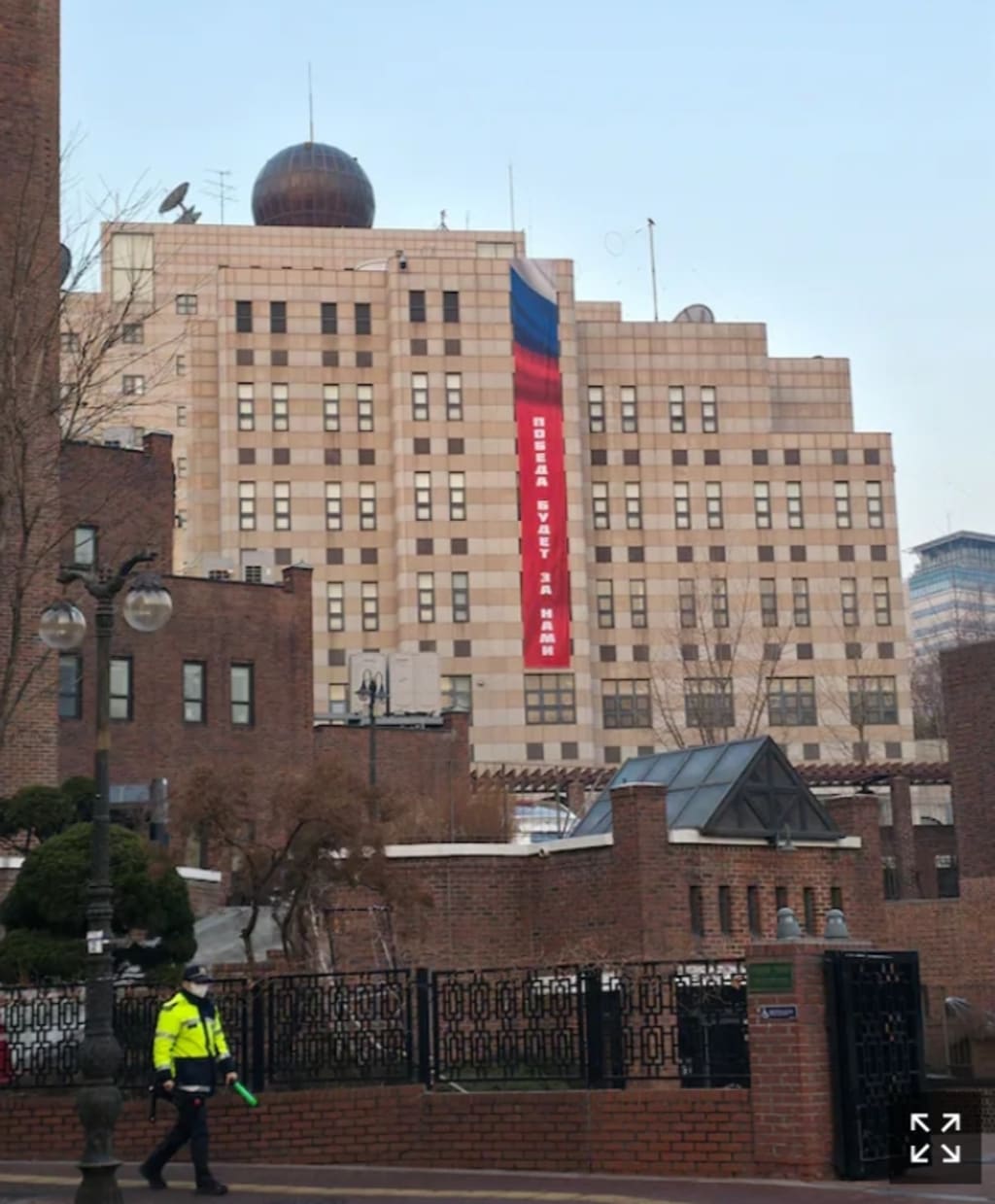
Diplomatic friction between South Korea and Russia escalated this week after the Russian Embassy in Seoul refused to remove a pro-war banner displayed prominently on its compound in central Seoul.
The banner, visible from a busy public road, contains messaging widely interpreted as endorsing Moscow’s ongoing military operations in Ukraine. South Korean officials have formally requested its removal, citing concerns over public order and diplomatic decorum. The embassy, however, has declined, arguing that the display falls within its rights under international diplomatic conventions.
The dispute has quickly become a flashpoint in an already delicate bilateral relationship.
A banner that sparked backlash
The banner first appeared earlier this month, draped across the embassy’s outer-facing facade. Featuring patriotic symbols and slogans supporting Russia’s armed forces, it drew swift attention from passersby and local media.
Civic groups staged small demonstrations outside the embassy gates, calling the banner provocative and insensitive. Some protesters carried Ukrainian flags; others demanded that Seoul take a firmer stance against Moscow.
Officials at South Korea’s Ministry of Foreign Affairs confirmed that they had communicated their concerns directly to embassy representatives. According to diplomatic sources, the government expressed regret over the display and urged restraint, noting that such public messaging could inflame tensions within the host country.
Yet the banner remains.
Diplomatic immunity versus host country sensitivities
At the center of the controversy is a legal gray area.
Under the Vienna Convention on Diplomatic Relations, embassies are granted significant protections. Their premises are considered inviolable, and host governments are generally prohibited from entering or interfering without consent.
Russian officials argue that the banner constitutes an internal expression of state policy on sovereign diplomatic territory. From Moscow’s perspective, removing it under external pressure would set an undesirable precedent.
South Korean authorities, meanwhile, contend that while embassies enjoy legal protections, diplomatic missions are also expected to respect the laws and norms of the host country. Privately, some officials describe the banner as unnecessarily confrontational, particularly given South Korea’s increasing alignment with Western partners on the Ukraine conflict.
The episode underscores a broader tension: how far diplomatic immunity extends when political messaging spills into public view.
A shifting geopolitical landscape
Since Russia launched its full-scale invasion of Ukraine in 2022, Seoul has gradually hardened its stance toward Moscow. While South Korea initially sought to balance economic interests with diplomatic caution, it has since imposed sanctions on Russian entities and tightened export controls on strategic materials.
President Yoon Suk Yeol has emphasized solidarity with democratic partners and adherence to international law. Though South Korea has not directly supplied lethal weapons to Ukraine, it has provided humanitarian assistance and indirect military support through third-party arrangements.
Russia, for its part, has warned against deeper South Korean involvement. Russian officials have suggested that expanded military cooperation with Ukraine could harm bilateral ties.
Against this backdrop, the embassy banner appears less like an isolated act and more like a symbolic assertion of Moscow’s position.
Public opinion and domestic politics
The controversy arrives at a sensitive moment domestically.
South Korean public opinion on Russia has shifted markedly since the invasion. Surveys indicate declining favorability ratings and growing sympathy for Ukraine. At the same time, South Korea must carefully manage relations with major powers, including Russia and China, given regional security concerns involving North Korea.
Opposition lawmakers have criticized the government’s response as overly cautious, urging stronger diplomatic action. Some have called for a formal protest note or even the summoning of the Russian ambassador for consultations.
Others warn that escalating the dispute could prove counterproductive.
“Diplomatic disagreements should be managed quietly,” one former foreign ministry official noted. “Turning this into a public standoff risks unnecessary deterioration in relations.”
Moscow’s messaging strategy
The banner also reflects a broader information campaign.
Since the start of the war, Russian diplomatic missions worldwide have increasingly used social media and public displays to project Moscow’s narrative. From commemorative events to symbolic installations, embassies have sought to rally support among sympathetic communities and reinforce domestic messaging abroad.
President Vladimir Putin has framed the conflict as a defensive operation against Western encroachment. Diplomatic outposts have echoed that language, often emphasizing patriotism and national resilience.
In Seoul, however, the strategy may be misaligned with public sentiment. South Korea’s strong media environment and global economic ties mean that overt pro-war messaging can generate backlash rather than solidarity.
Legal options and limitations
Despite the strong rhetoric, South Korea’s practical options remain limited.
Forcibly removing the banner would violate international diplomatic norms. Declaring diplomats persona non grata—a step sometimes taken in severe disputes—would represent a dramatic escalation unlikely to be justified solely by a public display.
Instead, officials appear to be pursuing continued dialogue behind closed doors.
Diplomatic sources suggest that Seoul hopes the embassy will eventually remove the banner voluntarily once it has made its intended statement. Whether that calculation proves accurate remains to be seen.
A symbol of strained ties
Historically, relations between South Korea and Russia have oscillated between cautious cooperation and strategic divergence. The two countries established diplomatic ties in 1990 and have collaborated in areas ranging from energy to space technology.
Yet geopolitical realities have grown more complex. Russia’s closer alignment with North Korea has heightened concerns in Seoul. Reports of expanded military cooperation between Moscow and Pyongyang have further strained trust.
Within this context, even symbolic gestures carry outsized weight.
What might once have been dismissed as routine political messaging now feels like a deliberate provocation to some observers.
What happens next?
For now, the banner continues to hang over the embassy grounds, fluttering in the winter wind.
Diplomatic tensions rarely erupt from a single act. More often, they accumulate through a series of symbolic and substantive disagreements. Whether this dispute fades quietly or becomes another marker of deteriorating ties will depend on broader geopolitical developments.
If South Korea deepens its involvement in supporting Ukraine, Moscow may respond with sharper rhetoric or reciprocal measures. Conversely, a cooling of global tensions could render the banner an ephemeral footnote.
What is clear is that even in an era dominated by digital communication, physical symbols still matter. A stretch of fabric fixed to a building has become a focal point for debates about sovereignty, international law, and the limits of diplomatic expression.
In the careful choreography of international relations, optics can be as powerful as policy.
About the Creator
A Gathering of Evil Bosses
“I’m the queen of chin jutting while I smooth my hair, attacking, insulting, and deflecting to protect my appointer.” “Oh, please, Blondi, my hair is curled, highlighted, and longer than yours. I feature television commercials telling immigrants that we will give them a free plane ride home, and if they voluntarily turn themselves in, they will be allowed to legally apply for re-entry. It runs everywhere, and I look good in it! You can’t compete because of your blond hair. Mine is nicer, and my lips are prettier than yours.”
By Andrea Corwin 6 days ago in The Swamp




Comments
There are no comments for this story
Be the first to respond and start the conversation.