
First Democratic Presidential Debate, Part 2 of 2
Winners and Losers

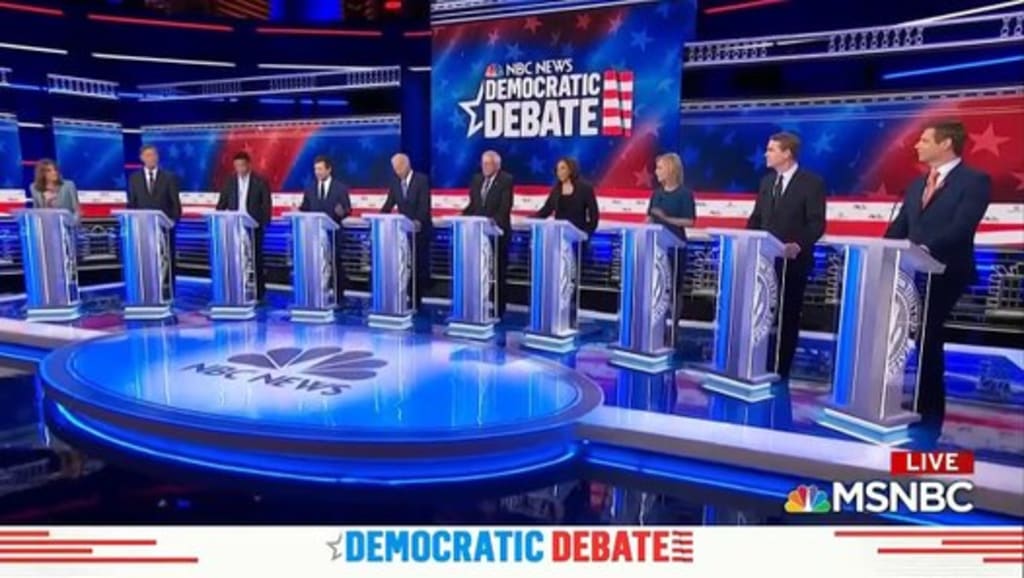
I thought the second part of the first 2020 Democratic Presidential debate was better than the first part, in that more of the ten on stage had standout moments. My assessment follows, in descending order of what I thought were the best performances:
Harris was clearly outstanding and the best last night. She was powerful and eloquent on health care and immigration. She was strong on the need to curb racism, including an attack on Biden for working with Southern racist Senators. I liked her intention to take executive action on banning assault weapons (though Swalwell was even stronger on this issue), and she had the best closing statement.
Gillibrand did a lot of good for herself on the need to curb gun violence, and on the danger of compromising on women's rights. I think she'll rise in the polls as a result of tonight's performance.
Among all the crucially important issues that beset us, I put reducing gun violence, a.k.a gun control, at the top of the list. I therefore agree completely with Swalwell putting gun control at the top of his list. His plan to buy back assault weapons makes good sense, and he captured the stakes in this issue well with his observation that we need to "love our children more than our guns."
Bennet was correct to speak about Nazi concentration camps in his denunciation of the camps for immigrants at our Southern border, and he was right to stress the need to win back the Senate in the 2020 election (as Booker did last night).
Sanders had a strong closing statement, and he was passionate as always on the need to equalize wealth in America.
Buttigieg was powerful and articulate on the need to end police racism, but Swalwell did him one better by challenging him to fire the police chief of South Bend.
Biden took a long time to come alive—too long—and responded pretty well to Harris's attacks (but he should have kept talking). He was excellent on the evil of putting children in cages, strong on the need to get our troops out of Afghanistan, and right to hold gun manufacturers responsible (but why let the NRA off the hook?). His closing statement was okay—which is about the best you could say about his overall performance.
The other three either outright crazy (Williamson), too focused on a single issue (Yang), or nothing special (Hickenlooper). I don't expect any of them to be on stage for the next debate.
But I'll be back here with another review.

Joe Biden does become President in this 2014 novel
About the Creator
Paul Levinson
Novels The Silk Code, The Plot To Save Socrates, It's Real Life: An Alternate History of The Beatles; LPs Twice Upon A Rhyme & Welcome Up; nonfiction The Soft Edge & Digital McLuhan, translated into 15 languages. Prof, Fordham Univ.
Keep reading
More stories from Paul Levinson and writers in The Swamp and other communities.
Why Black History Matters in America?
The United States of America is celebrating their 250th anniversary in 2026. I'm proud to be an American and as someone who was born here, I wouldn't imagine myself living anywhere else. This is a country where opportunities are possible. Where anyone can be successful in anything they desire to do. Equality, community, and togetherness are the backbones of what America is and should be about. However, we have an administration who wants to erase and disregard those who have made positive, meaningful impacts in our country, specifically Black figures, such as Martin Luther King, Jr., Rosa Parks, and Maya Angelou. President Trump and his administration have been constantly complaining and fighting against what they call the "Woke agenda". They use this excuse as a distraction from other issues they refuse to address, such as the high cost of living, climate change, and inflation. That equality is dividing America, when in reality, it's bringing us together. Being woke is not tied to a specific political party. No matter where you stand on the political spectrum, you can still care about other people and their plights. Compassion and empathy for others isn't tied to a political party, either. We were taught as children to treat others the way we want to be treated and not judge others because they're different from us. Caring about others isn't a personal attack on your beliefs. It doesn't make you any less of a person. People who are easily offended over African American figures, past or present, or anything related to it, are grasping at straws. Current and future generations need to know who people like Harriet Tubman and Shirley Chisholm were, especially in the classroom. Black History is part of American History. It should be recognized, not hidden or forgotten. Besides, you can't shield children from everything, just because your feelings are easily hurt.
By Mark Wesley Pritchard 14 days ago in The Swamp
As Costly As Rafale, Far Less Survivable: Why U.S. Apache Helos Found No Place in India’s $40B Deal
India’s ambitious $40 billion defense modernization program has reshaped the future of its air combat fleet, with a strong emphasis on survivability, multirole capability, and long-term strategic autonomy. While the deal prominently features advanced fighter jets such as the French-made Rafale, the conspicuous absence of the U.S.-built Apache attack helicopter has raised questions among defense analysts. The Apache, widely regarded as one of the most lethal helicopter gunships in the world, was once expected to play a larger role in India’s expanding aerial arsenal. Instead, it found itself sidelined in favor of other platforms deemed better suited to India’s evolving operational doctrine. The Apache’s reputation is formidable. Designed for high-intensity battlefields, it boasts advanced radar, precision-guided munitions, and a long combat record in U.S. military operations. However, India’s $40 billion procurement strategy is not merely about firepower; it is about survivability in contested airspace, integration with indigenous systems, and long-term cost-effectiveness. Cost Without Strategic Flexibility One of the most striking comparisons is cost. Each Apache helicopter, depending on configuration, can approach the price range of modern fighter aircraft such as Rafale. This raises a critical question: why invest fighter-jet-level resources in a helicopter platform that is inherently more vulnerable to modern air defenses? Helicopters, by design, operate at lower altitudes and slower speeds, making them more exposed to surface-to-air missiles, shoulder-fired weapons, and radar-guided systems. In modern battlefields saturated with air defense networks, survivability is no longer measured by armor alone but by stealth, speed, and electronic warfare capabilities—areas where fighter jets significantly outperform attack helicopters. Survivability in High-Threat Environments India’s security challenges include two nuclear-armed neighbors and the possibility of conflict in high-altitude and technologically dense theaters. In such scenarios, survivability becomes paramount. The Apache, though heavily armored, lacks the low-observable features and high-speed escape profiles of advanced fighter jets. Military planners increasingly prioritize platforms that can penetrate defended airspace, deliver strikes, and exit before detection or interception. The Apache’s operational doctrine works best in environments where air superiority is already established. India’s planners, however, are preparing for situations where air superiority cannot be assumed from the outset. Logistics and Dependency Concerns Another factor is logistical dependence. Apache helicopters rely heavily on U.S. supply chains for spare parts, software updates, and weapon systems. India has long pursued a policy of reducing overreliance on any single foreign supplier. While cooperation with the United States has grown, New Delhi remains cautious about potential political or regulatory constraints that could affect availability of parts during crises. By contrast, the Rafale deal includes technology transfer, local maintenance infrastructure, and greater autonomy in operations. This aligns with India’s broader “Make in India” and self-reliance initiatives in defense production. Shifting Doctrines and Indigenous Alternatives India is also investing heavily in indigenous rotary-wing platforms and armed drones. Attack helicopters are increasingly seen as vulnerable assets compared to unmanned systems that can perform reconnaissance and strike missions without risking pilot lives. Drones can loiter longer, operate at higher altitudes, and integrate more seamlessly with network-centric warfare strategies. Moreover, India’s focus is shifting toward multi-domain warfare—coordinating air, land, cyber, and space assets. Fighter aircraft and unmanned systems are better suited for such integration than traditional attack helicopters. Political and Strategic Calculations Defense procurement is never purely technical. Political alignment, strategic signaling, and long-term partnerships all play roles. The Rafale deal strengthened ties with France, a country that has historically supported India’s strategic independence and provided fewer restrictions on operational use of equipment. The Apache, despite its battlefield credibility, represents a model tied closely to U.S. doctrine and export controls. For India, the priority is not just buying weapons but ensuring freedom of action in future conflicts. The Bigger Picture The exclusion of Apache helicopters from India’s $40 billion deal does not mean the platform is ineffective. It remains one of the most capable attack helicopters in the world. However, India’s requirements are evolving toward survivability in high-threat environments, reduced dependency on foreign supply chains, and integration with indigenous and unmanned systems. In a battlefield defined by long-range missiles, electronic warfare, and dense air defense networks, a helicopter—no matter how advanced—faces limitations that fighter aircraft and drones do not. When cost is nearly comparable to a multirole fighter jet, the calculus becomes even more unforgiving. Conclusion India’s decision reflects a strategic shift rather than a rejection of U.S. technology. The Apache’s absence from the $40 billion deal underscores how modern warfare priorities have changed. Survivability, autonomy, and flexibility now outweigh sheer firepower. In that context, a platform as costly as Rafale but far less survivable in contested airspace simply could not justify its place in one of the largest defense modernization efforts in India’s history. The message is clear: future wars will be fought not just with powerful machines, but with systems that can endure, adapt, and operate independently in the most hostile environments.
By Fiaz Ahmed about 9 hours ago in The Swamp


Comments
There are no comments for this story
Be the first to respond and start the conversation.