
India and EU Set for ‘Mother of All Deals’ as Trump’s Tariff Uncertainty Looms
Trade talks gain urgency as Brussels and New Delhi push for a landmark agreement amid shifting US economic policy
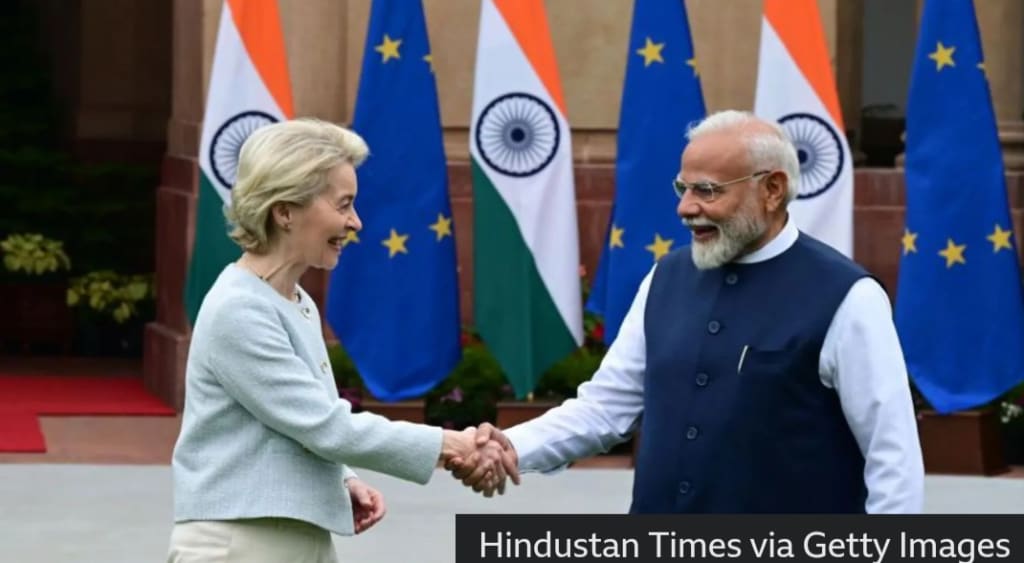
India and the European Union are moving closer to what officials are calling the “mother of all deals”, as both sides accelerate negotiations on a long-awaited free trade agreement amid growing uncertainty over potential tariff changes under a renewed Donald Trump presidency.
The proposed pact, if finalised, would be one of the largest trade agreements in the world, covering a combined market of more than 1.9 billion people. With the US signalling a tougher stance on trade and the possibility of sweeping new tariffs, India and the EU see deeper economic cooperation as a strategic necessity rather than a choice.
Why the Deal Matters Now
Trade talks between India and the EU have stalled and restarted multiple times over the past decade. However, recent geopolitical and economic developments have injected new urgency into the negotiations.
Donald Trump’s return to the White House has raised concerns across global markets about the reintroduction of aggressive tariff policies. During his previous term, Trump imposed wide-ranging tariffs that disrupted supply chains and strained relationships with both allies and rivals.
For India and the EU, the prospect of renewed US protectionism has underscored the need to diversify trade partnerships and reduce reliance on any single market.
What the Agreement Could Include
Negotiators say the proposed deal would go far beyond a traditional free trade agreement. Key areas under discussion include:
Reduced tariffs on goods such as automobiles, pharmaceuticals, textiles, and machinery
Greater access for EU companies to India’s services and public procurement markets
Improved protections for intellectual property
Sustainability and labour standards
Easier movement for professionals and skilled workers
If concluded, the agreement could significantly boost bilateral trade, which already exceeds €120 billion annually.
Benefits for India
For India, the deal represents an opportunity to accelerate economic growth and strengthen its role as a global manufacturing hub. Improved access to the EU market would benefit Indian exporters, particularly in sectors such as textiles, chemicals, IT services, and generic medicines.
Indian officials also see the agreement as a way to attract more European investment, support domestic job creation, and integrate more deeply into global supply chains.
At a time when India is positioning itself as an alternative to China for manufacturing and technology, closer ties with Europe could prove strategically valuable.
What the EU Stands to Gain
The European Union, meanwhile, views India as a critical long-term partner in a rapidly changing global economy. With China becoming a more complex and politically sensitive trading partner, Brussels is keen to deepen economic links with other major emerging markets.
European companies are particularly interested in gaining better access to India’s vast consumer market, which is expected to become the world’s third-largest economy within the decade.
The deal would also align with the EU’s broader goal of strengthening relationships with democratic partners and promoting rules-based trade.
Obstacles Still to Overcome
Despite renewed momentum, significant challenges remain. Previous rounds of talks broke down over disagreements on tariffs, market access, and regulatory standards.
The EU has pushed for stronger commitments on environmental protection and labour rights, while India has expressed concerns about the impact of such requirements on its domestic industries.
Agriculture remains another sensitive area, with both sides seeking to protect farmers and food producers from increased competition.
Negotiators acknowledge that compromise will be essential if the agreement is to be finalised.
The Shadow of US Trade Policy
Trump’s unpredictable approach to trade looms large over the talks. During his previous term, he withdrew from major trade agreements and frequently used tariffs as a negotiating tool.
If similar policies return, they could disrupt global trade flows and increase costs for exporters worldwide. For India and the EU, a comprehensive bilateral deal could serve as a buffer against external shocks and reduce exposure to US policy shifts.
Trade experts say the situation highlights a broader trend toward regional and bilateral trade agreements as countries seek stability in an uncertain global environment.
Geopolitical Implications
Beyond economics, the deal carries geopolitical significance. A stronger India-EU partnership could help shape global trade norms and counterbalance the influence of both the US and China.
Analysts say the agreement would signal a commitment to multilateralism and open markets at a time when protectionism is on the rise.
It could also strengthen cooperation in areas such as climate policy, digital regulation, and supply chain resilience.
What Happens Next
Officials on both sides say negotiations are entering a critical phase, with the goal of reaching a political agreement in the near future. However, any final deal would still need to be approved by EU member states and India’s parliament, a process that could take time.
While optimism is growing, experts caution that trade negotiations of this scale are complex and prone to last-minute hurdles.
Conclusion
As uncertainty over US trade policy intensifies, India and the European Union are seizing the moment to push forward what could become one of the most significant trade agreements in modern history. The so-called “mother of all deals” reflects not only economic ambition but also a strategic response to a rapidly shifting global landscape.
If successful, the agreement could reshape trade flows, strengthen political ties, and provide a measure of stability in an increasingly unpredictable world.
About the Creator
Keep reading
More stories from Aarif Lashari and writers in The Swamp and other communities.
New Zealand Landslide: Rescue Efforts Called Off for Six People Buried in Disaster
Rescue efforts have been officially called off for six people buried in a devastating landslide in New Zealand, as authorities confirmed that continued operations posed an unacceptable risk to emergency workers. The decision marks a painful turning point in a tragedy that has shaken the nation and reignited concerns over extreme weather, land stability, and disaster preparedness.
By Aarif Lashariabout a month ago in The Swamp
A Gathering of Evil Bosses
“I’m the queen of chin jutting while I smooth my hair, attacking, insulting, and deflecting to protect my appointer.” “Oh, please, Blondi, my hair is curled, highlighted, and longer than yours. I feature television commercials telling immigrants that we will give them a free plane ride home, and if they voluntarily turn themselves in, they will be allowed to legally apply for re-entry. It runs everywhere, and I look good in it! You can’t compete because of your blond hair. Mine is nicer, and my lips are prettier than yours.”
By Andrea Corwin 7 days ago in The Swamp
Punjab Airlines Operations Start Date Revealed
The government of Punjab has officially announced that its new provincial airline — Punjab Airlines — will begin flight operations in April 2026, marking a major milestone in the region’s aviation landscape. The announcement, part of an ongoing effort by the provincial administration to strengthen air connectivity and boost economic activity, was confirmed through official sources and local media reports. A New Era for Provincial Aviation Punjab Airlines, owned and operated by the provincial government under the leadership of Chief Minister Maryam Nawaz Sharif, is poised to become a unique addition to Pakistan’s aviation sector. Unlike traditional carriers that are commercially owned or national in scope, this airline is a provincially controlled carrier, designed to expand domestic flight options and promote regional economic integration. According to government sources, the inaugural flights are scheduled to begin in April 2026, with an initial fleet of seven passenger aircraft. These aircraft will service domestic routes during the first phase of operations, connecting major cities within Punjab and facilitating travel for both business and leisure passengers. Operational Plans and Strategy Punjab Airlines will initially operate domestically for the first two years, focusing on key routes that link provincial capitals and major urban centers. After this period, officials expect the airline to expand gradually into international markets, subject to regulatory approvals and market demand. One distinctive feature of Punjab Airlines’ operational model is its dual‑use fleet strategy. In addition to serving commercial travellers, government officials — including the Chief Minister — will also use the airline’s aircraft for official business. Government sources emphasise that this will be done on a commercial fare basis, meaning no separate or specially purchased jets will be assigned solely for VIP use. Officials said that including the Chief Minister’s existing helicopter in the company’s fleet will help minimise upfront investment and optimise asset utilisation. The strategy aims to reduce reliance on provincial treasury funds by using both existing and newly acquired aircraft for revenue‑generating passenger services. Economic and Political Context Punjab Airlines represents a bold move by the provincial government to diversify economic activity and improve infrastructure. By establishing a dedicated airline, Punjab aims to boost connectivity within the province and beyond, supporting tourism, commerce, and business travel. Local business leaders have generally welcomed the move, seeing it as a boost for sectors such as hospitality, trade, and logistics. However, the project has not been without controversy. Critics on social media and in political commentary have raised concerns over spending on aircraft — especially luxury jets — that many see as unnecessary given other pressing public needs. Some observers argue that public funds should be focused on sectors such as healthcare and education rather than aviation. Proponents counter these concerns by emphasising that the airline’s commercial model is designed to be financially sustainable. By operating passenger services and government travel on a fare‑paying basis, the model is framed as an innovative example of asset optimisation rather than expenditure without return. Preparing for Launch To prepare for the April launch date, the airline has been acquiring aircraft and securing regulatory approvals. The government has pursued both purchased planes and leased aircraft to meet its initial fleet requirements. Authorities are also recruiting pilots, crew, and ground support personnel to ensure that operations are ready to commence on schedule. Officials have indicated that daily operations will initially focus on major domestic routes, enhancing connectivity between Punjab’s cities and potentially relieving pressure on existing carriers. Once operational, the airline may add additional flights and destinations in response to customer demand and market trends. Future Prospects Looking further ahead, Punjab Airlines has ambitions to offer international flights after successfully establishing a domestic footprint. Expansion into regional air service markets could position the airline as a significant player in South Asian aviation, providing passengers with more travel options and enhancing competition in the sector. As preparations continue, the April 2026 start date marks a key milestone for the airline and for provincial ambitions in Pakistan’s aviation sector. Its success could serve as a model for other regions considering similar transportation and economic initiatives.
By Fiaz Ahmed 5 days ago in The Swamp



Comments
There are no comments for this story
Be the first to respond and start the conversation.