
New Maritime Security Plan Could See Irish Naval Officers Deployed as Liaisons on Foreign Ships
The proposal would allow Irish naval officers to serve as liaison personnel on allied vessels, strengthening maritime security cooperation while preserving Ireland’s policy of military neutrality.

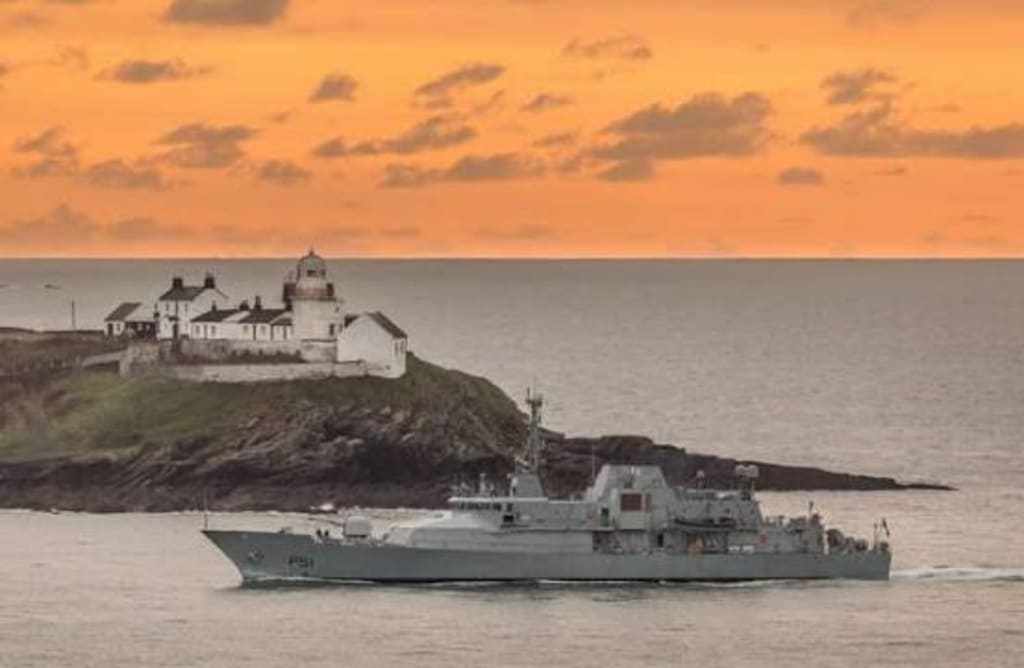
A new maritime security strategy under consideration by the Irish government could result in Irish naval officers being deployed as liaison personnel aboard foreign naval vessels, marking a significant shift in how the country contributes to international maritime operations while maintaining its long-standing policy of military neutrality.
The proposal, outlined in a draft review of Ireland’s overseas defence commitments, would allow officers from the Irish Naval Service to serve temporarily on allied ships taking part in multinational patrols and security missions. These officers would not command combat operations but would act as coordinators, intelligence links, and operational observers between Ireland and partner nations.
Strengthening Maritime Security Cooperation
Ireland’s extensive coastline and strategic position along major transatlantic shipping routes have made maritime security a growing priority. Officials say the plan is designed to enhance cooperation against threats such as illegal trafficking, human smuggling, piracy, and the sabotage of undersea infrastructure like communication cables and energy pipelines.
Under the new framework, Irish naval officers could be seconded to vessels operated by European Union partners or United Nations-mandated missions. Their role would focus on information sharing, situational awareness, and ensuring that Ireland remains fully informed about regional maritime developments without deploying full combat units.
Defence sources say the move reflects the reality that maritime security threats increasingly cross borders and require collective responses. “This is about presence and partnership, not participation in warfare,” one senior official familiar with the plan said. “Ireland would maintain its neutral stance while contributing expertise to international stability.”
Neutrality and Political Sensitivity
Ireland’s policy of military neutrality has long shaped its defence strategy. Any step that brings Irish personnel closer to foreign military operations can provoke political debate. Opposition parties and civil society groups have already raised concerns that the proposal could blur the line between neutral engagement and alliance-style cooperation.
Supporters argue that the liaison model is consistent with Ireland’s history of peacekeeping and international cooperation. Irish personnel already serve abroad in UN missions in non-combat roles, and this plan would extend that principle to maritime security.
The Department of Defence has stressed that any deployment would require government approval and would operate under strict legal and operational guidelines. Officers would not be embedded in offensive missions and would not take part in direct combat activities.
Operational Benefits for the Naval Service
For the Irish Naval Service, the initiative could offer practical advantages. Years of staffing shortages and budget constraints have limited Ireland’s ability to patrol its own waters continuously. By embedding officers on allied ships, Ireland gains access to wider surveillance networks and operational experience without the cost of deploying full vessels abroad.
Naval analysts note that this could improve training standards and professional development for Irish officers. Exposure to advanced maritime technologies and multinational command structures would enhance Ireland’s long-term naval capabilities.
“This is a knowledge-transfer opportunity,” said one former naval commander. “Irish officers would return with insights into modern maritime operations that could strengthen domestic security and readiness.”
European and Global Context
The plan comes amid growing international concern over maritime threats, particularly in the North Atlantic and Mediterranean regions. Recent incidents involving damage to undersea cables and increased migrant smuggling have highlighted vulnerabilities in Europe’s maritime domain.
Several EU states already use liaison officers as part of joint patrols and naval task forces. Ireland’s participation would align it more closely with European security initiatives while stopping short of formal military alliances.
Officials also emphasize that the deployments would be selective and mission-specific, focusing on humanitarian protection, law enforcement coordination, and early warning rather than combat deterrence.
Public and Parliamentary Scrutiny Ahead
Before the proposal can be implemented, it must pass through parliamentary review and public consultation. Lawmakers are expected to debate the legal limits of such deployments and how they fit within Ireland’s constitutional principles of neutrality.
Public opinion remains divided. Some view the plan as a pragmatic response to modern security threats, while others fear it could draw Ireland into geopolitical conflicts indirectly.
Defence officials insist transparency will be central to the policy. Each deployment would be announced publicly, with clear explanations of purpose and duration.
A Careful Step Forward
If approved, the maritime liaison initiative would represent a cautious evolution of Ireland’s security posture rather than a radical shift. By placing officers on foreign ships in advisory and coordination roles, Ireland seeks to protect its maritime interests while remaining true to its neutral tradition.
As global seas become more contested and complex, the government believes that cooperation — even in limited form — is essential. Whether this approach gains full political and public support will determine how far Ireland is willing to go in redefining its role in international maritime security.
About the Creator
Fiaz Ahmed
I am Fiaz Ahmed. I am a passionate writer. I love covering trending topics and breaking news. With a sharp eye for what’s happening around the world, and crafts timely and engaging stories that keep readers informed and updated.
Keep reading
More stories from Fiaz Ahmed and writers in The Swamp and other communities.
Trump’s New Tariff Comes into Effect at Lower Than Expected Rate
A new tariff introduced by Donald Trump has officially come into force in the United States, but at a significantly lower rate than many economists and industry groups had anticipated. The decision has eased immediate fears of sharp price increases while still signaling a renewed commitment by the administration to its protectionist trade agenda. The tariff, which targets a broad range of imported industrial and consumer goods, was initially expected to be set at a rate of up to 15 percent. Instead, the finalized measure applies a baseline rate of 7 percent, according to officials from the U.S. Department of Commerce. The administration described the lower figure as a “calibrated step” aimed at protecting domestic industries without triggering sudden inflation or retaliation from key trading partners. A Shift from Hardline Expectations When the proposal was first announced earlier this year, business leaders and financial markets reacted with concern, warning that higher tariffs could disrupt supply chains and push up costs for American consumers. Many companies had begun preparing contingency plans, including sourcing materials from alternative countries or passing additional costs on to customers. However, the administration’s revised approach appears designed to balance political messaging with economic caution. A senior White House official said the lower-than-expected rate reflected “careful consultation with manufacturers, farmers, and retail groups.” “This is not about shocking the economy,” the official said. “It’s about giving American producers a fair chance to compete while keeping prices stable for families.” Economic Impact and Market Reaction Markets responded positively to the announcement. Major stock indexes rose modestly after the tariff rate was confirmed, reflecting investor relief that the policy would be less disruptive than initially feared. Analysts said the reduced tariff could limit short-term inflationary pressure while still encouraging companies to invest in domestic production. Economists estimate the new tariff will generate several billion dollars annually in revenue, though far less than earlier projections. Importers will be required to pay the levy at ports of entry, and the cost may eventually be shared between foreign exporters, U.S. companies, and consumers. Retail groups welcomed the adjustment. One national trade association said the decision showed “a recognition that aggressive tariffs can hurt the very people they are meant to protect.” Political and Strategic Messaging The tariff remains a key part of Trump’s broader strategy of reshaping global trade relationships. Throughout his political career, he has argued that the United States has been treated unfairly by international trade rules and foreign competitors, particularly in manufacturing and steel production. By implementing the tariff at a lower rate, the administration can claim progress toward protecting domestic jobs while avoiding the political fallout of sharp price increases. Supporters view the move as a pragmatic compromise that keeps pressure on foreign exporters without escalating into a full trade conflict. Opposition lawmakers, however, criticized the policy as unnecessary and symbolic. One senior Democrat said the tariff would “create uncertainty for businesses and risk alienating allies at a time when economic cooperation is needed.” International Response Several U.S. trading partners are closely monitoring the situation. Officials in Europe and Asia have so far avoided public retaliation, noting that the lower tariff rate reduces the risk of a trade war. Still, diplomatic sources say governments are preparing contingency plans in case further increases are announced. The World Trade Organization has also taken note of the measure. While the tariff falls within existing U.S. legal frameworks, experts warn that prolonged use of unilateral trade actions could invite formal disputes under international trade rules. Business Adjustments Underway For American businesses, the new tariff creates both challenges and opportunities. Domestic producers in sectors such as steel, machinery, and electronics may benefit from reduced competition from cheaper imports. Import-dependent companies, meanwhile, are exploring ways to absorb or offset the added costs. Some firms have already begun renegotiating contracts with overseas suppliers, while others are considering shifting parts of their supply chains closer to home. Analysts say the lower rate gives companies more time to adapt gradually rather than forcing abrupt changes. Looking Ahead While the tariff is now in effect, officials emphasized that it could be adjusted in the coming months depending on economic conditions and trade negotiations. The administration has left open the possibility of raising the rate if foreign governments fail to make concessions in ongoing talks. For now, the lower-than-expected tariff has tempered immediate economic fears while reinforcing Trump’s message that trade policy will remain a central tool of his economic strategy. Whether this approach delivers long-term benefits or merely postpones larger trade disputes remains an open question.
By Fiaz Ahmed about 8 hours ago in The Swamp
A Gathering of Evil Bosses
“I’m the queen of chin jutting while I smooth my hair, attacking, insulting, and deflecting to protect my appointer.” “Oh, please, Blondi, my hair is curled, highlighted, and longer than yours. I feature television commercials telling immigrants that we will give them a free plane ride home, and if they voluntarily turn themselves in, they will be allowed to legally apply for re-entry. It runs everywhere, and I look good in it! You can’t compete because of your blond hair. Mine is nicer, and my lips are prettier than yours.”
By Andrea Corwin 7 days ago in The Swamp
U.S. Intelligence Warns 15,000+ at Large After ISIS Detention Camp Collapse in Syria
A new intelligence assessment from the United States has raised global alarm: at least 15,000 people linked to the extremist group Islamic State (ISIS) are now unaccounted for after the collapse of a massive detention camp in northeastern Syria.
By Sajida Sikandar4 days ago in The Swamp
Boundless
A geographical map could take you there. To the places I've been, to the sights I've seen, to the landscapes I've climbed. But no compass could point you in the direction of my memories. To the experiences I've lived, to the happiness I've felt, to the wonder I've held so close to my heart.
By Alyssa Musso3 days ago in Writers


Comments
There are no comments for this story
Be the first to respond and start the conversation.